

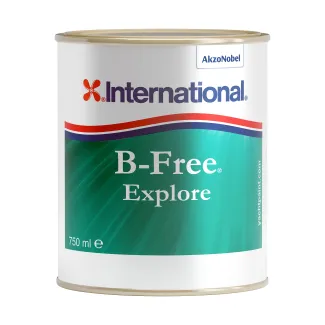
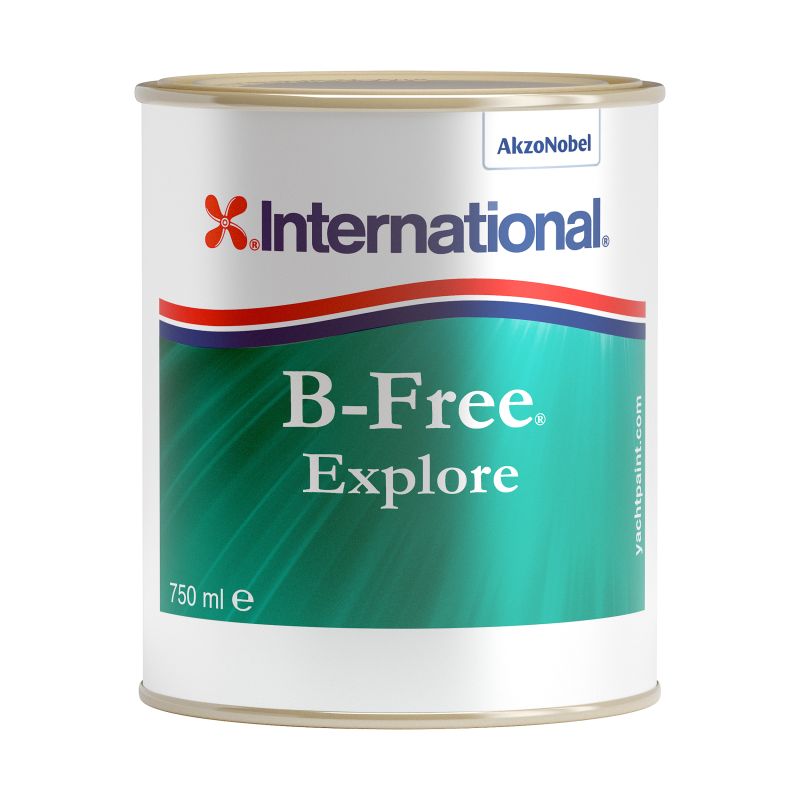
International B-Free Explore
At a glance
- Biocide-free antifouling
- Suitable for all substrates
- Prevents fouling
Fast delivery throughout Europe
Secure payment with PayPal, Mastercard, Visa and more
4.7 out of 5 stars on Trusted Shops
Product description
B-Free Explore is a premium, biocide-free, foul-release technology for use on underwater hulls, providing a semi-gloss finish with low VOC for multi-season performance. B-Free Explore offers boat owners many benefits, including good multi-season performance, improved boating performance and reduced fuel consumption. It is also a big plus that it is a biocide-free product, which in turn benefits the aquatic ecosystem.
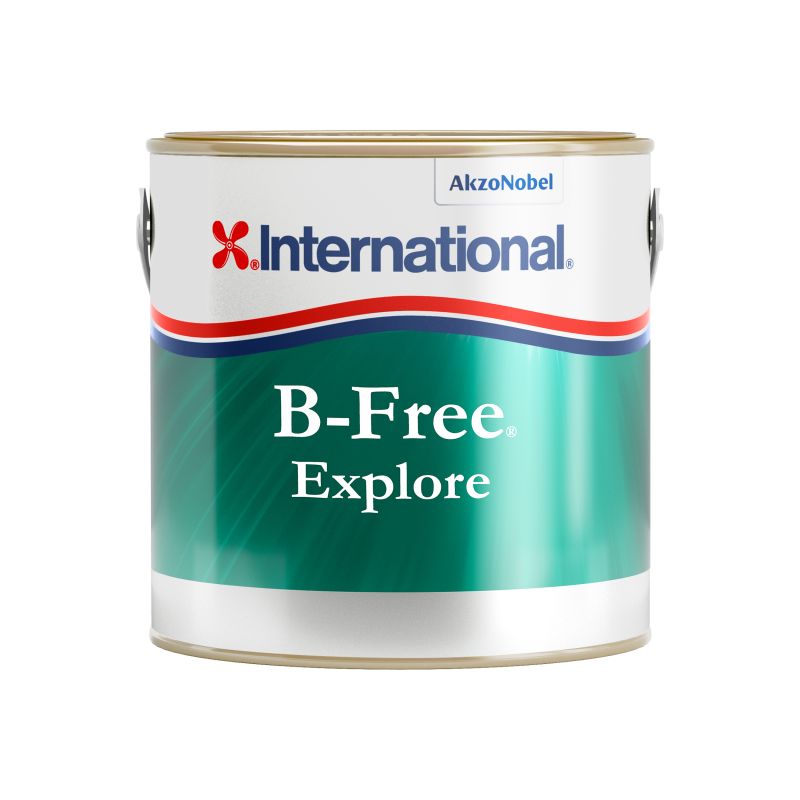
Looking for a large pack? International B-Free Explore is also available in 2.5-litre packs.
Biocide-free antifouling
B-Free Explore is based on a specially developed and innovative silicone polymer technology. This unique paint provides a very smooth surface that helps prevent organisms (such as barnacles, tubeworms and mussels), from adhering to the hull. Specially developed for pleasure craft, this specific technology features water-repellent (hydrophobic) and water-attractive (hydrophilic) properties. This unique combination makes it very difficult for water organisms to attach to the hull. Any fouling is removed by the hydrodynamic forces while sailing.
Suitable surface and waterways
This fouling-release system can be applied to aluminium and zinc-galvanised steel, cast iron, GRP (gelcoat), lead, steel and wood. B-Free Explore is particularly suitable for boats operating in fresh and brackish water. Biocide-free systems are not recommended for use exclusively in salt water. As this system does not contain copper, its effectiveness in salt water is more limited. For such sailing areas, we recommend a traditional antifouling, such as International Interspeed Extra.
Benefits of B-Free Explore
- Biocide-free (minimises impact on aquatic ecosystem).
- Good performance for several seasons.
- The smooth surface ensures efficiency and better boat performance. It also makes any fouling easy to remove.
Tip: with the Antifouling auxiliary materials package you have all the required materials at hand immediately!
Specifications
Packaging: 0.75 litre & 2.5 litre
Colour: navy, red, black, white
Finish: semi-gloss
Number of coats: 2-3
Coverage: 9 m²/L
Application method: brush or roller
Pot life: 4 hours (at 10°C)
Fully cured after: 7 hours (at 10°C)
Recoatable after: 7 hours - 5 days (at 10°C)
Shelf life: 12 months
Check the technical documentation for more information on the properties and processing of International B-Free Explore.
Product properties
The key technical properties clearly listed in one place.
- Article number
- BOO001543
-
The technical product category, such as primer, resin, hardener or cleaner. It explains the product's purpose and helps you find other products with a similar function.
- Biocide-free antifouling
-
The materials, substrates or tasks a product is intended for. A general claim such as 'suitable for plastics' does not mean it works with every type of plastic; the specific substrate and its preparation still matter.
- Polyester boten, Stalen-boten, Aluminium boten, Houten boten
-
The recommended number of coats needed to achieve the intended coverage, thickness or protection. Highly absorbent substrates or different application methods may require additional coats. Allow for the specified time between coats.
- 2-3 coats
-
The period for which an unopened product remains usable under the specified storage conditions. Check whether the period starts from the manufacturing date or another date. Shelf life may be shorter after opening, especially for products sensitive to air or moisture.
- 12 months
-
The overcoating interval tells you when the next layer of paint, varnish or coating may be applied. Many multi-coat systems specify both a minimum and a maximum interval:
- Minimum overcoating time: the previous layer is dry or cured enough to accept another coat.
- Maximum overcoating time: the period during which the next coat can bond without extra surface preparation under the stated conditions.
Overcoating too early can affect drying or the finish. Once the maximum interval has passed, cleaning and sanding may be needed to ensure adhesion between coats. Temperature and film thickness affect the waiting times.
- 7 hours - 5 days (10 °C)
-
Curing time is the period a product needs to reach a specified stage of cure. It is usually given in hours or days, often at a reference temperature such as 20 °C. A product may be tack-free or safe to handle before reaching its full mechanical and chemical resistance. Film thickness and mixed quantity may also affect the time.
- 7 hours (at 10 °C)
-
Consumption or coverage describes how much product is needed for a given surface area. Consumption may be stated in g/m² or kg/m², while coverage is often given in m²/L or m²/kg. A consumption of 0.2 kg/m² means a theoretical 200 grams per square metre. Actual use depends on film thickness, substrate absorbency, application method and waste.
- 9 m²/L
- Net contents
- 750 ml
-
The application or processing methods specified by the manufacturer, such as brushing, rolling, spraying, casting or hand laminating. The chosen method can affect consumption, layer thickness and finish.
- Brush, Roller
-
Working time is the period during which a product remains workable after mixing or activation, usually given in minutes at a specified temperature, often 20 °C. With reactive resins, the chemical reaction also continues in the mixing container, and larger quantities or higher temperatures can shorten this time. Working time is different from gel time and full curing time.
- Approximately 240 minutes (at 10 °C)
Reviews
Frequently bought together
Useful additions for your project.
Recommended
