Sikaflex-552 AT
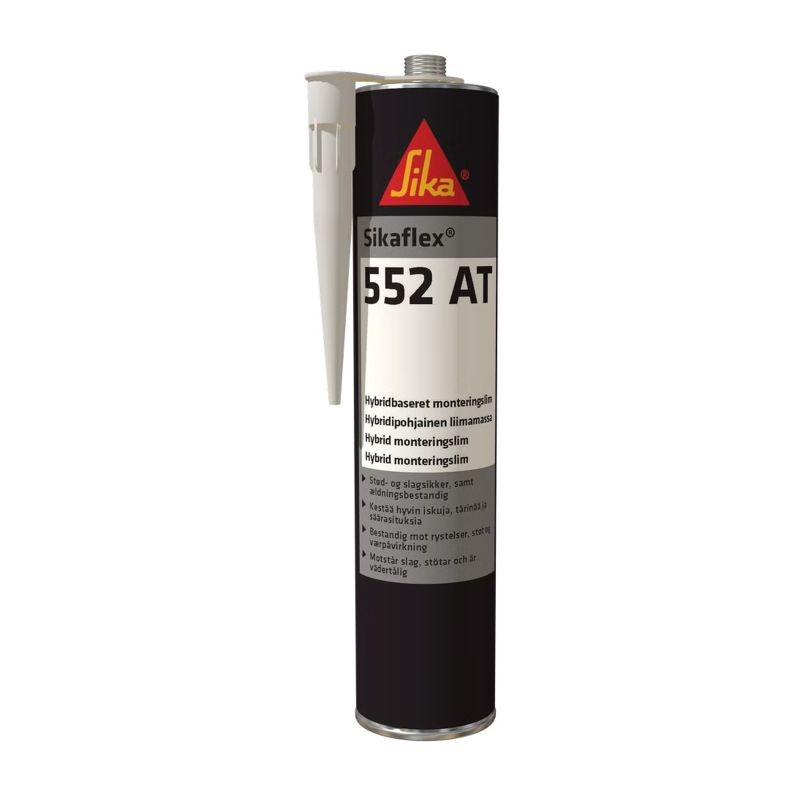
At a glance
- Elastic STP adhesive
- 1-component adhesive
- For bonding large sections

Sikaflex-552 AT is a one-component, elastic assembly adhesive based on Sika’s silane-terminated polymer (STP) technology. It is specifically designed for bonding large components in vehicle assembly. The product is suitable for bonding coated metals, GRP, ceramic materials and plastics. It provides excellent adhesion to a wide range of substrates with minimal pre-treatment Sikaflex-552 AT is produced in accordance with the ISO 9001 and ISO 14001 management systems and within the framework of the Responsible Care programme.
Benefits of Sikaflex-552 AT
- Excellent resistance to ageing and weathering.
- Excellent adhesion to a wide variety of substrates without the need for a primer.
- Isocyanate- and solvent-free.
- Capable of withstanding high dynamic stresses.
- High elasticity and low VOC content.
- Paintable.
- Silicone- and PVC-free.
Applications
Sikaflex-552 AT is suitable for bonded joints subjected to dynamic stresses. Compatible substrate materials include metals (particularly aluminium), primed metals, paint coatings, sheet steel, ceramic materials and plastics. The adhesive bonds to a wide range of substrates with minimal pre-treatment. Seek advice from the manufacturer and perform tests on actual substrates before using Sikaflex-552 AT on materials prone to stress cracking. This product is intended for professional use only. Tests with actual substrates and conditions have to be performed.
Specifications
Packaging: 300 ml (cartridge)
Colour: white or black
Chemical base: silane terminated polymer (STP)
Curing mechanism: moisture curing
Weathering resistance: very good
Application temperature: 5 to 40 °C
Skin formation time: 30 minutes
Open time: 20 minutes
Hardness (Shore A): 50
Tensile strength: 3 MPa
Elongation at break: 600 %
Tear propagation resistance: 15 N/mm
Service temperature: -50 to 90 °C
Shelf life: 15 months when stored below 25 °C
Product properties
The key technical properties clearly listed in one place.
- Article number
- LIJ001412
- Colour
- Zwart, White
-
Open time is the period during which an applied adhesive, sealant or mortar can still be assembled, positioned or adjusted. It is usually given in minutes under specified conditions, often around 20 or 23 °C. Open time generally starts at application and may differ from the working time after mixing.
- 20 minutes
-
This property lists the substrates on which an adhesive, resin or coating can achieve strong adhesion according to the product information. The result also depends on surface preparation.
- Cleaning and degreasing: removes dirt, oil and other substances that interfere with bonding.
- Sanding or roughening: can improve adhesion when suitable for the substrate.
- Primer: required or recommended for some surfaces.
Materials such as PE, PP and PTFE are difficult to bond with many conventional adhesives and may need a specialist adhesive or pretreatment. If in doubt, test adhesion on a small area.
- Glas/Epoxy (GRE), Aluminium, Staal, Keramiek
-
The recommended application temperature range indicates the conditions under which the product can generally be applied and cured properly. Three temperatures matter:
- Air: the temperature in the workshop or outdoors.
- Substrate: the temperature of the surface being treated.
- Product: the temperature of the resin, adhesive or coating itself.
A cold substrate can cause condensation and affect adhesion. At higher temperatures, two-component products may react faster, reducing their working time. Check the dew point and follow the product instructions.
- 5-40 °C
-
The chemical base describes the chemistry of an adhesive, sealant, resin or coating, such as epoxy, polyester, polyurethane, (methyl)methacrylate or a hybrid polymer. It affects curing, flexibility and adhesion. Products with the same chemical base are not necessarily suitable for the same applications.
- Silane-modified polymer (STP)
-
Hardness describes a material's resistance to indentation. For silicone rubber and other elastomers, the Shore A scale is commonly used: Shore A 15, for example, is softer than Shore A 40. Harder plastics may be rated on the Shore D scale. The number belongs to its Shore scale and is not a unit like MPa; values on different scales cannot be directly compared.
- Shore A 50
-
The period for which an unopened product remains usable under the specified storage conditions. Check whether the period starts from the manufacturing date or another date. Shelf life may be shorter after opening, especially for products sensitive to air or moisture.
- 15 months
-
The time after application during which a skin forms on the surface of a sealant. Tool the joint before the skin develops, as adjusting it afterwards can affect the finish or adhesion. Temperature and humidity influence this time.
- 30 minutes
-
Elongation at break indicates how much a material can stretch during a tensile test before it breaks. It is expressed as a percentage (%) of the original length. At 100% elongation, the material has doubled in length just before breaking. A high value indicates a high ability to deform, but not how much force is needed.
- 600%
-
Tear strength describes the force needed to extend an existing tear in a material. For silicone rubber, this matters when a mould is frequently stretched during demoulding. The value is often expressed in N/mm (newtons per millimetre of specimen thickness) or kN/m. These units are equivalent: 1 N/mm = 1 kN/m = 1,000 N/m. Check the unit carefully: a value in N/m is therefore a thousand times smaller than the same number in N/mm. Specimen shape and test method also affect the result.
- 15 N/mm
-
Sag resistance describes how well a paste, sealant or coating stays in place after application without running or slumping. It matters on vertical surfaces, in thick adhesive joints and for overhead repairs.
A product may be thixotropic: it becomes easier to work when stirred or spread, then thickens again at rest. This makes application easier without the material immediately running down the surface. Sag resistance is not the same as viscosity; behaviour after application also matters.
- Very good
-
Tensile strength is the maximum tensile stress a material can withstand during a tensile test before failure. It is usually expressed in MPa (megapascals) or N/mm² (newtons per square millimetre); 1 MPa = 1 N/mm². Under comparable test conditions, a higher value means greater resistance to tension. In composites, fibre orientation also affects the result.
- 3 MPa
-
The curing mechanism explains how a product develops its final strength or shape. The main mechanisms are:
- Two-component reaction (2K): a chemical reaction begins once components A and B are mixed. Mixing ratio and working time are important.
- Moisture curing (often 1K): the product reacts with moisture in the surrounding air. Temperature, humidity and film thickness affect the process.
- UV curing: light of the appropriate wavelength triggers the reaction. Areas that are not exposed to the light may not cure fully.
- Physical drying: water or solvent evaporates. This is different from chemical curing.
Some products use more than one mechanism, so the correct application conditions depend on the particular system.
- Moisture-curing
- Net contents
- 300 ml
-
Heat resistance describes the temperature a material can withstand after correct processing and curing, usually expressed in degrees Celsius (°C). Continuous exposure is different from a brief temperature peak, and mechanical loading may also affect the limit. Heat resistance is not the same as the temperature at which the product can be applied.
- -50 to 90 °C