
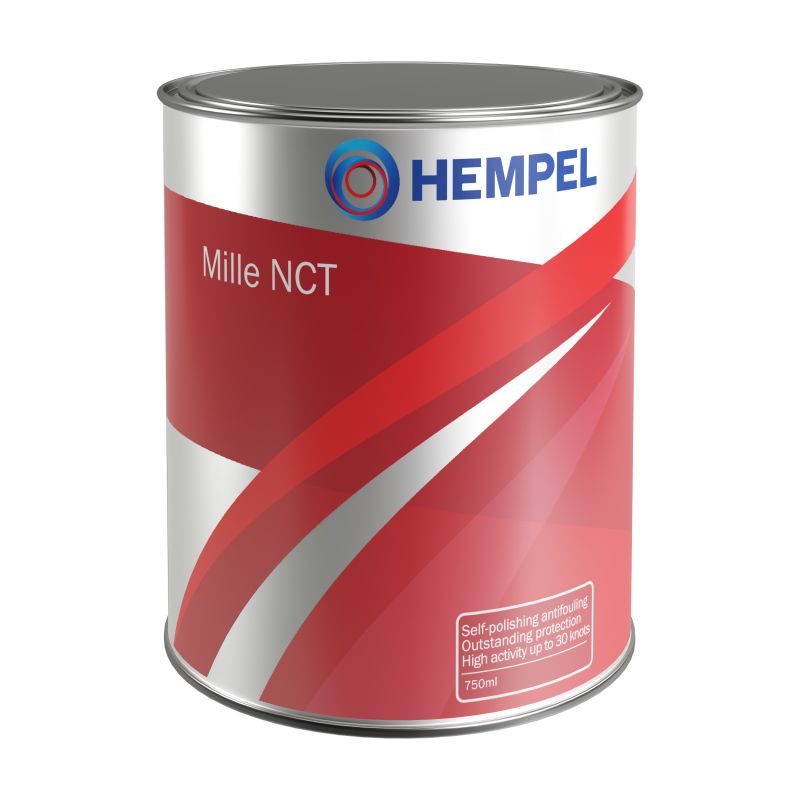
Hempel Mille NCT Antifouling
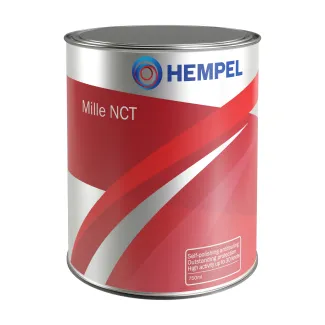
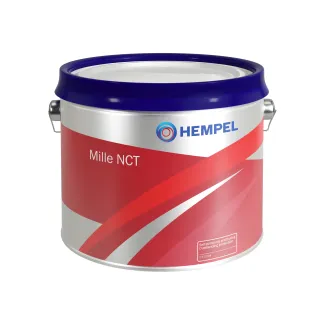
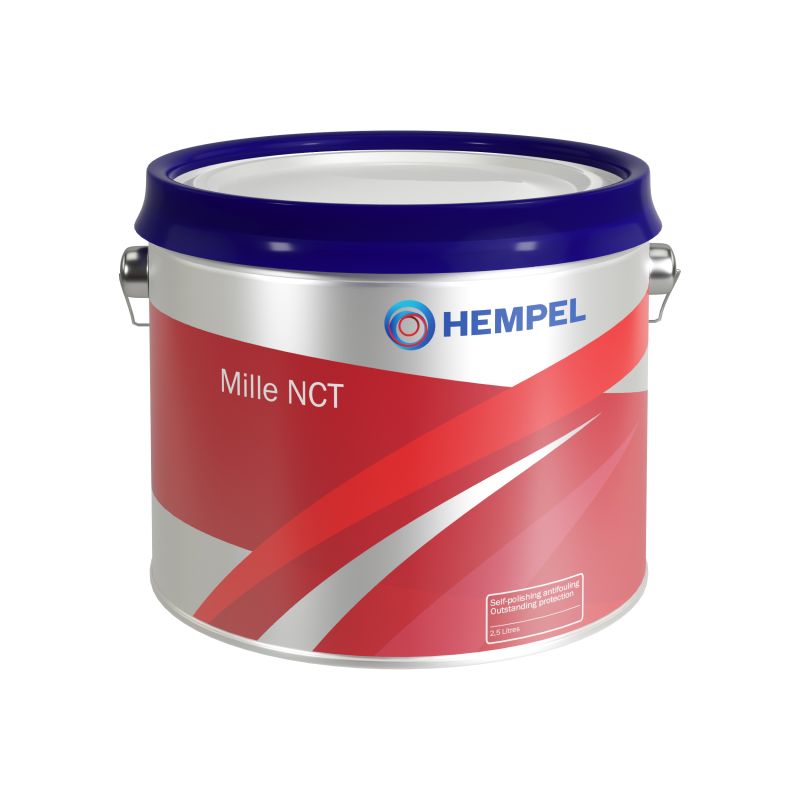
At a glance
- Hempel's Mille 7173C
- Self-polishing antifouling
- High colour retention
Fast delivery throughout Europe
Secure payment with PayPal, Mastercard, Visa and more
4.7 out of 5 stars on Trusted Shops
Hempel Mille NCT is a high performance self-polishing antifouling. Thanks to Hempel's patented binder technology, Mille NCT antifouling provides excellent protection in every season and is suitable for various boats. For example, the antifouling paint is suitable for boats made of polyester, wood and steel. The self-polishing Hempel antifouling is not suitable for aluminium or other light alloy metals. Mille NCT is easy to apply.
Benefits of Hempel Mille NCT
- Self-polishing antifouling (does not build up layer thickness).
- Easy to apply.
- Suitable for most boats (polyester, wood, steel).
- Colour retention for the whole season.
- Suitable for fresh, salt and brackish water.
Directions for use
Hempel's Mille NCT 7173C is easy to apply with a brush, roller or paint pad. The minimum processing temperature is 5°C. Avoid working in direct sunlight.
- Always ensure that the surface is lightly sanded, clean, grease-free and dry before applying the antifouling.
- Ensure that the surface has been properly prepared for the optimum performance of Mille NCT. Treat untreated surfaces with Hempel Underwater Primer. Do the same if the old antifouling is in poor condition.
- Stir the contents well to obtain a uniform colour. This is because the antifouling contains heavy particles.
- Apply 1 coat of Hempel Mille NCT with a dry film thickness of 40 µm. If necessary, add up to 5% thinner to aid application.
- Apply an additional coat around the waterline and on wear-sensitive areas.
- After approximately 4 hours (at 20°C) the antifouling is hand dry and ready for recoating.
- The boat can be launched after approximately 24 hours and up to a maximum of 9 months.
If your vessel is regularly used at speeds above 20 knots, 3 coats of antifouling paint is recommended.
Note: always wear protective clothing, gloves and a suitable vapour mask when working with Hempel Mille antifouling!
Specifications
Contents: 0.75 L and 2.5 L
Colour: black, red, blue
Finish: semi-matt
Coverage: approx. 13.5 m2/L
Hand dry: 2 hours (at 20°C)
Recoatable: 4 hours (at 20°C)
Application: brush, roller or paint pad
Thinner: Hempel Thinner 808 (No. 3)
Product properties
The key technical properties clearly listed in one place.
- Article number
- BOO001196
-
The materials, substrates or tasks a product is intended for. A general claim such as 'suitable for plastics' does not mean it works with every type of plastic; the specific substrate and its preparation still matter.
- Polyester boten, Stalen-boten, Houten boten
-
The technical product category, such as primer, resin, hardener or cleaner. It explains the product's purpose and helps you find other products with a similar function.
- Self-sharpening antifouling
-
The overcoating interval tells you when the next layer of paint, varnish or coating may be applied. Many multi-coat systems specify both a minimum and a maximum interval:
- Minimum overcoating time: the previous layer is dry or cured enough to accept another coat.
- Maximum overcoating time: the period during which the next coat can bond without extra surface preparation under the stated conditions.
Overcoating too early can affect drying or the finish. Once the maximum interval has passed, cleaning and sanding may be needed to ensure adhesion between coats. Temperature and film thickness affect the waiting times.
- 4 hours (20 °C)
-
Consumption or coverage describes how much product is needed for a given surface area. Consumption may be stated in g/m² or kg/m², while coverage is often given in m²/L or m²/kg. A consumption of 0.2 kg/m² means a theoretical 200 grams per square metre. Actual use depends on film thickness, substrate absorbency, application method and waste.
- Approximately 13.5 m²/L
-
A specific thinner that can be used, where permitted, to adjust a product's application properties or viscosity. The correct thinner and maximum quantity depend on the product. Incorrect thinning can affect coverage, drying and curing.
- Hempel Thinner 808 (No. 3)
- Net contents
- 2.5 L, 750 ml
-
The application or processing methods specified by the manufacturer, such as brushing, rolling, spraying, casting or hand laminating. The chosen method can affect consumption, layer thickness and finish.
- Brush, Roller, Paint pad
Reviews
Frequently bought together
Useful additions for your project.

Often chosen