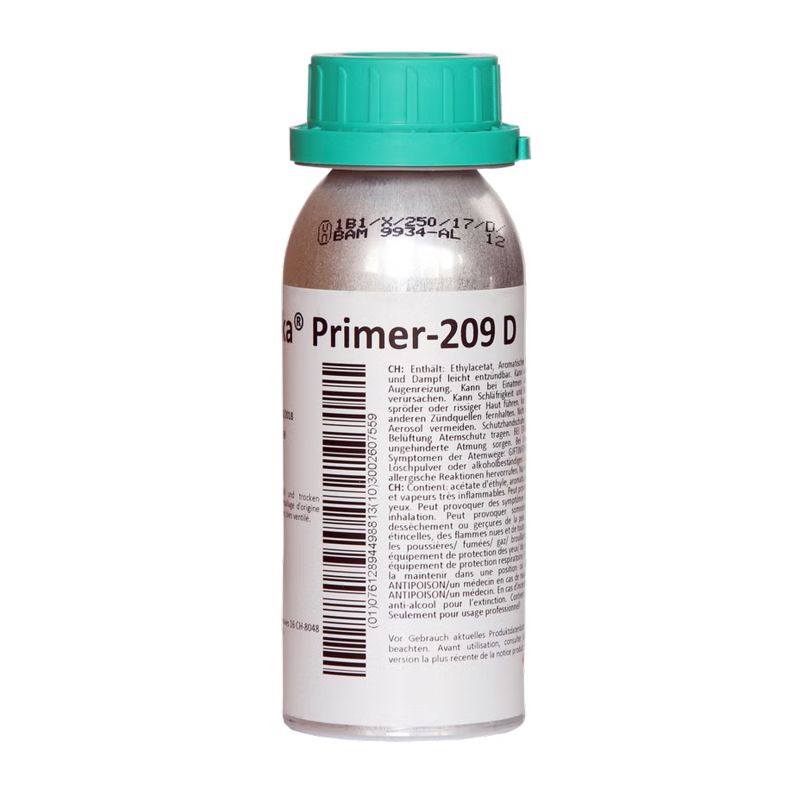

Sika Primer-209 D
At a glance
- Moisture-curing primer
- Easy to process
- Contents: 250 ml
Sika Primer-209 D (formerly 209 N) is a solvent-based black primer that reacts with moisture and forms a thin layer. This layer acts as a bonding link between substrates and adhesives. This Sika primer is specifically formulated for the treatment of bonding surfaces prior to application of Sika’s 1-component polyurethanes (e.g. Sikaflex-295 UV). This low-viscosity primer may provide excellent adhesion without a prior activation step on certain plastic substrates.
Sika Primer-209 D is used to improve adhesion on many plastics and paints such as Epoxy, Plexiglas (PMMA) and Lexan. We recommend to perform preliminary tests on original substrates under production conditions to determine adhesion and compatibility of the adhesive and material.
Benefits of Sika Primer-209 D
- Improves adhesion to plastic or paint.
- Easy to apply by brush or roller.
- Moisture curing and low viscosity.
Directions for use
- Make sure the surface is clean, dry and free of grease, oil dust and other contaminants before applying Sika Primer-209 D. You can improve the adhesion to substrates by applying and/or combining a pre-treatment process, such as roughening, cleaning and activation.
- Shake the can very thoroughly until the mixing ball rattles freely.
- Continue shaking for another minute (ideal processing temperature is between 15°C and 25°C).
- Apply a thin but covering coat with a brush, felt or foam applicator. Apply once only. Care must be taken to ensure that this single application gives adequately dense coverage.
- Tightly reseal container immediately after each use.
Consumption and application method depend on the specific characteristics of the substrate and the production process.
Specifications
Contents: 250 ml
Colour: black
Solids content: 30%
Processing temperature: 5-40°C
Application method: brush or roller
Consumption: 50 ml/m2
Chemical base: solvent-based polyurethane solution
Shelf life: 9 months (stored in sealed container in upright position in a dry place)
Product properties
The key technical properties clearly listed in one place.
- Article number
- LIJ001173
-
The technical product category, such as primer, resin, hardener or cleaner. It explains the product's purpose and helps you find other products with a similar function.
- 1K Primer
-
The recommended application temperature range indicates the conditions under which the product can generally be applied and cured properly. Three temperatures matter:
- Air: the temperature in the workshop or outdoors.
- Substrate: the temperature of the surface being treated.
- Product: the temperature of the resin, adhesive or coating itself.
A cold substrate can cause condensation and affect adhesion. At higher temperatures, two-component products may react faster, reducing their working time. Check the dew point and follow the product instructions.
- 5-40 °C
-
The chemical base describes the chemistry of an adhesive, sealant, resin or coating, such as epoxy, polyester, polyurethane, (methyl)methacrylate or a hybrid polymer. It affects curing, flexibility and adhesion. Products with the same chemical base are not necessarily suitable for the same applications.
- solvent-based polyurethane solution
-
The period for which an unopened product remains usable under the specified storage conditions. Check whether the period starts from the manufacturing date or another date. Shelf life may be shorter after opening, especially for products sensitive to air or moisture.
- 9 months
-
Solids content is the proportion of material remaining after volatile components have evaporated from a coating. It is stated as a percentage by weight or by volume (%); these are not interchangeable. Volume solids content helps estimate dry film thickness: with 60% volume solids, a 100 µm wet film will theoretically produce approximately 60 µm of dry film.
- Approximately: 30%
-
Consumption or coverage describes how much product is needed for a given surface area. Consumption may be stated in g/m² or kg/m², while coverage is often given in m²/L or m²/kg. A consumption of 0.2 kg/m² means a theoretical 200 grams per square metre. Actual use depends on film thickness, substrate absorbency, application method and waste.
- 50 ml/m²
- Net contents
- 250 ml
-
The application or processing methods specified by the manufacturer, such as brushing, rolling, spraying, casting or hand laminating. The chosen method can affect consumption, layer thickness and finish.
- Brush, Roller
Safety information
Read the warnings and use appropriate protective equipment before handling the product.
Reviews
Frequently bought together
Useful additions for your project.