
Popular

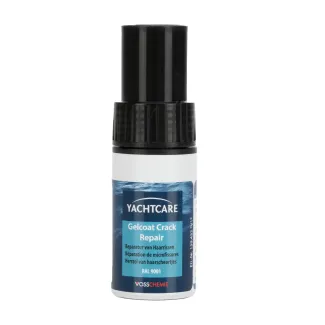
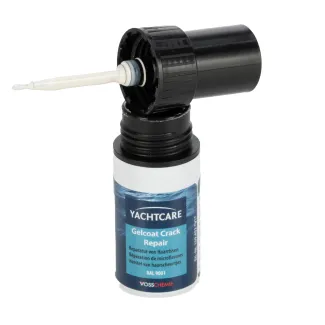
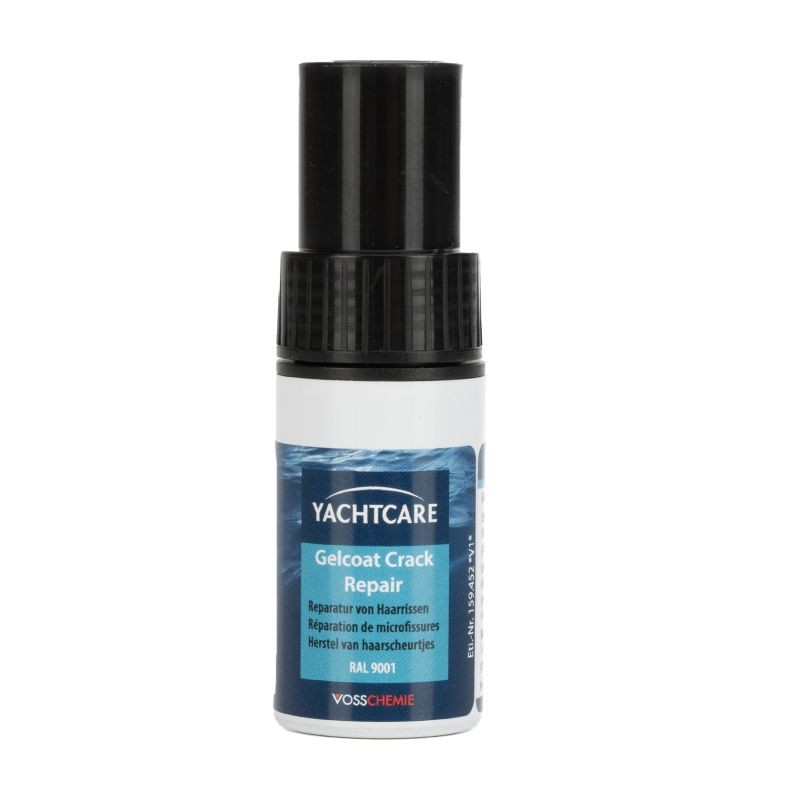
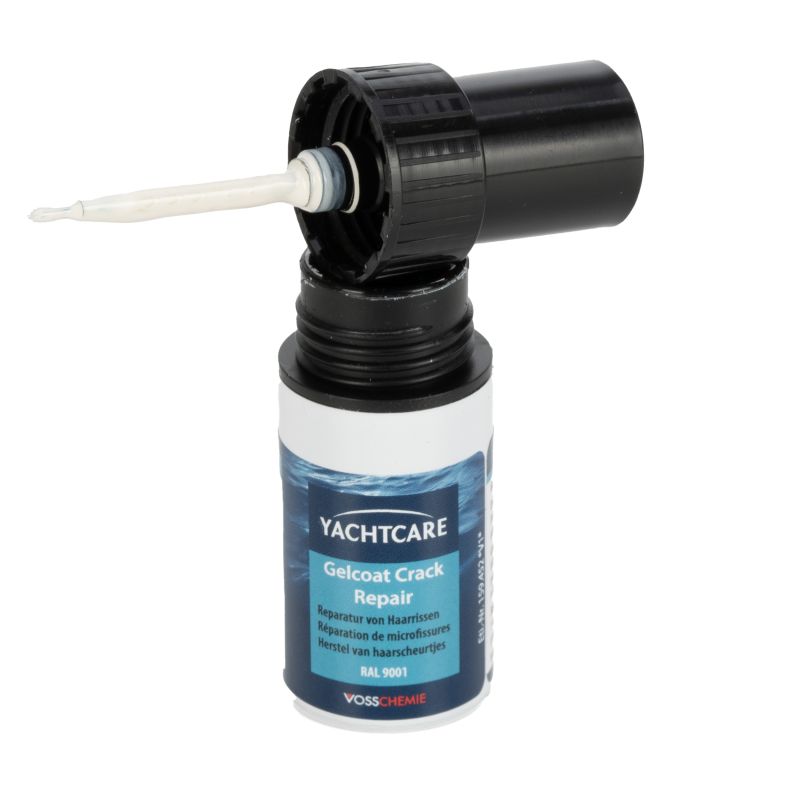
Yachtcare Gelcoat Crack Repair is suitable for sealing hairline cracks, small chips, or holes in areas above the waterline. This ready-to-use product is easy to use and comes with a nail polish brush that makes applying the crack repair very easy.
Yachtcare Gelcoat Crack Repair is easy to use. Follow the instructions below carefully:
Contents: 9 ml
Colour: RAL 9010 (pure white) or RAL 9001 (cream white)
Application temperature: 15°C
Drying time: 30 minutes (at 20°C)
Specific weight: 0.965 g/ml
Viscosity: liquid
The key technical properties clearly listed in one place.
The technical product category, such as primer, resin, hardener or cleaner. It explains the product's purpose and helps you find other products with a similar function.
The recommended application temperature range indicates the conditions under which the product can generally be applied and cured properly. Three temperatures matter:
A cold substrate can cause condensation and affect adhesion. At higher temperatures, two-component products may react faster, reducing their working time. Check the dew point and follow the product instructions.
Density describes the mass of a material per unit volume. Values may be given in g/cm³, kg/L or kg/m³; 1 g/cm³ equals 1 kg/L. For example, one litre of a liquid with a density of 1.2 kg/L weighs approximately 1.2 kg. Density helps convert between weight and volume, but it can vary with temperature.
Working time is the period during which a product remains workable after mixing or activation, usually given in minutes at a specified temperature, often 20 °C. With reactive resins, the chemical reaction also continues in the mixing container, and larger quantities or higher temperatures can shorten this time. Working time is different from gel time and full curing time.
Viscosity measures how easily a liquid flows, or how thick it is. Dynamic viscosity is usually expressed in mPa·s (millipascal-seconds), sometimes in cP (centipoise); 1 mPa·s = 1 cP. A lower value usually means a more free-flowing liquid, while a higher value indicates a thicker product. Temperature and test method strongly affect the value. Note that mPa·s is different from MPa, which is used to express mechanical strength.
Useful additions for your project.