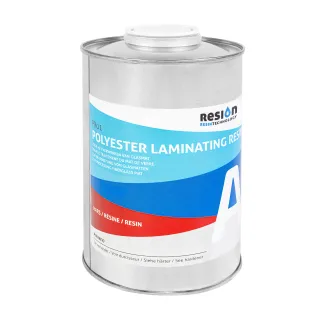
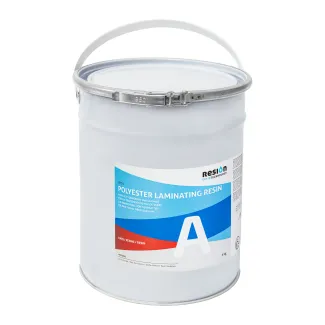
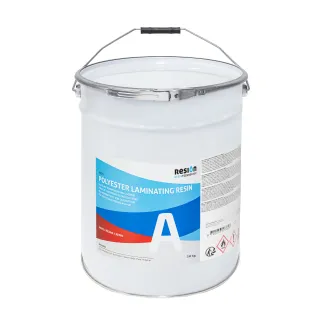
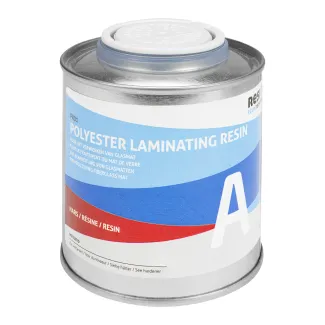
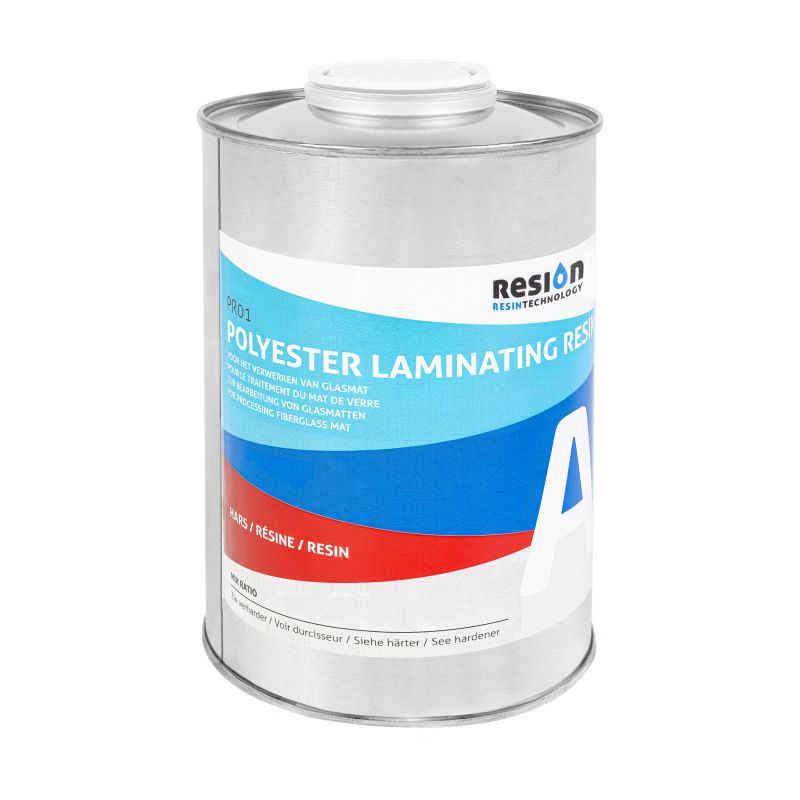
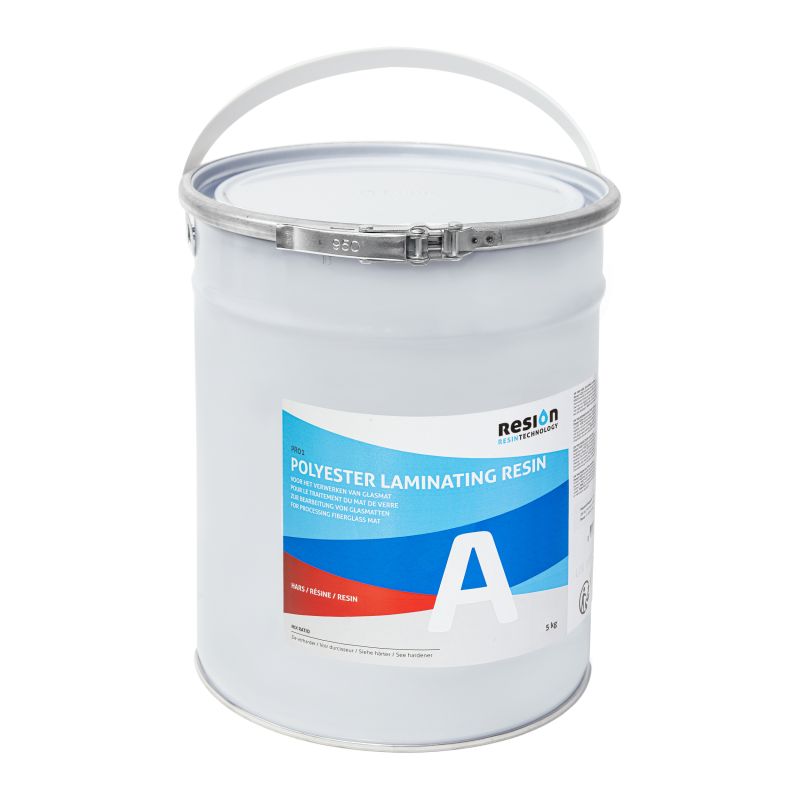
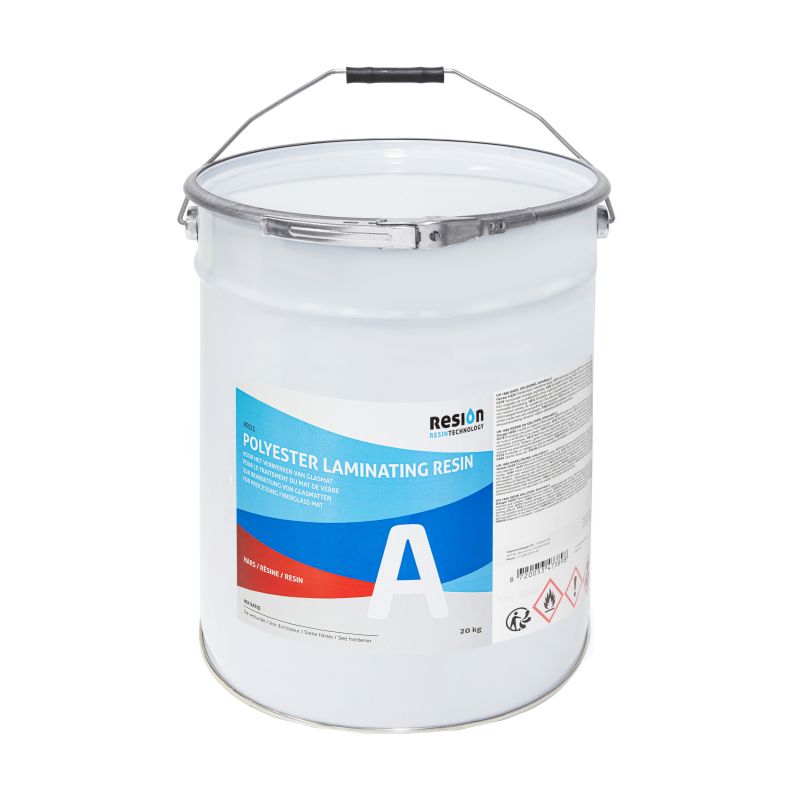
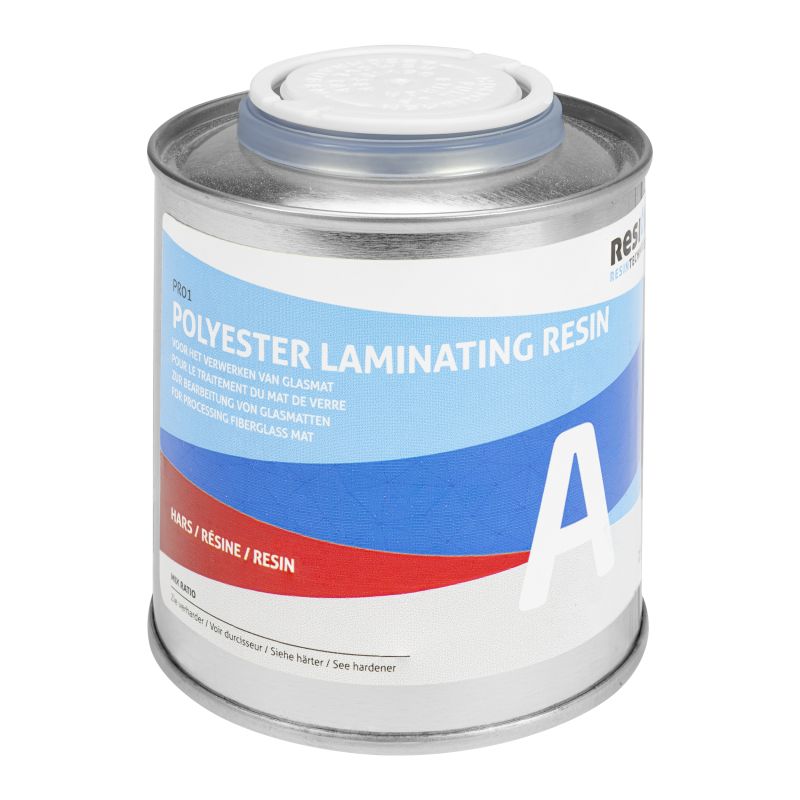

RESION Polyester laminating resin
At a glance
- Can be processed from 12°C
- 30 min. potlife
- For use with fibreglass mat
Not sure about your choice?
Want to know which polyester product you need? Use our selection tool!
RESION Polyester Laminating Resin is an orthophthalic polyester resin designed for laminating with fibreglass and for creating and repairing polyester structures. Use the resin in combination with chopped strand mat (CSM) for repairs to boats, car spoilers, carnival floats, motorcycle seats, model-making projects, swimming pools and ponds.
The laminating resin has excellent fibre wet-out properties, allowing it to penetrate the fibreglass easily. The resin does not drain out of the fibres quickly, and trapped air can be easily removed during lamination. A blue colour indicator makes application easier by helping you check whether MEKP hardener has been added to the polyester resin.
Benefits of Polyester Laminating Resin
- Suitable for laminating and repairs with chopped strand mat (CSM).
- Excellent fibreglass wet-out properties.
- Blue colour indicator to check whether hardener has been added.
- Approximately 30 minutes working time at 20°C.
- Can be applied at temperatures from 12°C.
- Suitable for both small repairs and larger polyester structures.
- Available in sizes ranging from 0.25 kg to 210 kg.
Application instructions
- Determine the required amount of hardener using the table below (1.5-2.5% MEKP hardener).
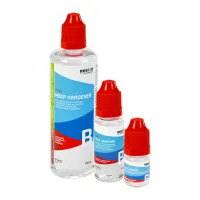
- Add the hardener to the polyester resin and mix thoroughly.
- The working time is approximately 30 minutes at 20°C.
- The curing time is 4 to 6 hours at 20°C.
How much MEKP hardener should you add?
The required amount of MEKP hardener depends on the temperature. Use the quantities below as a guideline for RESION Polyester Laminating Resin.
| Hardener | |||
| 12-17 °C | 18-23 °C | 23-30 °C | |
| Resin (PR01): | 2.5% | 2% | 1.5% |
| 0.25 kg | 6.25 grams | 5 grams | 3.75 grams |
| 1 kg | 25 grams | 20 grams | 15 grams |
| 5 kg | 125 grams | 100 grams | 75 grams |
| 20 kg | 500 grams | 400 grams | 300 grams |
| 210 kg | 5,250 grams | 4,200 grams | 3,150 grams |
At a normal application temperature of 18 to 23°C, add 2% MEKP hardener. For example, 1 kg of polyester laminating resin requires 20 grams of hardener.
Tips for working with polyester resin
- Prepare approximately 500 to 1,000 grams of resin at a time due to the limited working time.
- Mix the MEKP hardener thoroughly into the entire quantity of resin.
- Take the ambient temperature into account when determining the required amount of hardener.
- Wear nitrile gloves and suitable respiratory protection, such as an organic vapour respirator, during application.
- Use approximately 1 kg of polyester resin per m2 when working with a 450 g/m2 fibreglass mat.
- Want to colour the resin? Use polyester pigment paste.
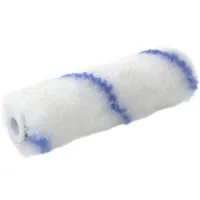
- Apply the laminating resin using a fleece roller or disposable brush.
Product properties
The key technical properties clearly listed in one place.
- Article number
- POL000001
-
The technical product category, such as primer, resin, hardener or cleaner. It explains the product's purpose and helps you find other products with a similar function.
- Resin system
-
The tasks a product is intended for, such as laminating, casting, bonding, sealing or protecting. Products intended for the same application can differ considerably in processing, curing time and final properties.
- Laminate, Repair
-
The type of resin indicates its chemical and mechanical properties.
- Orthophthalic (ORTHO)
-
The recommended application temperature range indicates the conditions under which the product can generally be applied and cured properly. Three temperatures matter:
- Air: the temperature in the workshop or outdoors.
- Substrate: the temperature of the surface being treated.
- Product: the temperature of the resin, adhesive or coating itself.
A cold substrate can cause condensation and affect adhesion. At higher temperatures, two-component products may react faster, reducing their working time. Check the dew point and follow the product instructions.
- From 12 °C
-
Dosage indicates how much additive, filler or auxiliary material is added to a base product. It is often given as a percentage (%), grams per kilogram (g/kg) or a ratio between components. Check whether the percentage is based on the resin, hardener or total mixture weight. Adding too much or too little can change the product's properties.
- MEKP hardener: 1.5%-2.5%
-
The period for which an unopened product remains usable under the specified storage conditions. Check whether the period starts from the manufacturing date or another date. Shelf life may be shorter after opening, especially for products sensitive to air or moisture.
- 12 months
-
Hardener type indicates which component or substance is needed to cure a resin, adhesive or coating. The mechanism varies with the chemical system:
- Epoxy: usually a specific compatible hardener (component B), mixed with the resin at the stated ratio.
- Polyester and vinyl ester: often an MEKP initiator that starts the curing reaction. Dosage is normally given as a percentage.
- Two-component polyurethane: uses a compatible second component, often based on isocyanates, as specified for the system.
Hardeners are not interchangeable. Use only the combination, dosage and safety precautions stated by the manufacturer.
- MEKP hardener
-
Curing time is the period a product needs to reach a specified stage of cure. It is usually given in hours or days, often at a reference temperature such as 20 °C. A product may be tack-free or safe to handle before reaching its full mechanical and chemical resistance. Film thickness and mixed quantity may also affect the time.
- Approximately 4-6 hours (20 °C)
- Net contents
- 1 kg, 20 kg, 210 kg (drum), 250 g, 5 kg
-
The application or processing methods specified by the manufacturer, such as brushing, rolling, spraying, casting or hand laminating. The chosen method can affect consumption, layer thickness and finish.
- Pile roller, Disposable brush
-
Working time is the period during which a product remains workable after mixing or activation, usually given in minutes at a specified temperature, often 20 °C. With reactive resins, the chemical reaction also continues in the mixing container, and larger quantities or higher temperatures can shorten this time. Working time is different from gel time and full curing time.
- Approximately 30 minutes (at 20 °C)
Safety information
Read the warnings and use appropriate protective equipment before handling the product.
Reviews
Frequently bought together
Useful additions for your project.