
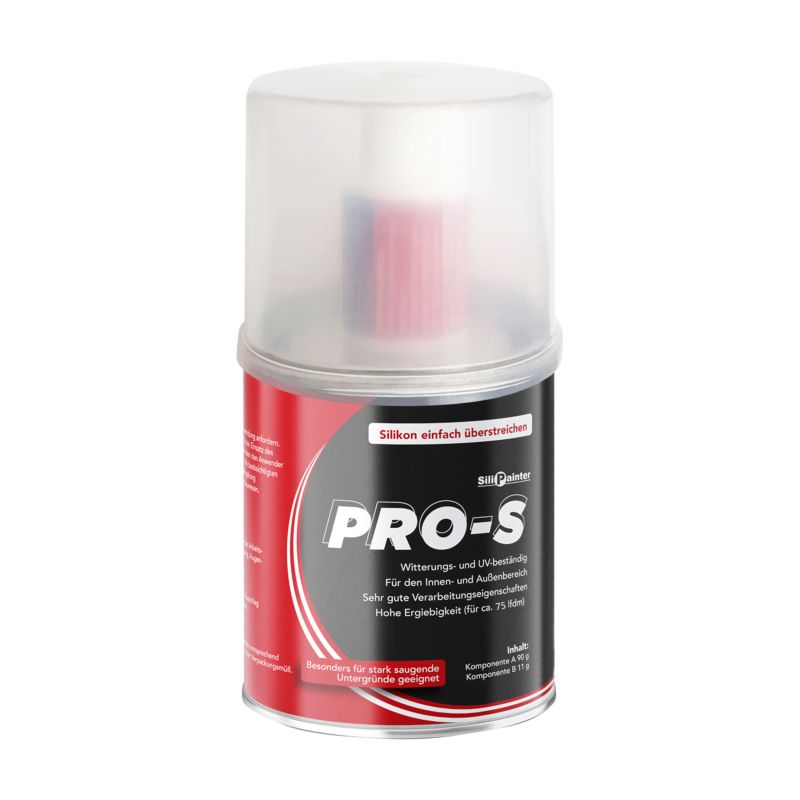
Silipainter primer for silicones (PRO S)
At a glance
- Primer for silicones
- Easy paintable
- Weather and UV resistant
Fast delivery throughout Europe
Secure payment with PayPal, Mastercard, Visa and more
4.7 out of 5 stars on Trusted Shops
Painting over silicone sealant a problem? Not with SiliPainter primer! This 2-component primer allows you to paint over silicone sealant without any problems. You can use Silipainter PRO S for the following applications, for example: preparing existing silicone joints on windows, doors, sanitary areas and building areas for subsequent coating systems.
Benefits of Silipainter
- Very good processing properties.
- Very high productivity.
- Weather and UV resistant.
- For indoor and outdoor areas (no solvents).
- Applicable on old silicone joints (in windows, doors, sanitary areas and construction).
Directions for use
You can easily apply Silipainter PRO S using the following steps:
1. Clean and dust the surface before applying the sealant.
2. Apply the sealant in the joints, it is important that you always overfill the joints.
3. Scrape off the excess silicone with a levelling tool (spatula).
4. Now open the packaging of the Silipainter and pour component B into component A and stir well for about 1 minute.
5. Apply the Silipainter PRO S over the surface as quickly as possible.
Tip: for optimal adhesion, it is recommended to paint over the silicone sealant while it is still fresh. Fresh sealant has a slightly tacky texture, which allows the primer and topcoat to adhere best. If you wait until the sealant is fully cured, adhesion may be reduced.
The steps are visually explained in the (German) video above.
Specifications
Contents: 100 ml (90 grams A and 10 grams B)
Colour: white
Weight: 0.190 kg
Pot life: 1-2 hours (possibly longer)
Recoating interval: approx. 20 - 60 minutes (at 21°C)
Fully cured after: approx. 21 days
Storage: store dark and cool, but frost-free, not at temperatures below 5°C
Coverage: 150 g/m
Product properties
The key technical properties clearly listed in one place.
- Article number
- LAK001097
-
The technical product category, such as primer, resin, hardener or cleaner. It explains the product's purpose and helps you find other products with a similar function.
- Primer
-
Gloss level indicates how much light a dry paint or coating reflects and how the finished surface looks.
- Matt: little reflection and a subdued appearance.
- Satin: a gentle sheen between matt and high gloss.
- High gloss: stronger reflections and a more pronounced colour, although surface imperfections may become more visible.
Gloss can be measured in gloss units (GU) at a specified angle. Terms such as matt and satin do not necessarily mean exactly the same thing across manufacturers. Substrate condition and application also affect the final appearance.
- Does not apply
-
The stated weight of a product or component. For liquids and powders this usually refers to the net contents, while the weight of a tool can affect how comfortable it is to use.
- 190 g
-
The overcoating interval tells you when the next layer of paint, varnish or coating may be applied. Many multi-coat systems specify both a minimum and a maximum interval:
- Minimum overcoating time: the previous layer is dry or cured enough to accept another coat.
- Maximum overcoating time: the period during which the next coat can bond without extra surface preparation under the stated conditions.
Overcoating too early can affect drying or the finish. Once the maximum interval has passed, cleaning and sanding may be needed to ensure adhesion between coats. Temperature and film thickness affect the waiting times.
- Approximately 20-60 minutes (21 °C)
-
Curing time is the period a product needs to reach a specified stage of cure. It is usually given in hours or days, often at a reference temperature such as 20 °C. A product may be tack-free or safe to handle before reaching its full mechanical and chemical resistance. Film thickness and mixed quantity may also affect the time.
- Approximately 21 days
-
Consumption or coverage describes how much product is needed for a given surface area. Consumption may be stated in g/m² or kg/m², while coverage is often given in m²/L or m²/kg. A consumption of 0.2 kg/m² means a theoretical 200 grams per square metre. Actual use depends on film thickness, substrate absorbency, application method and waste.
- 150 g/m
- Net contents
- 100 ml
-
Working time is the period during which a product remains workable after mixing or activation, usually given in minutes at a specified temperature, often 20 °C. With reactive resins, the chemical reaction also continues in the mixing container, and larger quantities or higher temperatures can shorten this time. Working time is different from gel time and full curing time.
- Approximately 1-2 hours
Reviews
Frequently bought together
Useful additions for your project.