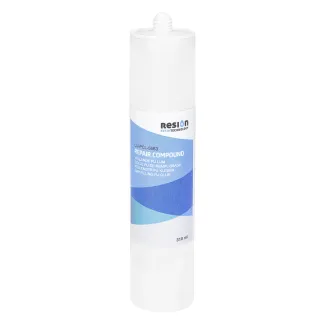
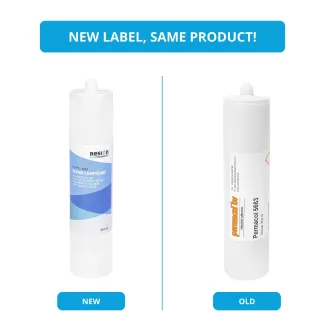

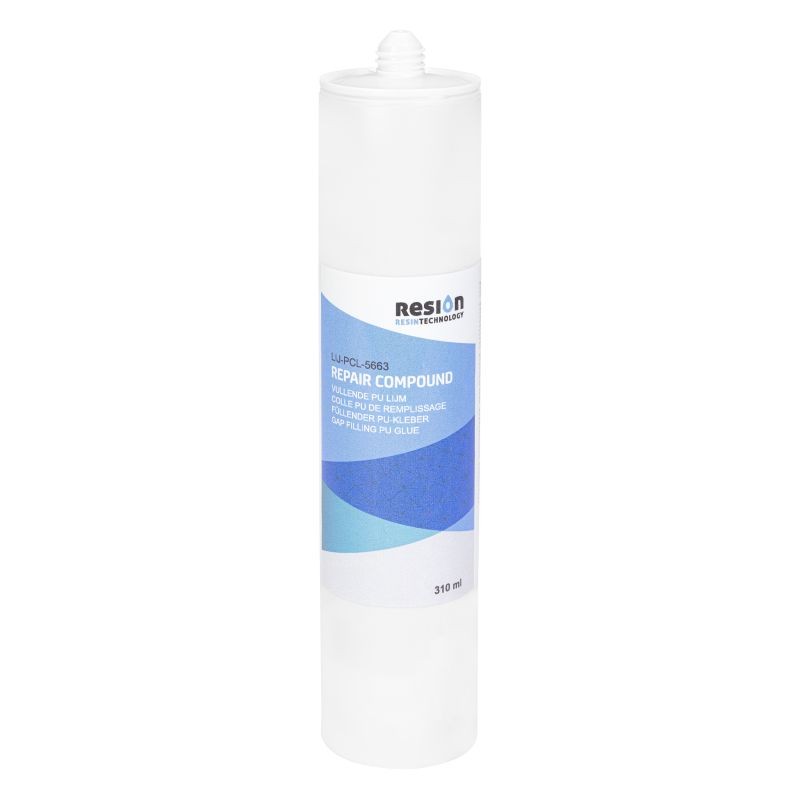

RESION Repair Compound | koker 310 ml
UFI: FVD0-P0W5-R00X-WD5A
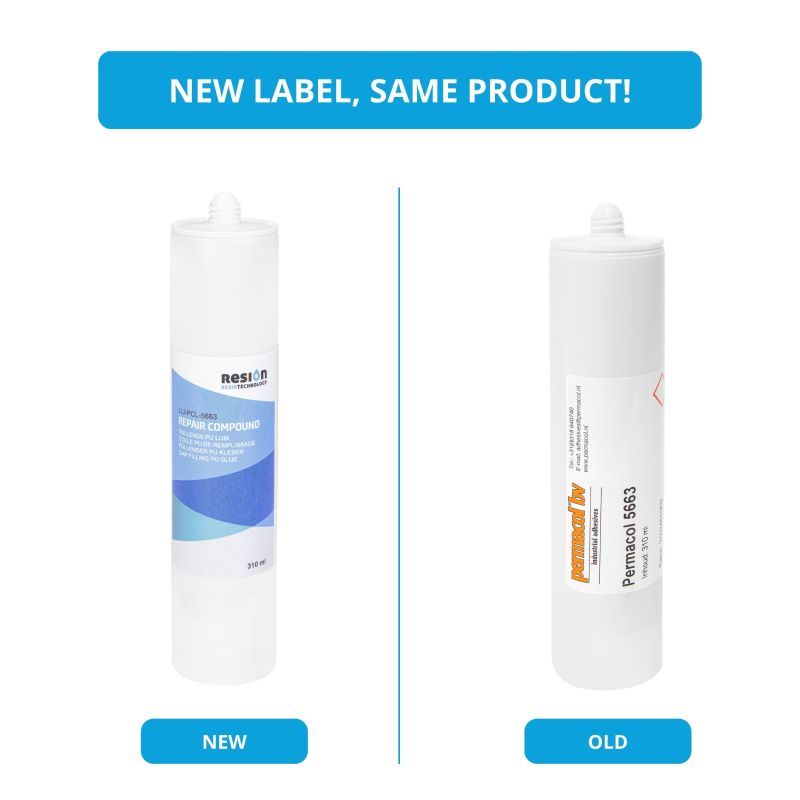
RESION Repair Compound PU Adhesive (formerly known as Permacol 5663) is a fluid, solvent-free, one-component polyurethane adhesive that cures upon exposure to moisture. This moisture may originate from the air or from the substrates being bonded. The curing speed depends on the moisture content, temperature, and the thickness of the adhesive layer.
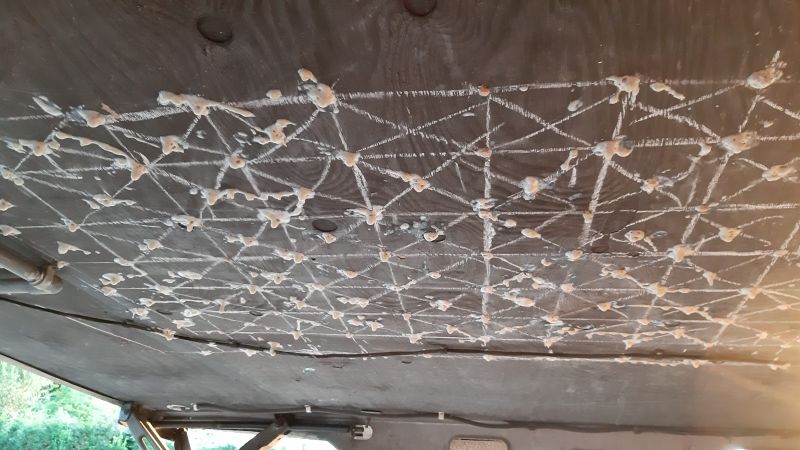
This polyurethane adhesive is particularly suitable for bonding wood, rigid PVC, GRP, ABS, foamed polystyrene, PVC, PU, aluminum, steel, stainless steel, galvanised steel, concrete, stone and combinations, for example: sandwich panels, aluminum insulation panels on polystyrene, asphalt paper on polystyrene and chipboard on polystyrene. Permacol 5663 is often used for injecting caravan floors and is especially suitable for making (sea) water-resistant wood glue constructions (according to EN standard 204-D4, DIN 68602 B4).
Permacol 5663 is not suitable for: glass, polyethylene (PE), polypropylene (PP), polyamide (PA) and polytetrafluoroethylene (PTFE).
To properly apply Permacol 5663 PU Glue, please follow the instructions below:
Contents: 310 ml
Colour (cured): light yellow brown
Viscosity (23°C): 7,000 mPa.s
Density (23°C): 1.10 g/cm3
Application temperature: 15-20°C
Ambient humidity (working area): 50%
Wood moisture content: 8-16%
Application gun: sealant gun for cartridges
Open time: 30-60 minutes
Open time (thin layer): 20-25 minutes
Full cure: 24-48 hours
Solids content: 100%
Temperature resistance: -30°C to + 80°C
Consumption: approx. 200 g/m2
Storage stability at 23°C: 6 months in a well-closed original container
The key technical properties clearly listed in one place.
Adhesive type describes the family of adhesive or sealant, such as epoxy adhesive, (methyl)methacrylate adhesive, polyurethane adhesive or polymer sealant. Its chemistry affects processing, curing, flexibility and adhesion. Products of the same type may still differ, so check the suitable substrates and application instructions.
Open time is the period during which an applied adhesive, sealant or mortar can still be assembled, positioned or adjusted. It is usually given in minutes under specified conditions, often around 20 or 23 °C. Open time generally starts at application and may differ from the working time after mixing.
This property lists the substrates on which an adhesive, resin or coating can achieve strong adhesion according to the product information. The result also depends on surface preparation.
Materials such as PE, PP and PTFE are difficult to bond with many conventional adhesives and may need a specialist adhesive or pretreatment. If in doubt, test adhesion on a small area.
The recommended application temperature range indicates the conditions under which the product can generally be applied and cured properly. Three temperatures matter:
A cold substrate can cause condensation and affect adhesion. At higher temperatures, two-component products may react faster, reducing their working time. Check the dew point and follow the product instructions.
Density describes the mass of a material per unit volume. Values may be given in g/cm³, kg/L or kg/m³; 1 g/cm³ equals 1 kg/L. For example, one litre of a liquid with a density of 1.2 kg/L weighs approximately 1.2 kg. Density helps convert between weight and volume, but it can vary with temperature.
A solvent-free product contains no added solvents according to the manufacturer's specification. This does not automatically mean it is odourless, emission-free or safe to use without protective measures.
Curing time is the period a product needs to reach a specified stage of cure. It is usually given in hours or days, often at a reference temperature such as 20 °C. A product may be tack-free or safe to handle before reaching its full mechanical and chemical resistance. Film thickness and mixed quantity may also affect the time.
Solids content is the proportion of material remaining after volatile components have evaporated from a coating. It is stated as a percentage by weight or by volume (%); these are not interchangeable. Volume solids content helps estimate dry film thickness: with 60% volume solids, a 100 µm wet film will theoretically produce approximately 60 µm of dry film.
Consumption or coverage describes how much product is needed for a given surface area. Consumption may be stated in g/m² or kg/m², while coverage is often given in m²/L or m²/kg. A consumption of 0.2 kg/m² means a theoretical 200 grams per square metre. Actual use depends on film thickness, substrate absorbency, application method and waste.
Working time is the period during which a product remains workable after mixing or activation, usually given in minutes at a specified temperature, often 20 °C. With reactive resins, the chemical reaction also continues in the mixing container, and larger quantities or higher temperatures can shorten this time. Working time is different from gel time and full curing time.
Viscosity measures how easily a liquid flows, or how thick it is. Dynamic viscosity is usually expressed in mPa·s (millipascal-seconds), sometimes in cP (centipoise); 1 mPa·s = 1 cP. A lower value usually means a more free-flowing liquid, while a higher value indicates a thicker product. Temperature and test method strongly affect the value. Note that mPa·s is different from MPa, which is used to express mechanical strength.
Heat resistance describes the temperature a material can withstand after correct processing and curing, usually expressed in degrees Celsius (°C). Continuous exposure is different from a brief temperature peak, and mechanical loading may also affect the limit. Heat resistance is not the same as the temperature at which the product can be applied.
Read the warnings and use appropriate protective equipment before handling the product.
UFI: FVD0-P0W5-R00X-WD5A
Useful additions for your project.