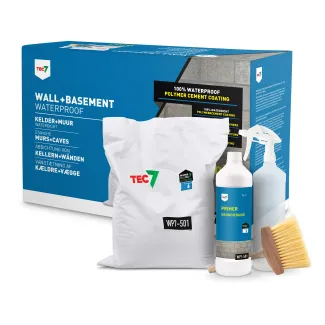


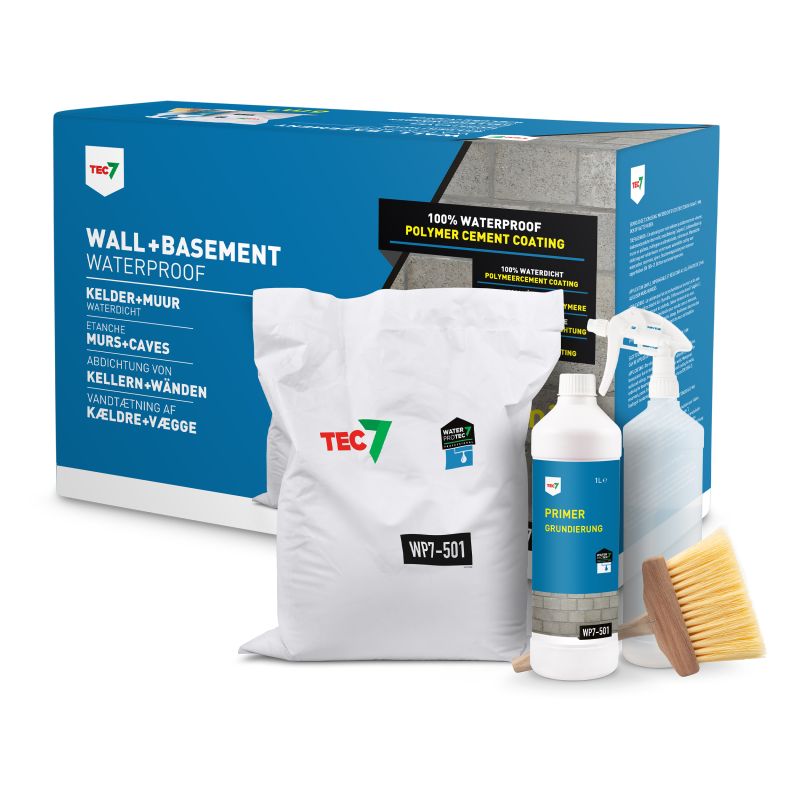


Tec7 WP7-501 Wall + Basement Waterproof
At a glance
- Polymer-modified cement coating
- Waterproof from 2 mm
- Resists water pressure and salt
Tec7 WP7-501 Wall + Basement Waterproof is a polymer-modified cement coating from the Tec7 Waterprotect 7 product range, designed to completely waterproof basements and walls. This hard yet elastic coating is ideal for damp basement walls, cellar floors and technical rooms. The polymer cement coating can be tiled over, plastered or painted.
After mixing with water, Tec7 WP7-501 is easy to apply with a brush. It adheres well to porous materials and hardens quickly. The product is resistant to salts and water pressure on stable, absorbant substrates. It offers crack-bridging capability and resistance to permanent immersion. It prevents or significantly reduces salt efflorescence and is waterproof while remaining vapour-permeable.
Benefits of Tec7 WP7-501 Wall + Basement Waterproof
- 100% waterproof.
- Easy to apply.
- Waterproof and salt resistant from 2 mm.
- Also suitable for damp walls.
Applications
- The solution for wet stains on basement walls and floors, loose plaster due to moisture, salt efflorescence, mould growth on walls and ceilings, musty odours and crumbling wet walls.
- Waterproof base layer for basement floors and terraces, waterproof coating for wells, reservoirs, ponds.
- Protective coating for concrete surfaces (EN 1504-2).
- Sealing foundation walls.
Directions for use
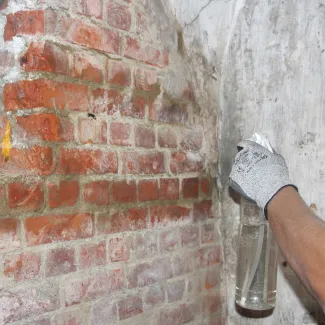
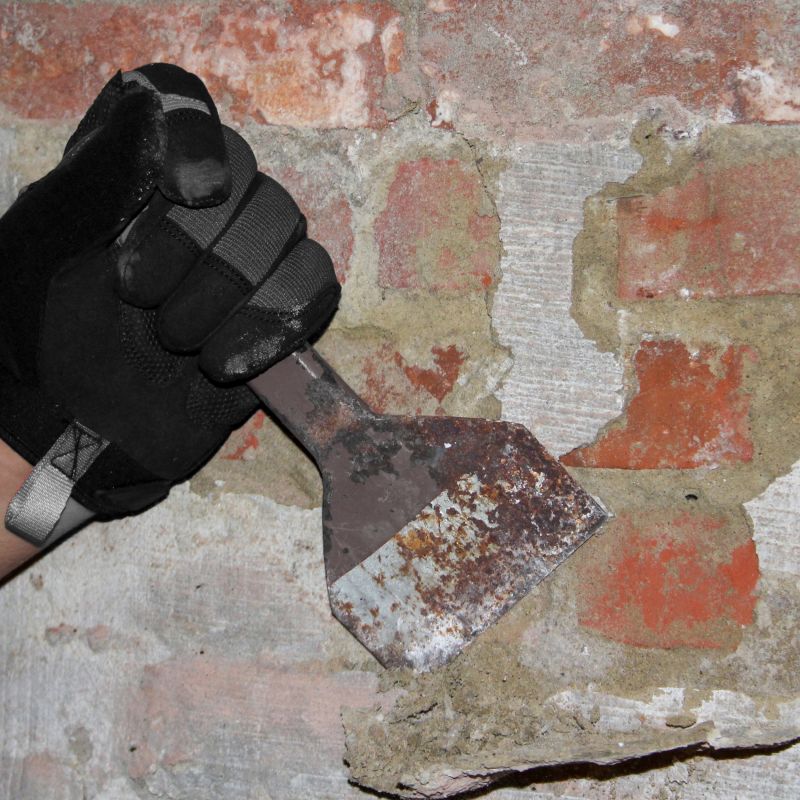
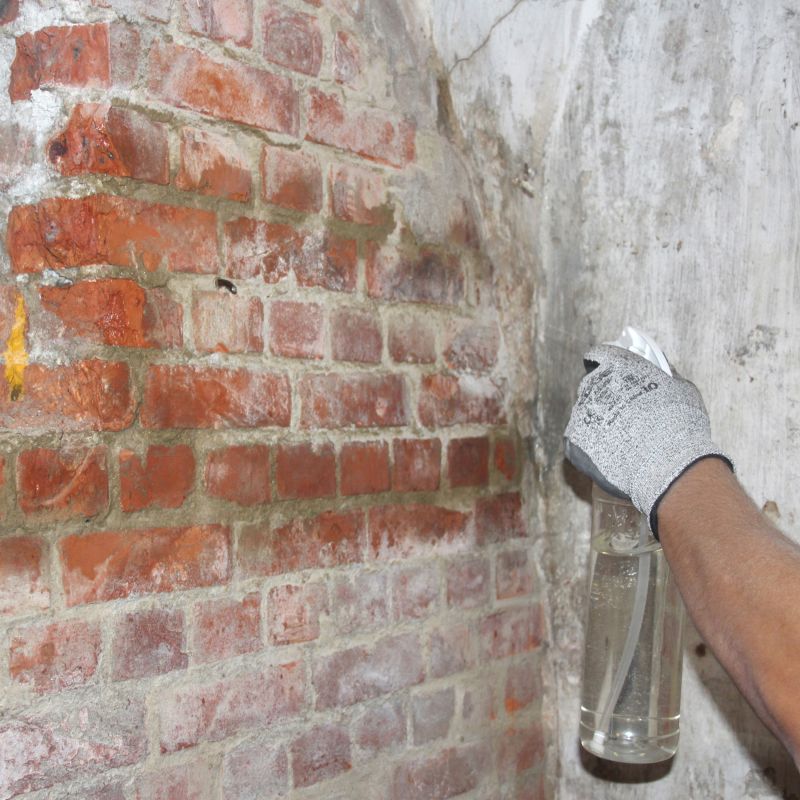
- Remove as much old paint and loose plaster as possible. Dilute the sealing primer 1:1 with pure water and apply generously with the spray pump on a clean, receptive and stable surface.
- Mix the required amount of polymer cement for the first layer (1 kg per 1.2 m²) with pure water. Mixing ratio 400 ml water per kg. Mix with a slowly rotating mixer (500 rpm) to a thick, fluid, lump-free mixture and let it rest for 2 minutes. Stir again before use. The mixture can be processed for 35 to 45 minutes depending on the ambient temperature. When stiffening in the pot, never add water to respect the mixing ratio: mix as much product as you can apply within the processing time.
- Apply the first coat of +/- 1 mm evenly to the still wet primer using a wide, stiff brush.
- Allow to dry for 2 to 5 hours before applying the second coat (the first one should feel cured). Moisten the first coat with water using a sprayer and apply the second coat of +/- 1 mm perpendicular to the brush direction of the first coat.
Immediately clean material and spilled product with clear water. After curing, it can only be removed mechanically. Full cure after 7 to 14 days, depending on the temperature. Humidity during that period: 50 to 80%. Provide ventilation to avoid condensation. Do not use a building dryer or dehumidifier in the first month after application. Can be recoated after curing with breathable paint. Consumption: 1 bag of 10 kg for 6 m² (2 mm thick in 2 layers on a smooth wall).
Specifications
Base: polymers, cement
Contents: 10 kg powder + 1L primer
Colour: white
Density (mixed): 1.1
Resting time: 2 minutes
Working time:
- 10°C: 120 minutes
- 15°C: 75 minutes
- 20°C: 45 minutes
- 25°C: 30 minutes
Optimal layer thickness: 2 mm
Maximum layer thickness: 5 mm
Processing temperature: +5°C to +35°C
Curing (depending on T° and RH):
- Mechanical: 3-7 days
- Water pressure: 3 days
- Paintable: after 7 to 14 days
Tensile strength: 1.6 MPa
Elongation at break: 30%
Capillary water absorption: 0.02 kg/m2h
Resistance to water pressure (2 mm thick):
- Negative: >1 bar
- Positive: >5 bar
Water vapour permeability: Sd 1.3m
Shelf life: 12 months, stored cool and dry in original packaging
Product properties
The key technical properties clearly listed in one place.
- Article number
- DAK001081
-
The recommended application temperature range indicates the conditions under which the product can generally be applied and cured properly. Three temperatures matter:
- Air: the temperature in the workshop or outdoors.
- Substrate: the temperature of the surface being treated.
- Product: the temperature of the resin, adhesive or coating itself.
A cold substrate can cause condensation and affect adhesion. At higher temperatures, two-component products may react faster, reducing their working time. Check the dew point and follow the product instructions.
- 5-35 °C
-
The chemical base describes the chemistry of an adhesive, sealant, resin or coating, such as epoxy, polyester, polyurethane, (methyl)methacrylate or a hybrid polymer. It affects curing, flexibility and adhesion. Products with the same chemical base are not necessarily suitable for the same applications.
- Polymers, cement
-
The period for which an unopened product remains usable under the specified storage conditions. Check whether the period starts from the manufacturing date or another date. Shelf life may be shorter after opening, especially for products sensitive to air or moisture.
- 12 months
-
Some two-component paints and coatings need to rest for a specified period after components A and B are mixed. This waiting period, known as induction time, allows the chemical reaction to begin before application.
If the induction time is 15 minutes, wait that long before applying the product. Induction time is not automatically additional working time: for many products, working time starts as soon as the components are mixed. Follow the sequence and timings in the product instructions.
- 2 minutes
-
The overcoating interval tells you when the next layer of paint, varnish or coating may be applied. Many multi-coat systems specify both a minimum and a maximum interval:
- Minimum overcoating time: the previous layer is dry or cured enough to accept another coat.
- Maximum overcoating time: the period during which the next coat can bond without extra surface preparation under the stated conditions.
Overcoating too early can affect drying or the finish. Once the maximum interval has passed, cleaning and sanding may be needed to ensure adhesion between coats. Temperature and film thickness affect the waiting times.
- 7-14 days
-
Elongation at break indicates how much a material can stretch during a tensile test before it breaks. It is expressed as a percentage (%) of the original length. At 100% elongation, the material has doubled in length just before breaking. A high value indicates a high ability to deform, but not how much force is needed.
- 30%
-
Tensile strength is the maximum tensile stress a material can withstand during a tensile test before failure. It is usually expressed in MPa (megapascals) or N/mm² (newtons per square millimetre); 1 MPa = 1 N/mm². Under comparable test conditions, a higher value means greater resistance to tension. In composites, fibre orientation also affects the result.
- 1.6 MPa
- Net contents
- 10 kg powder + 1 L primer
Safety information
Read the warnings and use appropriate protective equipment before handling the product.
Reviews
Frequently bought together
Useful additions for your project.