
Recommended

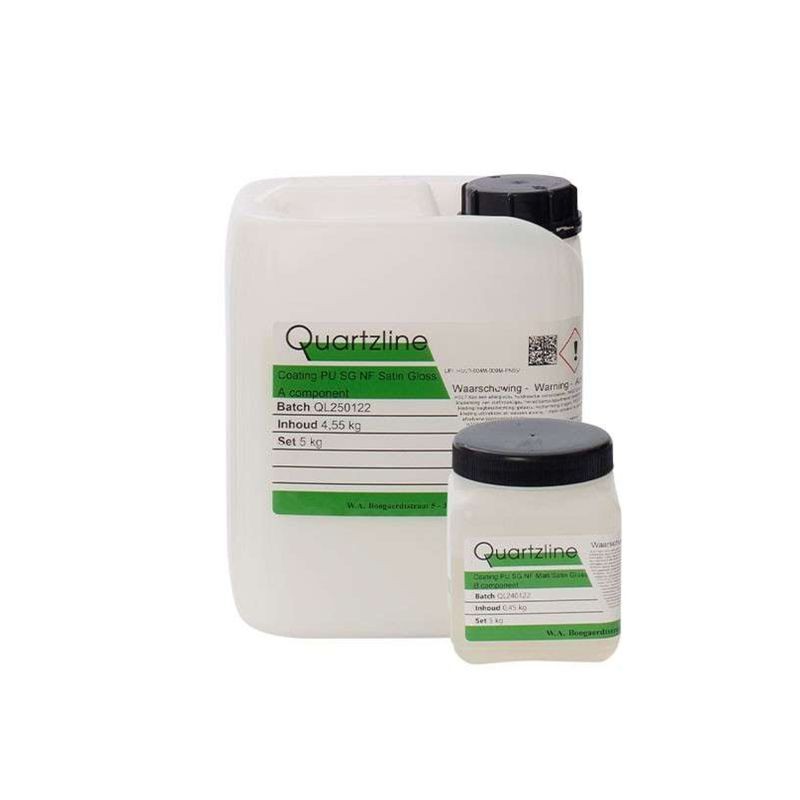
Do you want to renovate an existing PU or epoxy floor, improve its UV resistance, or are you not satisfied with the current colour or final result? Then PU SG Coloured polyurethane topcoat is the perfect solution for you!
PU SG Coloured Coating is a 2-component, satin gloss polyurethane topcoat. This coloured polyurethane coating is water-based and offers good wear resistance. An important feature of this smooth coating is its bacteriostatic properties, which means that microorganisms cannot multiply on the coating. This makes PU SG Coloured Coating particularly suitable for use in hospitals and laboratories.
This satin gloss PU topcoat is easy to use. Follow the instructions below or refer to the technical documentation. Sand the substrate with P220 grit before application.
| Contents | Coverage | Base (component A) | Hardener (component B) |
| 1 kg | approx. 6.5 m2 | 0.91 kg | 0.09 kg |
| 2.5 kg | approx. 16.5 m2 | 2.28 kg | 0.23 kg |
| 5 kg | approx. 33 m2 | 4.55 kg | 0.45 kg |
Gloss: satin gloss
Colour: available in all colours
Mixing ratio: 91:9 (by weight)
Working time: 30 minutes (20 °C)
Application method: velour roller
Dust-dry: 2 hours (20 °C)
Walkable: 24 hours (20 °C)
Lightly loadable: 48 hours (20 °C)
Fully cured: 7 days (20 °C)
Application temperature: 10 °C–25 °C
Relative humidity: max. 70% RH
Consumption: 150 g/m²
Viscosity: 450–550 mPa·s
VOC content: low, in accordance with AgBB
Shelf life: 6 months
Suitable for: epoxy floor coating, epoxy cast floor, polyurethane cast floor.
The key technical properties clearly listed in one place.
The technical product category, such as primer, resin, hardener or cleaner. It explains the product's purpose and helps you find other products with a similar function.
The resin family or system that a hardener, additive or reinforcement material can be combined with, such as epoxy, polyester or vinyl ester. Compatibility depends on the complete system, not just the general resin type.
The recommended application temperature range indicates the conditions under which the product can generally be applied and cured properly. Three temperatures matter:
A cold substrate can cause condensation and affect adhesion. At higher temperatures, two-component products may react faster, reducing their working time. Check the dew point and follow the product instructions.
The waiting time before a coating, floor or bonded joint can withstand a specified load, such as light foot traffic or gentle handling. Resistance often increases as curing continues; full mechanical and chemical resistance may be reached later.
The period for which an unopened product remains usable under the specified storage conditions. Check whether the period starts from the manufacturing date or another date. Shelf life may be shorter after opening, especially for products sensitive to air or moisture.
Humidity during application is given as relative humidity, usually in percent (% RH). It indicates how much water vapour the air contains compared with the maximum it can hold at that temperature. Excessive humidity can interfere with drying or adhesion of some coatings. Also check that the substrate is dry enough and free from condensation.
Mixing ratio indicates how much of each component is needed, for example resin (A) and hardener (B). A ratio of 100:50 by weight means 100 grams of A to 50 grams of B; by volume you might use millilitres. Weight and volume ratios are not necessarily the same because the components may have different densities. Accurate measuring is important for proper curing.
A paint or varnish layer is dust-dry when settling dust is less likely to stick to the surface. It may not yet be touch-dry, ready for overcoating or suitable for loading; these are different stages of drying and curing.
Curing time is the period a product needs to reach a specified stage of cure. It is usually given in hours or days, often at a reference temperature such as 20 °C. A product may be tack-free or safe to handle before reaching its full mechanical and chemical resistance. Film thickness and mixed quantity may also affect the time.
Consumption or coverage describes how much product is needed for a given surface area. Consumption may be stated in g/m² or kg/m², while coverage is often given in m²/L or m²/kg. A consumption of 0.2 kg/m² means a theoretical 200 grams per square metre. Actual use depends on film thickness, substrate absorbency, application method and waste.
The application or processing methods specified by the manufacturer, such as brushing, rolling, spraying, casting or hand laminating. The chosen method can affect consumption, layer thickness and finish.
Working time is the period during which a product remains workable after mixing or activation, usually given in minutes at a specified temperature, often 20 °C. With reactive resins, the chemical reaction also continues in the mixing container, and larger quantities or higher temperatures can shorten this time. Working time is different from gel time and full curing time.
Viscosity measures how easily a liquid flows, or how thick it is. Dynamic viscosity is usually expressed in mPa·s (millipascal-seconds), sometimes in cP (centipoise); 1 mPa·s = 1 cP. A lower value usually means a more free-flowing liquid, while a higher value indicates a thicker product. Temperature and test method strongly affect the value. Note that mPa·s is different from MPa, which is used to express mechanical strength.
Useful additions for your project.