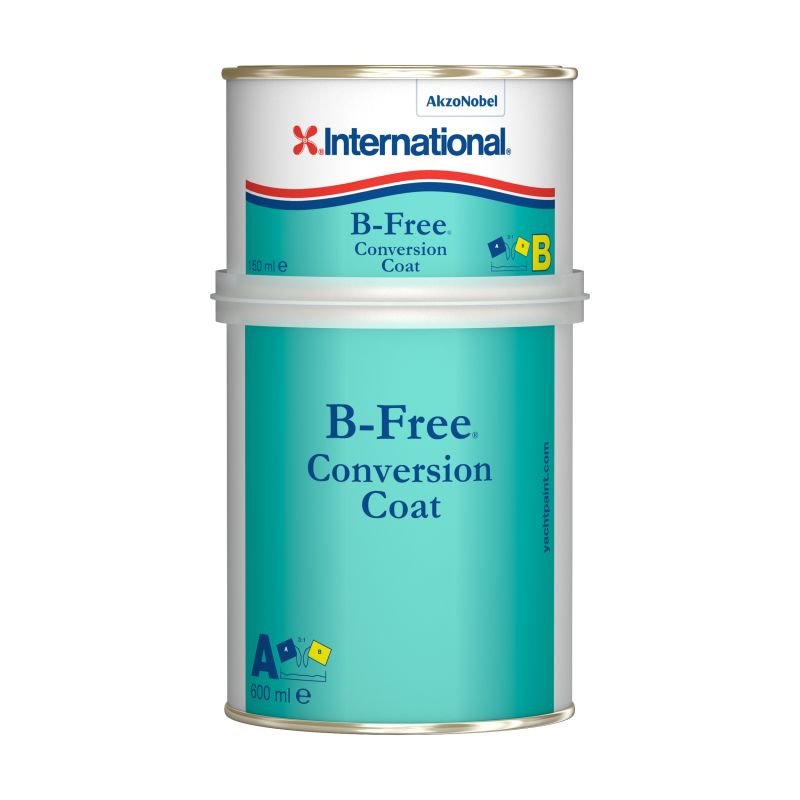
International B-Free Conversion Coat
At a glance
- 2-component primer
- To seal off old antifouling
- Contents: 750 ml & 2.5 litres

Product description
International B-Free Conversion Coat is a 2-component primer specifically designed to seal off conventional antifouling which is already present. The conversion primer is applied before painting B-Free Tiecoat, as part of a conversion system for B-Free Explore.
Benefits B-Free Conversion Coat
- Compatible and can be applied over a conventional antifouling in good condition, without having to remove it completely.
- Seals the existing antifouling, allowing easy conversion to a B-Free antifouling system.
- Easy to apply in one coat to prepare the surface before applying B-Free Tiecoat.
Specifications
Packaging: 750 ml and 2.5 L
Colour: grey
Finish: matt
Mixing ratio: 4:1 by volume
Recommended numer of coats: 1
Touch dry after: 2 hours (at 25°C)
Pot life: 3 hours (at 25°C)
Application method: brush or roller
Coverage: 9 m2/L
Shelf life: 2 years
Product properties
The key technical properties clearly listed in one place.
- Article number
- BOO001545
-
The technical product category, such as primer, resin, hardener or cleaner. It explains the product's purpose and helps you find other products with a similar function.
- 2K Primer
-
The materials, substrates or tasks a product is intended for. A general claim such as 'suitable for plastics' does not mean it works with every type of plastic; the specific substrate and its preparation still matter.
- Polyester boten, Stalen-boten, Aluminium boten, Houten boten
-
The recommended number of coats needed to achieve the intended coverage, thickness or protection. Highly absorbent substrates or different application methods may require additional coats. Allow for the specified time between coats.
- 1 coat
-
The period for which an unopened product remains usable under the specified storage conditions. Check whether the period starts from the manufacturing date or another date. Shelf life may be shorter after opening, especially for products sensitive to air or moisture.
- 24 months
-
The time until the surface no longer feels tacky to a light touch. The material underneath may still be soft, so tack-free does not mean fully cured or ready for heavy loading.
- 2 hours (25 °C)
-
Mixing ratio indicates how much of each component is needed, for example resin (A) and hardener (B). A ratio of 100:50 by weight means 100 grams of A to 50 grams of B; by volume you might use millilitres. Weight and volume ratios are not necessarily the same because the components may have different densities. Accurate measuring is important for proper curing.
- 4:1 (by volume)
-
Consumption or coverage describes how much product is needed for a given surface area. Consumption may be stated in g/m² or kg/m², while coverage is often given in m²/L or m²/kg. A consumption of 0.2 kg/m² means a theoretical 200 grams per square metre. Actual use depends on film thickness, substrate absorbency, application method and waste.
- 9 m²/L
- Net contents
- 2.5 L, 750 ml
-
The application or processing methods specified by the manufacturer, such as brushing, rolling, spraying, casting or hand laminating. The chosen method can affect consumption, layer thickness and finish.
- Brush, Roller
-
Working time is the period during which a product remains workable after mixing or activation, usually given in minutes at a specified temperature, often 20 °C. With reactive resins, the chemical reaction also continues in the mixing container, and larger quantities or higher temperatures can shorten this time. Working time is different from gel time and full curing time.
- Approximately 180 minutes (at 25 °C)