Recommended

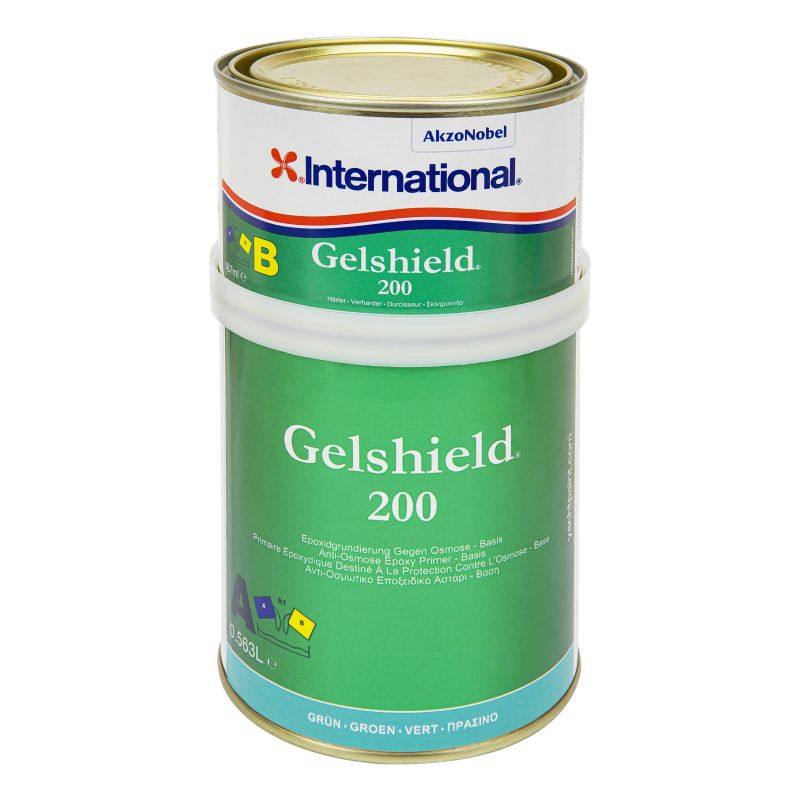
Protect your polyester boat against osmosis with International Gelshield 200. This fast-drying epoxy primer is easy to apply and vapour-tight, making it ideal for preventing osmosis in polyester. The 2-component epoxy primer can be used at temperatures from 5°C and cures quickly, allowing you to apply multiple coats in a single day.
For effective osmosis protection, we recommend applying at least five coats of Gelshield 200, with a total dry film thickness of approximately 250 µm.
Follow the instructions below to correctly apply International Gelshield 200:
| Packaging | Surface |
| 0.75 L | approx. 6 m2 |
| 2.5 L | approx. 20 m2 |
Colours: grey or green
Finish: matt
VOC: 464 g/L
Mixing ratio: 3:1 by volume (as supplied)
Coverage: approx. 8 m2/L
Minimum application temperature: 5°C
Number of coats: 5 (50µm per coat)
Application: nylon roller or brush
Thinner: Thinner No.7
Pot life: 5 hours (at 15°C)
Tack-free after: 2 hours (at 15°C)
Water-immersion after: 18 hours (at 15°C)
Recoatable (Gelshield 200) after: 5 hours (at 15°C)
Recoatable (antifouling) after:
Shelf life: 2 years
For more information on properties, surface preparation, or curing times, please consult the International Gelshield 200 technical documentation.
Primers, antifouling, boat paints, gelcoat, topcoat and all other products for boat maintenance are available at Polyestershoppen.com! All our products are available from stock. If you place your order before 5:00 pm CET (Central European Time), your order will be dispatched the same day.
Do you have a question about osmosis treatment, repairs or antifouling? Take a look at our information centre. Would you rather contact one of our specialists? We are ready to assist you via email, telephone, WhatsApp or live chat!
The key technical properties clearly listed in one place.
The materials, substrates or tasks a product is intended for. A general claim such as 'suitable for plastics' does not mean it works with every type of plastic; the specific substrate and its preparation still matter.
The technical product category, such as primer, resin, hardener or cleaner. It explains the product's purpose and helps you find other products with a similar function.
The recommended number of coats needed to achieve the intended coverage, thickness or protection. Highly absorbent substrates or different application methods may require additional coats. Allow for the specified time between coats.
The period for which an unopened product remains usable under the specified storage conditions. Check whether the period starts from the manufacturing date or another date. Shelf life may be shorter after opening, especially for products sensitive to air or moisture.
The time until the surface no longer feels tacky to a light touch. The material underneath may still be soft, so tack-free does not mean fully cured or ready for heavy loading.
Mixing ratio indicates how much of each component is needed, for example resin (A) and hardener (B). A ratio of 100:50 by weight means 100 grams of A to 50 grams of B; by volume you might use millilitres. Weight and volume ratios are not necessarily the same because the components may have different densities. Accurate measuring is important for proper curing.
Minimum application temperature is the lowest temperature at which a product may be used according to the manufacturer. The limit can apply to the air, substrate and product itself.
At lower temperatures, resins and coatings can become thicker and cure more slowly. Moisture can also condense on a cold substrate and reduce adhesion. Check the dew point and measure the surface temperature before starting. A longer drying time does not automatically make application below the specified minimum acceptable.
The minimum waiting time between applying an underwater coating or antifouling paint and launching the boat. Some products also specify a maximum time before launch. These times may depend on temperature and applied film thickness.
Consumption or coverage describes how much product is needed for a given surface area. Consumption may be stated in g/m² or kg/m², while coverage is often given in m²/L or m²/kg. A consumption of 0.2 kg/m² means a theoretical 200 grams per square metre. Actual use depends on film thickness, substrate absorbency, application method and waste.
A specific thinner that can be used, where permitted, to adjust a product's application properties or viscosity. The correct thinner and maximum quantity depend on the product. Incorrect thinning can affect coverage, drying and curing.
The application or processing methods specified by the manufacturer, such as brushing, rolling, spraying, casting or hand laminating. The chosen method can affect consumption, layer thickness and finish.
Working time is the period during which a product remains workable after mixing or activation, usually given in minutes at a specified temperature, often 20 °C. With reactive resins, the chemical reaction also continues in the mixing container, and larger quantities or higher temperatures can shorten this time. Working time is different from gel time and full curing time.
VOC content (volatile organic compounds) indicates the amount of these substances in a product, usually expressed in g/L (grams per litre). They may evaporate during application and drying. The value describes the composition, but actual exposure also depends on how much is used, ventilation and the application method.
Useful additions for your project.