
International Primocon Primer
At a glance
- One-component primer
- Quick-drying
- Can be used over old antifouling
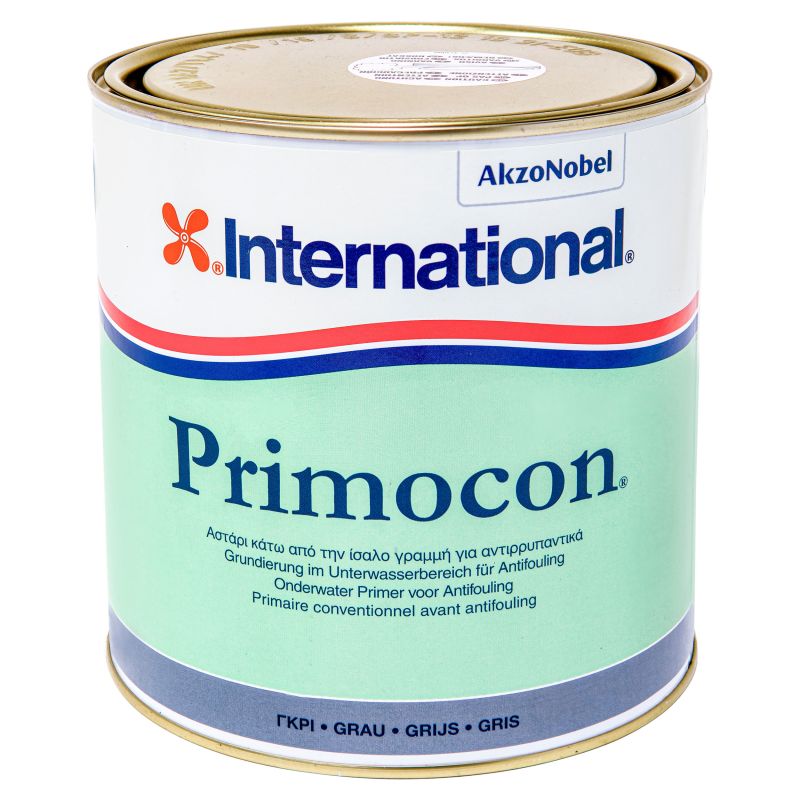
Good maintenance of your boat, ship or yacht is essential for years of trouble-free enjoyment. International Primocon has been specially developed for boats, ships and yachts. It is a quick-drying primer for sealing and protecting bare surfaces below the waterline. This is why International Primocon is an indispensable product in our range.
International Primocon Primer is a one-component primer for underwater hulls. It is ideal as an adhesion primer, sealer or tie coat when the existing antifouling is unknown or incompatible. The primer is tar-free, easy to apply, and quick-drying. Thanks to its anti-corrosive properties, Primocon is suitable for a wide range of substrates, including aluminium, GRP (gelcoat), lead, steel, wood, carbon fibre, and cast iron. Primocon is widely used by professional boatyards and is equally suitable for DIY boat owners thanks to its ease of application.
Benefits of International Primocon Primer
- Fast-drying one-component primer, even in challenging conditions.
- Suitable for use under all International antifoulings.
- Tar-free.
- Anti-corrosive protection.
Suitable substrates
International Primocon Primer is suitable for use on the following substrates:
- Aluminium / Zinc-galvanised steel
- Carbon fibre
- GRP (gelcoat)
- Lead
- Steel
- Wood
- Cast iron
Directions for use
Clean and degrease the surface thoroughly. Then sand according to the recommendations for your substrate (see table). Remove all sanding dust and stir the primer thoroughly before use.
|
Substrate |
Surface preparation |
Thinning |
| GRP (gelcoat) |
Sand P120-P180 |
No |
| Wood |
Sand P80–P180, then P280 |
First coat 10–15% |
| Aluminium | Degrease, sand P24-P120 |
First coat 10–15% |
| Zinc | Degrease, sand P60-P120 |
First coat 10–15% |
| Lead | Degrease, sand P120 |
First coat 10–15% |
| Steel |
Grit blast SA2.5 or coarse sanding P24–P36 |
First coat 10–15% |
|
Existing antifouling |
Good condition: wash with fresh water and dry Poor condition: remove old layers with International Interstrip |
No |
- Apply International Primocon Primer using a fleece roller, brush or Airless spray. The recommended dry film thickness is 40 microns (121 microns wet) with a coverage of approximately 8 m²/L per coat.
- The primer becomes tack-free after 1 hour and can be recoated with Primocon after 3 hours.
-
Apply your chosen International antifouling, such as Interspeed Extra, Micron LZ or Cruiser One, within 24 hours of applying the final coat of Primocon.
Specifications
| Packaging | Surface |
| 0.75 L | approx. 6 m2 |
| 2.5 L | approx. 20 m2 |
| 5 L | approx. 40 m2 |
Coverage: approximately 8 m²/L per coat
Colour: grey
Finish: matt
VOC: 584 g/L
Minimum application temperature: 5°C
Number of coats: 1-5 (depending on the substrate)
Application method: roller or brush or airless spray
Tack-free: after 1 hour (23°C)
Recoatable: after 3 hours (23°C)
Thinner: Thinner No.3
Shelf life: 2 years
Everything for your boat!
Primers, antifouling, boat paints, gelcoat, topcoat and all other products for boat maintenance are available at Polyestershoppen.com! All our products are available from stock. If you place your order before 5:00 pm CET (Central European Time), your order will be dispatched the same day.
Do you have a question about osmosis treatment, repairs or antifouling? Take a look at our information centre. Would you rather contact one of our specialists? We are ready to assist you via email, telephone, WhatsApp or live chat!
Product properties
The key technical properties clearly listed in one place.
- Article number
- BOO000486
-
The materials, substrates or tasks a product is intended for. A general claim such as 'suitable for plastics' does not mean it works with every type of plastic; the specific substrate and its preparation still matter.
- Polyester boten, Stalen-boten, Aluminium boten, Houten boten
-
The technical product category, such as primer, resin, hardener or cleaner. It explains the product's purpose and helps you find other products with a similar function.
- 1K Primer
-
The recommended number of coats needed to achieve the intended coverage, thickness or protection. Highly absorbent substrates or different application methods may require additional coats. Allow for the specified time between coats.
- 1-5 coats
-
The period for which an unopened product remains usable under the specified storage conditions. Check whether the period starts from the manufacturing date or another date. Shelf life may be shorter after opening, especially for products sensitive to air or moisture.
- 24 months
-
The time until the surface no longer feels tacky to a light touch. The material underneath may still be soft, so tack-free does not mean fully cured or ready for heavy loading.
- 1 hour (23 °C)
-
Minimum application temperature is the lowest temperature at which a product may be used according to the manufacturer. The limit can apply to the air, substrate and product itself.
At lower temperatures, resins and coatings can become thicker and cure more slowly. Moisture can also condense on a cold substrate and reduce adhesion. Check the dew point and measure the surface temperature before starting. A longer drying time does not automatically make application below the specified minimum acceptable.
- 5 °C
-
The overcoating interval tells you when the next layer of paint, varnish or coating may be applied. Many multi-coat systems specify both a minimum and a maximum interval:
- Minimum overcoating time: the previous layer is dry or cured enough to accept another coat.
- Maximum overcoating time: the period during which the next coat can bond without extra surface preparation under the stated conditions.
Overcoating too early can affect drying or the finish. Once the maximum interval has passed, cleaning and sanding may be needed to ensure adhesion between coats. Temperature and film thickness affect the waiting times.
- 3 hours (23 °C)
-
Consumption or coverage describes how much product is needed for a given surface area. Consumption may be stated in g/m² or kg/m², while coverage is often given in m²/L or m²/kg. A consumption of 0.2 kg/m² means a theoretical 200 grams per square metre. Actual use depends on film thickness, substrate absorbency, application method and waste.
- 8 m²/L
-
A specific thinner that can be used, where permitted, to adjust a product's application properties or viscosity. The correct thinner and maximum quantity depend on the product. Incorrect thinning can affect coverage, drying and curing.
- Thinner No.3
-
The application or processing methods specified by the manufacturer, such as brushing, rolling, spraying, casting or hand laminating. The chosen method can affect consumption, layer thickness and finish.
- Airless spray, Brush, Roller
-
VOC content (volatile organic compounds) indicates the amount of these substances in a product, usually expressed in g/L (grams per litre). They may evaporate during application and drying. The value describes the composition, but actual exposure also depends on how much is used, ventilation and the application method.
- 584 g/L
Safety information
Read the warnings and use appropriate protective equipment before handling the product.
Reviews
Frequently bought together
Useful additions for your project.