Recommended

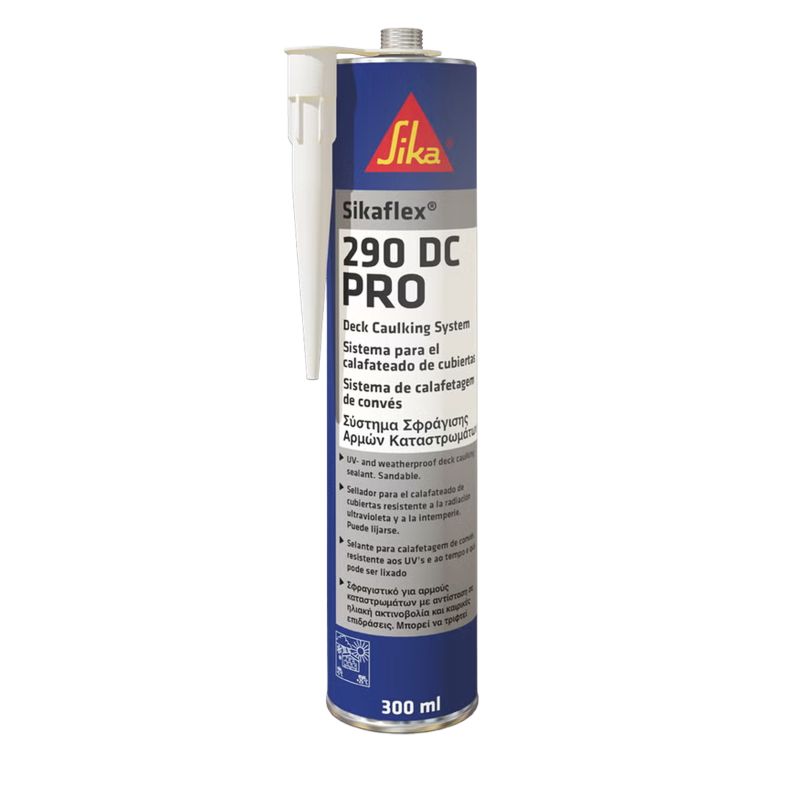
Sikaflex-290 DC PRO is a UV-resistant one-component sealant based on polyurethane. The deck caulking compound has been specifically formulated for sealing joints in traditional timber marine decks. The sealing compound cures to form a flexible elastomer which allows fast and easy sanding.
Sikaflex-290 DC PRO meets the low flame spread requirements of the International Maritime Organisation (IMO). Sikaflex-290 DC PRO is manufactured in accordance with the ISO 9001 quality management system and the ISO 14001 environmental management system, and the “Responsible Care” programme.
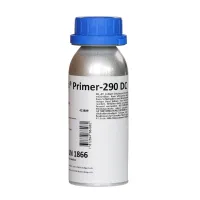
Sikaflex-290 DC PRO is designed for caulking joints in traditional timber decks for boat, yacht and commercial ship construction. Use this teak joint sealant in combination with the corresponding primer: Sika Primer-290 DC.
We advise placing bond breaker tape at the bottom of the seam. The tape prevents an adhesive bond of the caulking to the bottom of the seam, allowing movement during sealant expansion and contraction. For example, fineline tape can be used. Apply the sealant with a caulking gun and ensure a convex finish, as Sikaflex will shrink slightly. After three days, excess sealant can be sanded away and any air bubbles can be refilled.
Contents: 300 ml
Colour: black
Chemical base: 1-component polyurethane
Cure mechanism: moisture curing
Application temperature: 5-35°C
Skin time: 90 minutes
Hardness: Shore A40
Temperature resistance: -50°C to + 90°C
Shelf life: 12 months (stored at temperatures below 25°C)
Application gun: sealant gun for cartridges
The key technical properties clearly listed in one place.
The recommended application temperature range indicates the conditions under which the product can generally be applied and cured properly. Three temperatures matter:
A cold substrate can cause condensation and affect adhesion. At higher temperatures, two-component products may react faster, reducing their working time. Check the dew point and follow the product instructions.
The chemical base describes the chemistry of an adhesive, sealant, resin or coating, such as epoxy, polyester, polyurethane, (methyl)methacrylate or a hybrid polymer. It affects curing, flexibility and adhesion. Products with the same chemical base are not necessarily suitable for the same applications.
The period for which an unopened product remains usable under the specified storage conditions. Check whether the period starts from the manufacturing date or another date. Shelf life may be shorter after opening, especially for products sensitive to air or moisture.
The time after application during which a skin forms on the surface of a sealant. Tool the joint before the skin develops, as adjusting it afterwards can affect the finish or adhesion. Temperature and humidity influence this time.
Elongation at break indicates how much a material can stretch during a tensile test before it breaks. It is expressed as a percentage (%) of the original length. At 100% elongation, the material has doubled in length just before breaking. A high value indicates a high ability to deform, but not how much force is needed.
Tensile strength is the maximum tensile stress a material can withstand during a tensile test before failure. It is usually expressed in MPa (megapascals) or N/mm² (newtons per square millimetre); 1 MPa = 1 N/mm². Under comparable test conditions, a higher value means greater resistance to tension. In composites, fibre orientation also affects the result.
The curing mechanism explains how a product develops its final strength or shape. The main mechanisms are:
Some products use more than one mechanism, so the correct application conditions depend on the particular system.
Heat resistance describes the temperature a material can withstand after correct processing and curing, usually expressed in degrees Celsius (°C). Continuous exposure is different from a brief temperature peak, and mechanical loading may also affect the limit. Heat resistance is not the same as the temperature at which the product can be applied.
Useful additions for your project.