
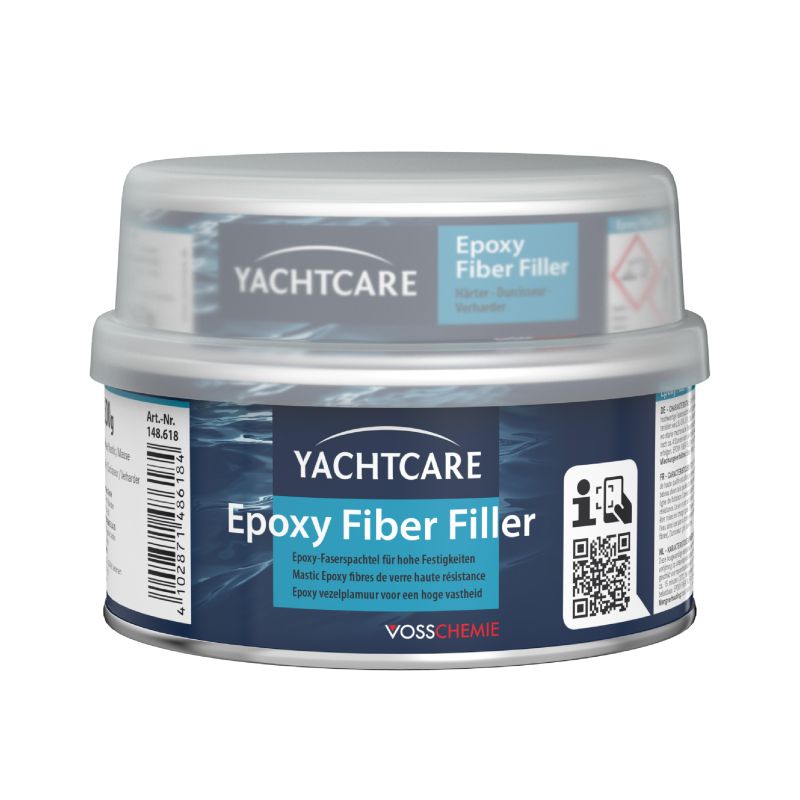
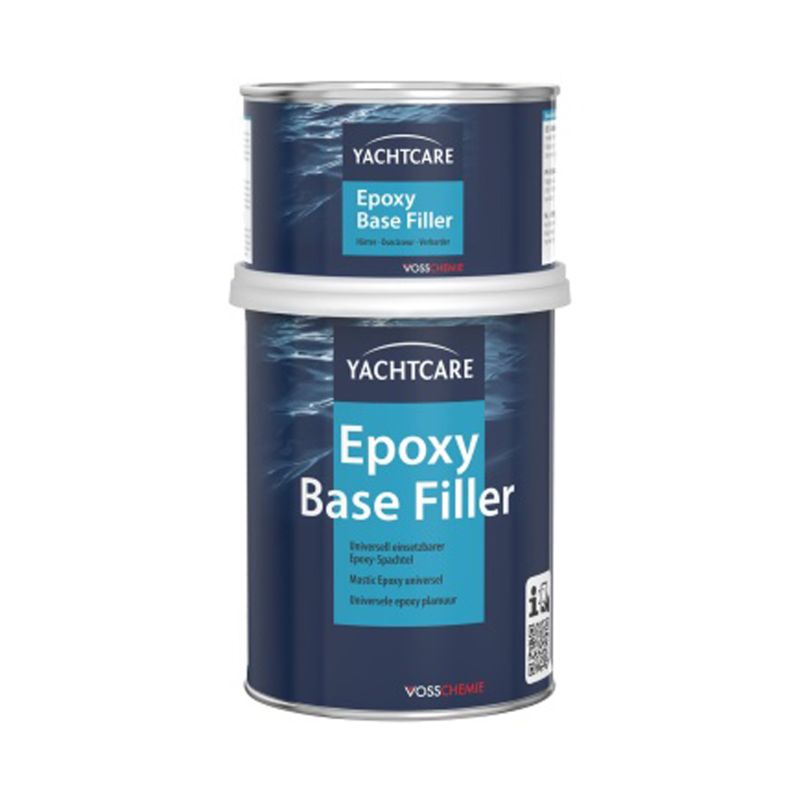
Yachtcare Epoxy Fiber Filler
At a glance
- 2-component epoxy filler
- For above and below the waterline
- High water resistance
Fast delivery throughout Europe
Secure payment with PayPal, Mastercard, Visa and more
4.7 out of 5 stars on Trusted Shops
Yachtcare Epoxy Fiber Filler is a universal, solvent-free, 2-component epoxy fibre filler. Due to its excellent water resistance, this filler is not only suitable for use above the waterline but also below the waterline, which makes it a perfect filler for the marine industry.
Benefits of Yachtcare Epoxy Fiber Filler
- For use above and below the waterline.
- High water resistance.
- Easy to use.
Directions for use
Yachtcare Epoxy Fiber Filler is very easy to use. Make sure the surface is clean, dry, free of grease and dirt before you start filling. Also remove loose or poorly adhering parts. Mix the base and hardener in the specified mixing ratio of 2:1 by weight. Mix until a homogeneous, light grey colour is obtained. We recommend making only a quantity that you can process within 30 minutes. Apply a maximum of 2 cm of filler per layer. Is a thicker layer required? Then sand the last layer first before applying a new layer of putty. The maximum time between applying 2 layers of filler should not exceed 24 hours (+20°C).
The minimum processing temperature of Yachtcare Epoxy Fiber Filler is 10°C. After mixing, it must be processed within 30 minutes at an ambient temperature of 20°C. Curing can be accelerated by applying heat up to a maximum of 60°C.
Specifications
Contents: 500 grams, 2 kg
Colour: light grey
Brand: Yachtcare
Mixing ratio: 2:1 (weight)
Standard layer thickness: max. 2 cm
Minimum application temperature: 10°C
Pot life: 30 minutes (20°C)
Sandable: after 6 hours (20°C)
Recoating time with primer:
- min. 12 hours (20°C)
- max. 24 hours (20°C)
Full cure: after 5 days
Coverage: 1.1 m2/kg
Specific gravity: approx. 1.78 g/ml
Product properties
The key technical properties clearly listed in one place.
- Article number
- BOO001642
-
Density describes the mass of a material per unit volume. Values may be given in g/cm³, kg/L or kg/m³; 1 g/cm³ equals 1 kg/L. For example, one litre of a liquid with a density of 1.2 kg/L weighs approximately 1.2 kg. Density helps convert between weight and volume, but it can vary with temperature.
- Approximately 1.78 g/ml
-
Mixing ratio indicates how much of each component is needed, for example resin (A) and hardener (B). A ratio of 100:50 by weight means 100 grams of A to 50 grams of B; by volume you might use millilitres. Weight and volume ratios are not necessarily the same because the components may have different densities. Accurate measuring is important for proper curing.
- 2:1 (by weight)
-
Minimum application temperature is the lowest temperature at which a product may be used according to the manufacturer. The limit can apply to the air, substrate and product itself.
At lower temperatures, resins and coatings can become thicker and cure more slowly. Moisture can also condense on a cold substrate and reduce adhesion. Check the dew point and measure the surface temperature before starting. A longer drying time does not automatically make application below the specified minimum acceptable.
- 10 °C
-
The waiting time before an applied layer is dry or hard enough to sand without smearing or damage. Sanding too early can also clog the abrasive quickly. Layer thickness and temperature affect this time.
- 6 hours (20 °C)
-
Curing time is the period a product needs to reach a specified stage of cure. It is usually given in hours or days, often at a reference temperature such as 20 °C. A product may be tack-free or safe to handle before reaching its full mechanical and chemical resistance. Film thickness and mixed quantity may also affect the time.
- 5 days
-
Consumption or coverage describes how much product is needed for a given surface area. Consumption may be stated in g/m² or kg/m², while coverage is often given in m²/L or m²/kg. A consumption of 0.2 kg/m² means a theoretical 200 grams per square metre. Actual use depends on film thickness, substrate absorbency, application method and waste.
- 1.1 m²/kg
- Net contents
- 2 kg, 500 g
-
Working time is the period during which a product remains workable after mixing or activation, usually given in minutes at a specified temperature, often 20 °C. With reactive resins, the chemical reaction also continues in the mixing container, and larger quantities or higher temperatures can shorten this time. Working time is different from gel time and full curing time.
- Approximately 30 minutes (at 20 °C)
Reviews
Frequently bought together
Useful additions for your project.
Often chosen


Often chosen