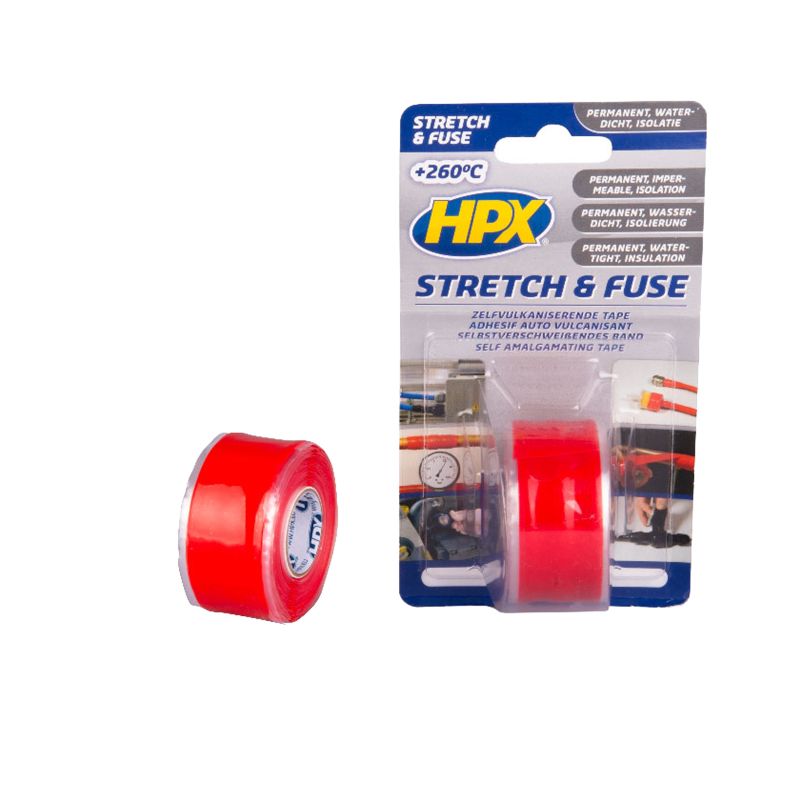
HPX Stretch & Fuse (red)
At a glance
- Self-vulcanising tape
- Permanent waterproofing
- Colour: red

With HPX Stretch & Fuse, you can quickly and efficiently seal leaks in, for example, garden hoses, vacuum hoses, and other types of tubing. This self-fusing tape provides a permanent air- and watertight seal on virtually any surface. The tape can be removed cleanly and can even be applied under water. It withstands pressures of up to 8 bar and is suitable for temperatures ranging from -65°C to +200°C.
Stretch & Fuse tape is available in red and black.
Benefits of Stretch & Fuse
- Permanent air- and watertight seal.
- Self-fusing tape.
- Suitable for all surfaces (including underwater applications)
- Cleanly removable.
- Very easy to use.
- Pressure resistant up to 8 bar.
Directions for use
Using this self-fusing tape is simple:
- Remove the protective backing from the tape.
- Stretch the tape to three times its original length while applying it.
- Wrap the tape with a 50% overlap on each turn.
- Apply multiple layers of HPX tape for optimal sealing.
- The tape self-fuses within a few minutes.
Specifications
Colour: red or black
Backing material: silicone
Length: 3 metres
Width: 25 mm
Thickness: 0.5 mm
Pressure resistance: up to 8 bar
Temperature resistance: -65°C to +200°C (short-term up to +265°C)
Tensile strength: 0.50 MPa
Dielectric strength: 8 kV
Product properties
The key technical properties clearly listed in one place.
- Article number
- HUL002351
-
The tasks a product is intended for, such as laminating, casting, bonding, sealing or protecting. Products intended for the same application can differ considerably in processing, curing time and final properties.
- Masking
-
The purpose of an accessory or consumable during preparation, application or finishing, such as mixing, masking, removing trapped air or dosing. This classification helps you find tools and materials for each stage of a job.
- Tape
-
The measurement across a product from one side to the other, for example for rolls, panels or fabrics. With rolled materials, the usable width may differ from the overall width.
- 25 mm
-
The physical thickness of the supplied material, such as a panel, pad, film or foam sheet. This differs from the thickness of a liquid coating applied to a surface.
- 0.5 mm
-
The backing material that supports a functional layer, such as paper or fabric behind abrasive grains or film behind an adhesive coating. The backing affects flexibility, tear resistance and suitability for wet or dry use.
- silicone
- Length
- 3 m
-
Tensile strength is the maximum tensile stress a material can withstand during a tensile test before failure. It is usually expressed in MPa (megapascals) or N/mm² (newtons per square millimetre); 1 MPa = 1 N/mm². Under comparable test conditions, a higher value means greater resistance to tension. In composites, fibre orientation also affects the result.
- 0.5 MPa
-
Heat resistance describes the temperature a material can withstand after correct processing and curing, usually expressed in degrees Celsius (°C). Continuous exposure is different from a brief temperature peak, and mechanical loading may also affect the limit. Heat resistance is not the same as the temperature at which the product can be applied.
- -65 to 200 °C (short-term up to 265 °C)
-
Working pressure is the pressure at which a device or system normally operates; maximum pressure is the limit that must not be exceeded. Values are often given in bar, or sometimes kPa or MPa (1 bar = 100 kPa = 0.1 MPa). In a system with several connected components, the lowest-rated component determines the maximum permissible system pressure.
- Maximum 8 bar