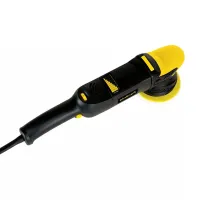
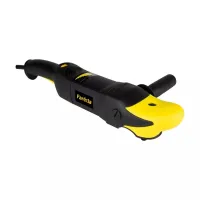
To restore the weathered paintwork on your car, boat, caravan or motorhome, it’s important to polish it properly. There are several techniques to achieve this, with rotary polishing and dual-action (DA) polishing being the most commonly used methods. But what are the differences? Which method should you use and when? And which polishing machine is best suited to your job? In this article, we explain everything you need to know about these widely used polishing techniques.
If you have any questions about polishing that aren’t covered in this article, feel free to contact our product specialists!
What is rotary polishing?
Rotary polishing means that the polishing pad spins solely around its own axis. This is also known as concentric polishing. It provides a powerful and aggressive cutting action, allowing deep scratches and oxidation to be removed quickly. This technique is often used by professionals because it delivers faster and deeper correction results.
Advantages of rotary polishing:
- Suitable for heavy correction work and deep scratches.
- Faster results when performing coarse polishing.
- Less noise than dual-action polishing.
Disadvantages of rotary polishing:
- High heat build-up can damage the paint.
- Increased risk of swirls and holograms.
- Harder to control and less suitable for beginners.
What is Dual Action polishing?
With dual-action polishing, the polishing pad not only rotates around its own axis but also moves in an eccentric (oscillating) motion. This results in a safer and milder polishing action than rotary polishing, greatly reducing the risk of paint damage. This makes Dual Action (DA) polishers ideal for beginners and for achieving a high-gloss finish without swirls or holograms.
Advantages of Dual Action polishing:
- Easier to control.
- Safer due to minimal heat build-up.
- Prevents swirls and holograms.
- Suitable for polishing larger surfaces.
Disadvantages of Dual Action polishing:
- Less powerful than rotary polishing.
- Produces more noise due to combined motion.
- Less effective at removing deep scratches.
Differences between polishing methods
In addition to rotary and Dual Action polishing, there are a few other polishing methods you may come across. Here is an overview:
-
Rotary polishing (Rotary):
A single rotary motion around its own axis. -
Orbital polishing:
An eccentric motion without rotation around its own axis, often less effective. -
Eccentric rotation (Dual Action polishing):
A combined orbital and rotary motion. -
Forced rotation (Planetary):
A dual-action movement with a forced rotation around its own axis, providing a more consistent polishing result.

Which polishing machine should you choose?
The right polishing machine depends on your experience level and intended application:
- For beginners or maintenance polishing, a Dual Action polisher is safer and easier to use.
- For professionals and heavy correction work, a rotary polisher is recommended. It provides quicker and deeper correction but requires more skill and control.
More information about polishing?
Are you unsure which method or machine is best for your project? Get advice from a specialist and ensure you use the right pads and compounds for the best possible results. Feel free to contact us. With the right knowledge and tools, you can make any surface shine like new again!