Coltech Transelast Wood Coating
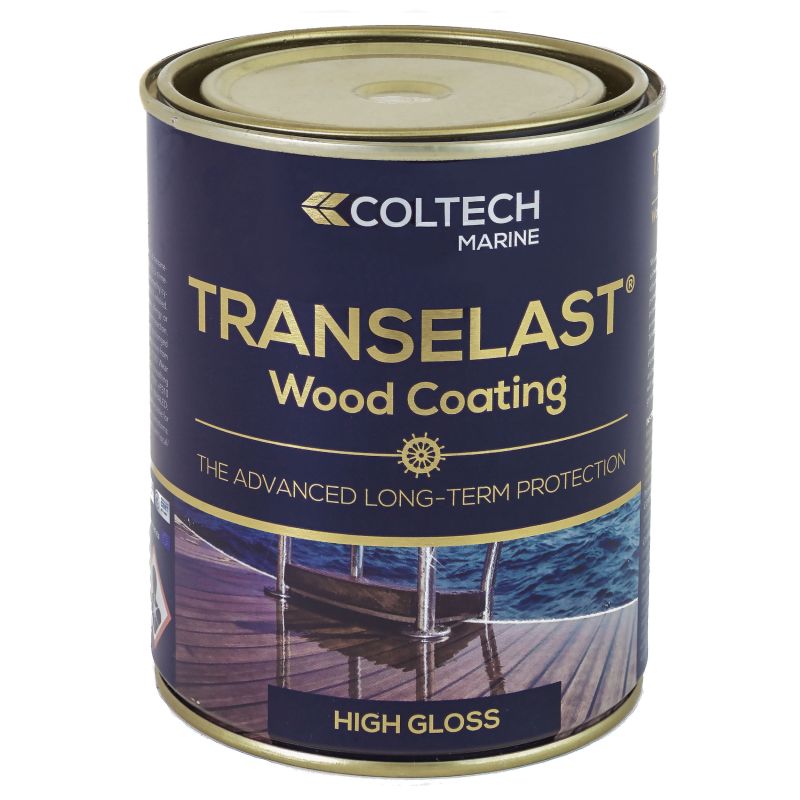
At a glance
- 1-component
- For wooden decks, railings etc.
- Flexible and durable

Product description
Coltech Transelast Wood Coating has been developed to protect boat decks from weathering and heavy use. Coltech Transelast is a high-build, aliphatic PU coating with excellent resistance to UV radiation and daylight. The coating is extremely durable due to its thick film build and high elasticity, making it resistant to cracking and blistering. Its vapour-permeable properties allow the wood to breathe normally. It also offers high chemical resistance to alcohol, petrol, and cleaning agents.
The flexible Coltech Transelast coating restores wooden boat decks to a like-new appearance while providing protection against weathering and heavy use.
Transelast is available in both a glossy and a matte version. The matte version can be applied as a topcoat over the glossy version. Always build up the desired film thickness using the glossy version.
Features Coltech Transelast Wood Coating
- 1 component.
- Very easy to apply, ready for use.
- UV- and weather-resistant.
- Forms a thick, strong and transparent membrane.
- Elastic, resistant to cracking, does not blister.
- Durable, walkable under heavy use.
- Resistant to salt water.
- Extremely long-lasting.
Applications
Coltech Transelast Wood Coating can be used for the following applications:
- Wooden boat decks
- Wooden stairs
- Wooden rub rails
- Wooden railings
- Wooden masts
- Wooden chests
- Wooden blocks
- Wooden dagger boards and rudders
Specifications
Contents: 0.75 ltr can
Gloss: high-gloss or matt
Dilute with: Transelast Solvent
Application method: brush or roller
Application temperature: 5-25 °C
Drying/light foot traffic: 24 hours
Fully cured after: 7 days
Consumption: 0.8-1.0 kg/m2
Product properties
The key technical properties clearly listed in one place.
- Article number
- LAK000546
-
Gloss level indicates how much light a dry paint or coating reflects and how the finished surface looks.
- Matt: little reflection and a subdued appearance.
- Satin: a gentle sheen between matt and high gloss.
- High gloss: stronger reflections and a more pronounced colour, although surface imperfections may become more visible.
Gloss can be measured in gloss units (GU) at a specified angle. Terms such as matt and satin do not necessarily mean exactly the same thing across manufacturers. Substrate condition and application also affect the final appearance.
- High gloss, Matte
-
The technical product category, such as primer, resin, hardener or cleaner. It explains the product's purpose and helps you find other products with a similar function.
- Finish coat
-
The recommended application temperature range indicates the conditions under which the product can generally be applied and cured properly. Three temperatures matter:
- Air: the temperature in the workshop or outdoors.
- Substrate: the temperature of the surface being treated.
- Product: the temperature of the resin, adhesive or coating itself.
A cold substrate can cause condensation and affect adhesion. At higher temperatures, two-component products may react faster, reducing their working time. Check the dew point and follow the product instructions.
- 5-25 °C
-
Curing time is the period a product needs to reach a specified stage of cure. It is usually given in hours or days, often at a reference temperature such as 20 °C. A product may be tack-free or safe to handle before reaching its full mechanical and chemical resistance. Film thickness and mixed quantity may also affect the time.
- 7 days
-
Consumption or coverage describes how much product is needed for a given surface area. Consumption may be stated in g/m² or kg/m², while coverage is often given in m²/L or m²/kg. A consumption of 0.2 kg/m² means a theoretical 200 grams per square metre. Actual use depends on film thickness, substrate absorbency, application method and waste.
- 0.8-1 kg/m²
- Net contents
- 750 ml
-
The application or processing methods specified by the manufacturer, such as brushing, rolling, spraying, casting or hand laminating. The chosen method can affect consumption, layer thickness and finish.
- Brush, Roller