Recommended

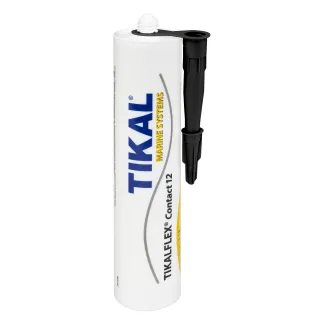
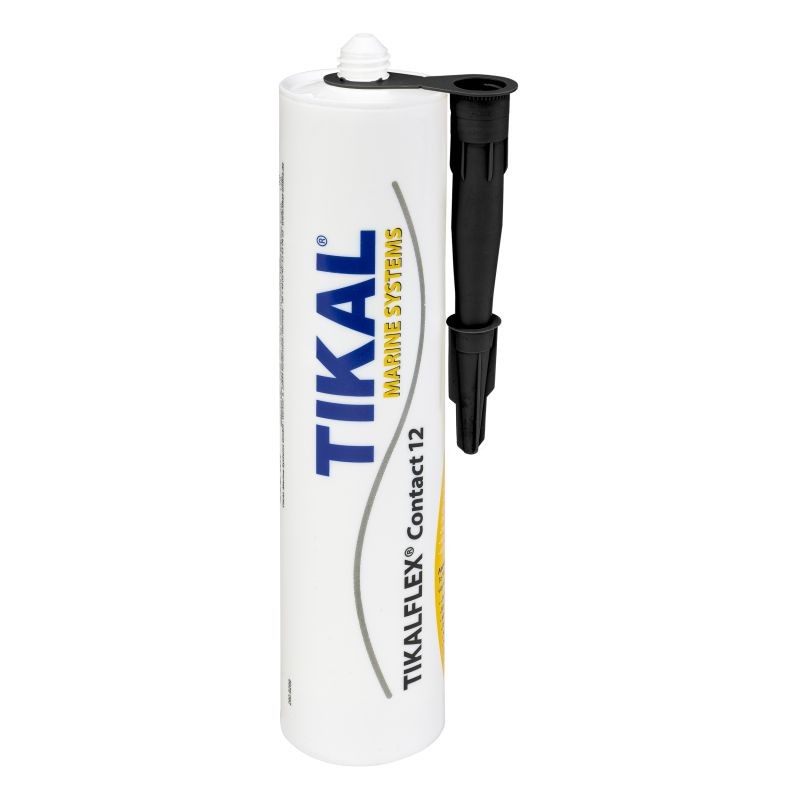
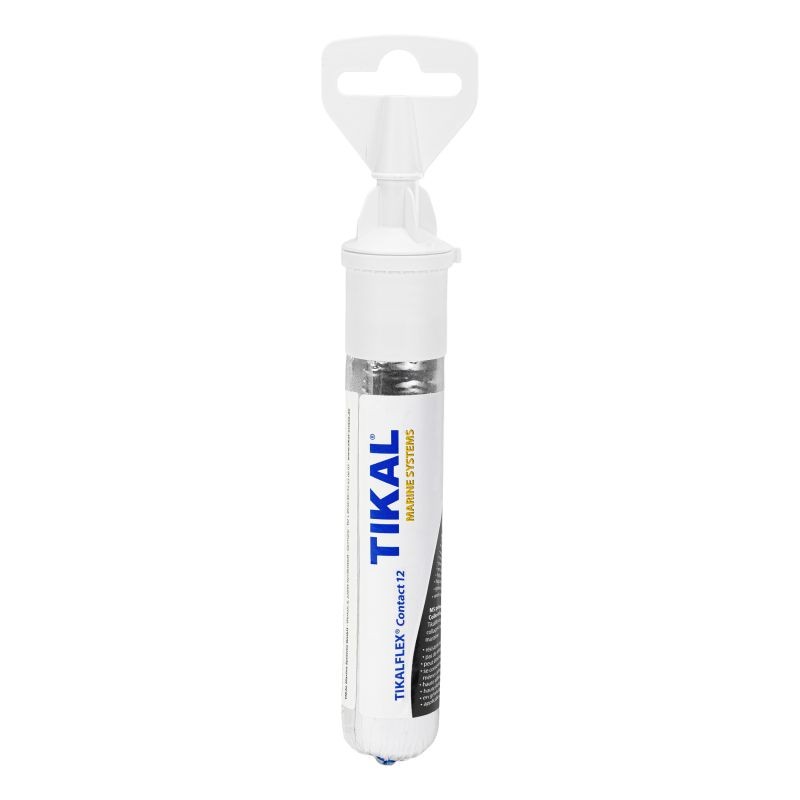
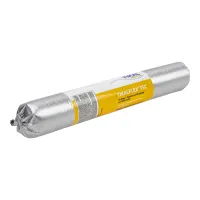
Tikalflex Contact 12 is a powerful, universal one-component MS-polymer adhesive. This high-performance adhesive sealant is specifically developed for demanding applications in construction, yacht building, and the caravan and marine industries. It combines very high final strength with long-lasting elasticity, making it ideal for structural bonding applications exposed to vibration, mechanical loads and moisture.
Tikalflex Contact 12 provides excellent adhesion to a wide range of common materials without the need for a primer. It also cures reliably on damp substrates and even under water.
Tikalflex Contact 12 bonds exceptionally well to:
Tikalflex Contact 12 is a true all-round adhesive for marine and caravan applications, suitable for:
Contents: 70 ml (sausage pack), 290 ml (cartridge)
Colour: black, grey or white
Chemical base: MS polymer
Density: 1.54 g/ml
Application temperature: 0-40°C
Skin formation time: 10-15 minutes (at 23°C)
Hardness: Shore A 60
Application method: caulk gun for 290-310 ml cartridges
Temperature resistance: -40°C to +90°C
Tensile strength: 2.3 N/mm²
Elongation at break: 350%
Resistant to salt water and weathering: yes
UV resistant: no
Shelf life: 18 months when stored at 5-25°C
The key technical properties clearly listed in one place.
Adhesive type describes the family of adhesive or sealant, such as epoxy adhesive, (methyl)methacrylate adhesive, polyurethane adhesive or polymer sealant. Its chemistry affects processing, curing, flexibility and adhesion. Products of the same type may still differ, so check the suitable substrates and application instructions.
This property lists the substrates on which an adhesive, resin or coating can achieve strong adhesion according to the product information. The result also depends on surface preparation.
Materials such as PE, PP and PTFE are difficult to bond with many conventional adhesives and may need a specialist adhesive or pretreatment. If in doubt, test adhesion on a small area.
The recommended application temperature range indicates the conditions under which the product can generally be applied and cured properly. Three temperatures matter:
A cold substrate can cause condensation and affect adhesion. At higher temperatures, two-component products may react faster, reducing their working time. Check the dew point and follow the product instructions.
The chemical base describes the chemistry of an adhesive, sealant, resin or coating, such as epoxy, polyester, polyurethane, (methyl)methacrylate or a hybrid polymer. It affects curing, flexibility and adhesion. Products with the same chemical base are not necessarily suitable for the same applications.
Density describes the mass of a material per unit volume. Values may be given in g/cm³, kg/L or kg/m³; 1 g/cm³ equals 1 kg/L. For example, one litre of a liquid with a density of 1.2 kg/L weighs approximately 1.2 kg. Density helps convert between weight and volume, but it can vary with temperature.
Hardness describes a material's resistance to indentation. For silicone rubber and other elastomers, the Shore A scale is commonly used: Shore A 15, for example, is softer than Shore A 40. Harder plastics may be rated on the Shore D scale. The number belongs to its Shore scale and is not a unit like MPa; values on different scales cannot be directly compared.
The period for which an unopened product remains usable under the specified storage conditions. Check whether the period starts from the manufacturing date or another date. Shelf life may be shorter after opening, especially for products sensitive to air or moisture.
The time after application during which a skin forms on the surface of a sealant. Tool the joint before the skin develops, as adjusting it afterwards can affect the finish or adhesion. Temperature and humidity influence this time.
Elongation at break indicates how much a material can stretch during a tensile test before it breaks. It is expressed as a percentage (%) of the original length. At 100% elongation, the material has doubled in length just before breaking. A high value indicates a high ability to deform, but not how much force is needed.
Tensile strength is the maximum tensile stress a material can withstand during a tensile test before failure. It is usually expressed in MPa (megapascals) or N/mm² (newtons per square millimetre); 1 MPa = 1 N/mm². Under comparable test conditions, a higher value means greater resistance to tension. In composites, fibre orientation also affects the result.
Heat resistance describes the temperature a material can withstand after correct processing and curing, usually expressed in degrees Celsius (°C). Continuous exposure is different from a brief temperature peak, and mechanical loading may also affect the limit. Heat resistance is not the same as the temperature at which the product can be applied.
Useful additions for your project.