

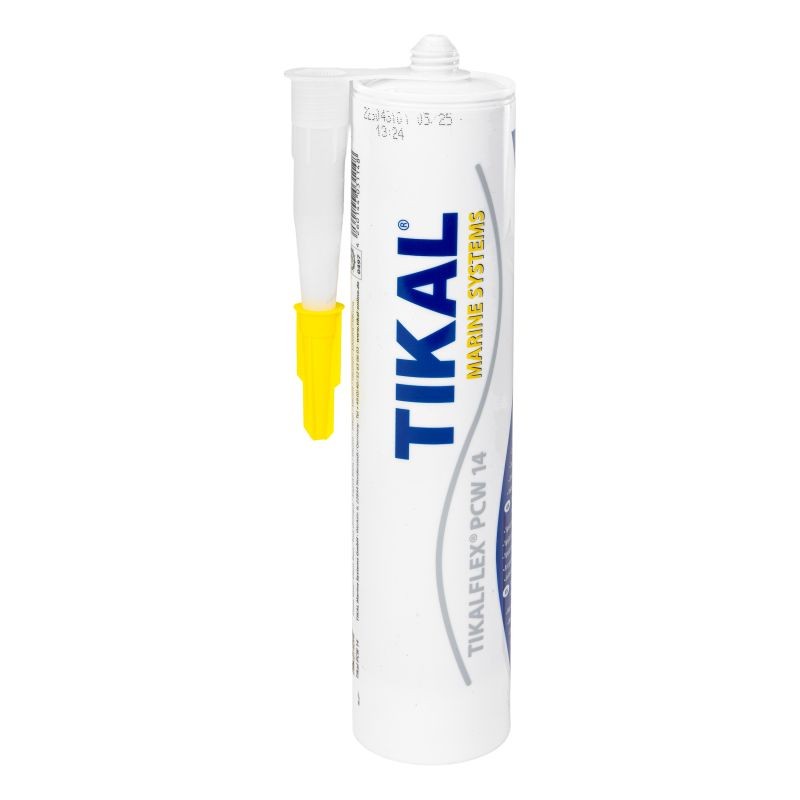
Tikalflex PCW14 Window Sealant
At a glance
- Silicone window sealant
- High UV resistance
- No primer required
Fast delivery throughout Europe
Secure payment with PayPal, Mastercard, Visa and more
4.7 out of 5 stars on Trusted Shops
Tikalflex PCW14 is a high-quality silicone window sealant designed for bonding and sealing polycarbonate, acrylic and glass windows. It is highly UV-resistant, colourfast and provides excellent adhesion without the need for a primer.
Features of Tikalflex PCW14
- Highly UV-resistant.
- Excellent adhesion to PVC, acrylic, polycarbonate and glass.
- Good adhesion to wood, metal and GRP.
- No primer required.
- Not paintable.
Specifications
Packaging: 300 ml cartridge
Chemical base: polysiloxane (silicone)
Curing system: moisture curing
Skin formation time: 10-20 minutes
Cure rate: approx. 2 mm per 24 hours
Hardness (Shore A): 20-25
Density: 1.03 g/mL
Elongation at break (ISO 37): > 600%
Resilience (ISO 7389): > 80%
Tensile strength (ISO 37): 1.50 N/mm2
Processing temperature: 5-35°C
Temperature resistance: - 40°C to 180°C
Product properties
The key technical properties clearly listed in one place.
- Article number
- LIJ002299
-
This property lists the substrates on which an adhesive, resin or coating can achieve strong adhesion according to the product information. The result also depends on surface preparation.
- Cleaning and degreasing: removes dirt, oil and other substances that interfere with bonding.
- Sanding or roughening: can improve adhesion when suitable for the substrate.
- Primer: required or recommended for some surfaces.
Materials such as PE, PP and PTFE are difficult to bond with many conventional adhesives and may need a specialist adhesive or pretreatment. If in doubt, test adhesion on a small area.
- Glas, Polycarbonaat (PC), Plexiglas (PMMA)
-
The recommended application temperature range indicates the conditions under which the product can generally be applied and cured properly. Three temperatures matter:
- Air: the temperature in the workshop or outdoors.
- Substrate: the temperature of the surface being treated.
- Product: the temperature of the resin, adhesive or coating itself.
A cold substrate can cause condensation and affect adhesion. At higher temperatures, two-component products may react faster, reducing their working time. Check the dew point and follow the product instructions.
- 5-35 °C
-
The chemical base describes the chemistry of an adhesive, sealant, resin or coating, such as epoxy, polyester, polyurethane, (methyl)methacrylate or a hybrid polymer. It affects curing, flexibility and adhesion. Products with the same chemical base are not necessarily suitable for the same applications.
- polysiloxane (silicone)
-
Density describes the mass of a material per unit volume. Values may be given in g/cm³, kg/L or kg/m³; 1 g/cm³ equals 1 kg/L. For example, one litre of a liquid with a density of 1.2 kg/L weighs approximately 1.2 kg. Density helps convert between weight and volume, but it can vary with temperature.
- 1.03 g/ml
-
Hardness describes a material's resistance to indentation. For silicone rubber and other elastomers, the Shore A scale is commonly used: Shore A 15, for example, is softer than Shore A 40. Harder plastics may be rated on the Shore D scale. The number belongs to its Shore scale and is not a unit like MPa; values on different scales cannot be directly compared.
- Shore A 20-25
-
The time after application during which a skin forms on the surface of a sealant. Tool the joint before the skin develops, as adjusting it afterwards can affect the finish or adhesion. Temperature and humidity influence this time.
- 10-20 minutes
-
The curing mechanism explains how a product develops its final strength or shape. The main mechanisms are:
- Two-component reaction (2K): a chemical reaction begins once components A and B are mixed. Mixing ratio and working time are important.
- Moisture curing (often 1K): the product reacts with moisture in the surrounding air. Temperature, humidity and film thickness affect the process.
- UV curing: light of the appropriate wavelength triggers the reaction. Areas that are not exposed to the light may not cure fully.
- Physical drying: water or solvent evaporates. This is different from chemical curing.
Some products use more than one mechanism, so the correct application conditions depend on the particular system.
- Moisture-curing
- Net contents
- 300 ml
-
Heat resistance describes the temperature a material can withstand after correct processing and curing, usually expressed in degrees Celsius (°C). Continuous exposure is different from a brief temperature peak, and mechanical loading may also affect the limit. Heat resistance is not the same as the temperature at which the product can be applied.
- -40 to 180 °C
Reviews
Frequently bought together
Useful additions for your project.

