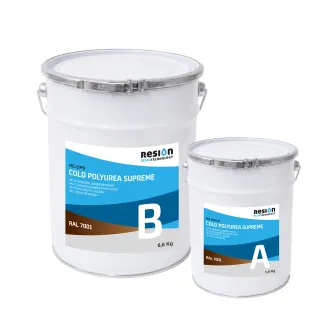
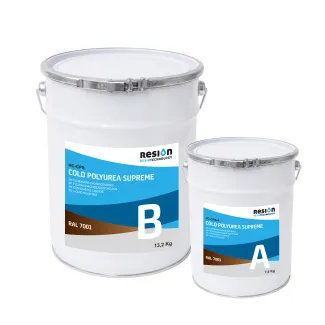
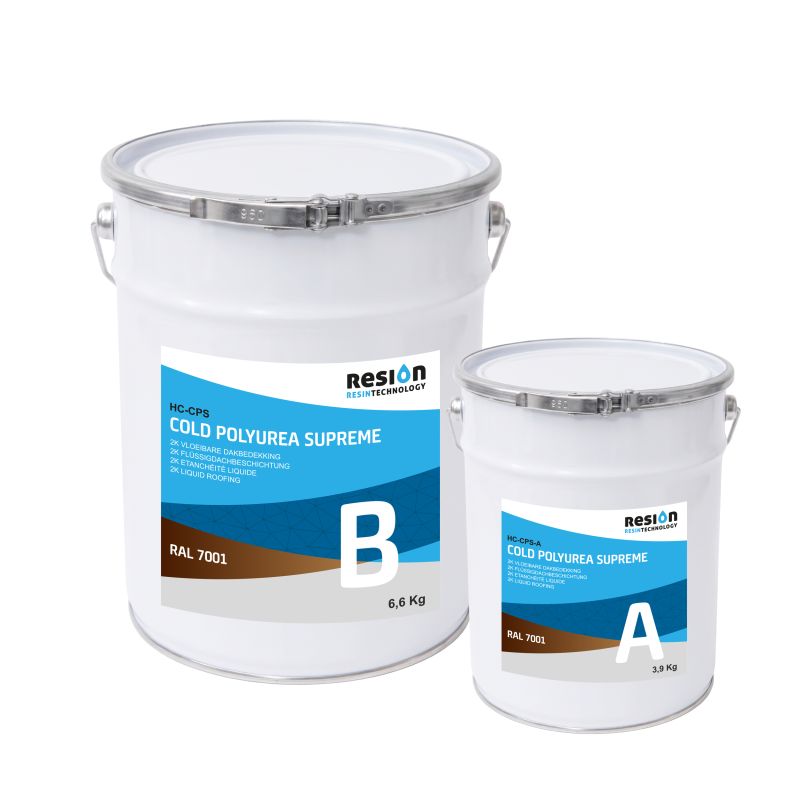
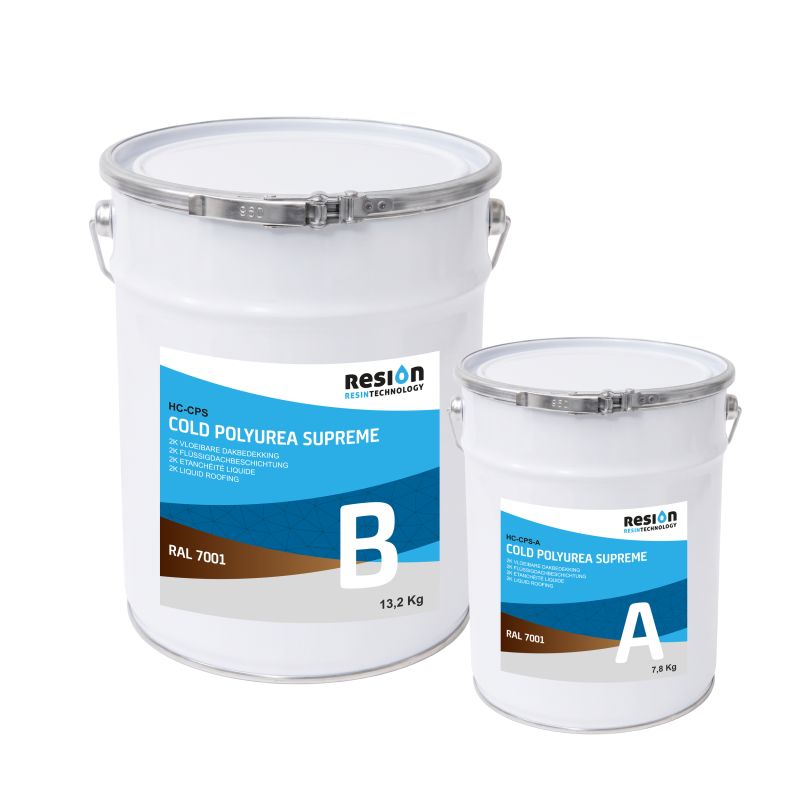

Impermax Cold Polyurea Suprême | RAL 7001 | Base | 3,9 kg
UFI: STD0-A04U-E006-DR7N
Impermax Cold Polyurea Supreme is a two-component liquid roof coating based on polyurea. Once cured, this solvent-free coating forms a seamless, elastic and fully waterproof seal with excellent mechanical and chemical resistance.
The 2K Impermax coating is rain-resistant after approximately 2 hours and can be applied in a single thick layer. This saves application time and makes the system ideal for projects where speed and reliability are important.
Thanks to its unique formulation containing 90% aliphatic components, this system offers an exceptionally long service life, excellent colour retention and outstanding performance under demanding conditions. This cold-applied polyurea combines the advantages of traditional sprayed polyurea with the convenience of manual application. This makes the product ideal for projects where speed, reliability and durability are essential.
Impermax Cold Polyurea Supreme is suitable for various professional applications, including:
Follow the instructions below to apply 2K Impermax correctly. Please note that this product has a very short working time. Keep this in mind and preferably work with several people so that tasks can be divided. Always consult the technical documentation as well.
The set consists of the following products:
| Packaging | Component A | Component B | Coverage |
| 10.5 kg | 3.9 kg | 6.6 kg | approx. 5.25 m2 |
| 21 kg | 7.8 kg | 13.2 kg | approx. 10.5 m2 |
Colour: RAL 7001 (silver grey)
Mixing ratio: 100:170
Consumption: 2 kg/m2 per coat
Working time: 30 minutes (at 20°C)
Curing time: 4 hours (at 20°C)
Application temperature: 5°C–35°C
Relative humidity: maximum 70%
Density: 1.13 g/cm3 (at 25°C)
Viscosity: 3,200 mPa·s (at 25°C)
Hardness: Shore A 70
Elongation at break: >950%
Maximum tensile strength: 12 MPa (EN ISO 527-1/3)
Tear strength: 48 N/m (EN ISO 34-1)
Storage: store between 10°C and 30°C
Shelf life: 12 months
The key technical properties clearly listed in one place.
The recommended application temperature range indicates the conditions under which the product can generally be applied and cured properly. Three temperatures matter:
A cold substrate can cause condensation and affect adhesion. At higher temperatures, two-component products may react faster, reducing their working time. Check the dew point and follow the product instructions.
Density describes the mass of a material per unit volume. Values may be given in g/cm³, kg/L or kg/m³; 1 g/cm³ equals 1 kg/L. For example, one litre of a liquid with a density of 1.2 kg/L weighs approximately 1.2 kg. Density helps convert between weight and volume, but it can vary with temperature.
Hardness describes a material's resistance to indentation. For silicone rubber and other elastomers, the Shore A scale is commonly used: Shore A 15, for example, is softer than Shore A 40. Harder plastics may be rated on the Shore D scale. The number belongs to its Shore scale and is not a unit like MPa; values on different scales cannot be directly compared.
The period for which an unopened product remains usable under the specified storage conditions. Check whether the period starts from the manufacturing date or another date. Shelf life may be shorter after opening, especially for products sensitive to air or moisture.
Humidity during application is given as relative humidity, usually in percent (% RH). It indicates how much water vapour the air contains compared with the maximum it can hold at that temperature. Excessive humidity can interfere with drying or adhesion of some coatings. Also check that the substrate is dry enough and free from condensation.
Mixing ratio indicates how much of each component is needed, for example resin (A) and hardener (B). A ratio of 100:50 by weight means 100 grams of A to 50 grams of B; by volume you might use millilitres. Weight and volume ratios are not necessarily the same because the components may have different densities. Accurate measuring is important for proper curing.
Elongation at break indicates how much a material can stretch during a tensile test before it breaks. It is expressed as a percentage (%) of the original length. At 100% elongation, the material has doubled in length just before breaking. A high value indicates a high ability to deform, but not how much force is needed.
Tear strength describes the force needed to extend an existing tear in a material. For silicone rubber, this matters when a mould is frequently stretched during demoulding. The value is often expressed in N/mm (newtons per millimetre of specimen thickness) or kN/m. These units are equivalent: 1 N/mm = 1 kN/m = 1,000 N/m. Check the unit carefully: a value in N/m is therefore a thousand times smaller than the same number in N/mm. Specimen shape and test method also affect the result.
Tensile strength is the maximum tensile stress a material can withstand during a tensile test before failure. It is usually expressed in MPa (megapascals) or N/mm² (newtons per square millimetre); 1 MPa = 1 N/mm². Under comparable test conditions, a higher value means greater resistance to tension. In composites, fibre orientation also affects the result.
Curing time is the period a product needs to reach a specified stage of cure. It is usually given in hours or days, often at a reference temperature such as 20 °C. A product may be tack-free or safe to handle before reaching its full mechanical and chemical resistance. Film thickness and mixed quantity may also affect the time.
Consumption or coverage describes how much product is needed for a given surface area. Consumption may be stated in g/m² or kg/m², while coverage is often given in m²/L or m²/kg. A consumption of 0.2 kg/m² means a theoretical 200 grams per square metre. Actual use depends on film thickness, substrate absorbency, application method and waste.
Working time is the period during which a product remains workable after mixing or activation, usually given in minutes at a specified temperature, often 20 °C. With reactive resins, the chemical reaction also continues in the mixing container, and larger quantities or higher temperatures can shorten this time. Working time is different from gel time and full curing time.
Viscosity measures how easily a liquid flows, or how thick it is. Dynamic viscosity is usually expressed in mPa·s (millipascal-seconds), sometimes in cP (centipoise); 1 mPa·s = 1 cP. A lower value usually means a more free-flowing liquid, while a higher value indicates a thicker product. Temperature and test method strongly affect the value. Note that mPa·s is different from MPa, which is used to express mechanical strength.
Read the warnings and use appropriate protective equipment before handling the product.
UFI: STD0-A04U-E006-DR7N
UFI: NWD0-T0U7-Q00Q-12TQ