

Farécla G3 Glaze Gloss Enhancer
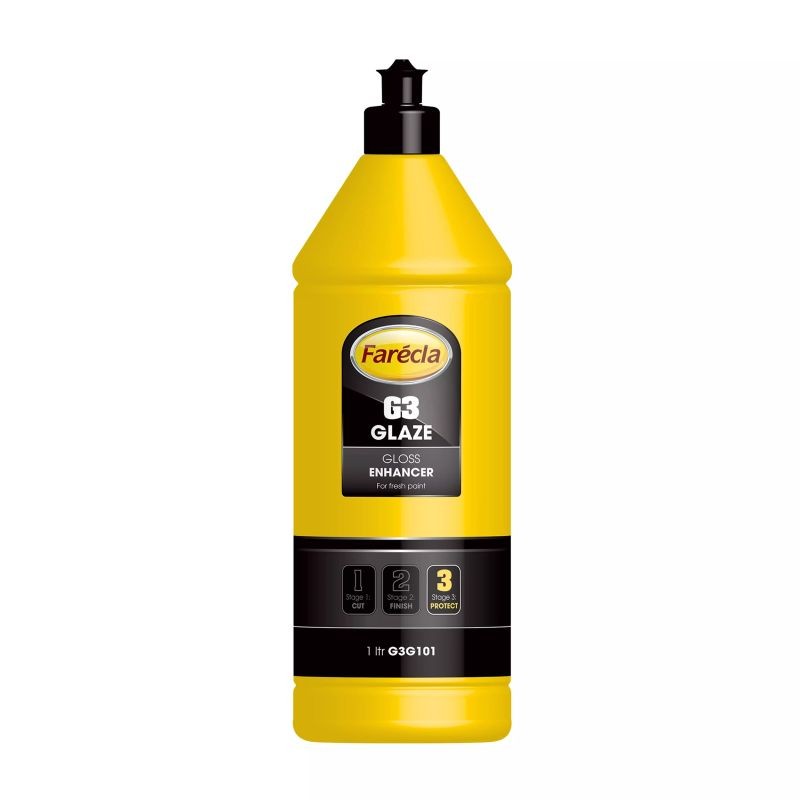
At a glance
- Gloss enhancer
- Fills the smallest scratches
- Gloss restorer
Fast delivery throughout Europe
Secure payment with PayPal, Mastercard, Visa and more
4.7 out of 5 stars on Trusted Shops
Product description
Farécla G3 Glaze Gloss Enhancer is a protective product with excellent filling capabilities for minor scratches and swirls. Leaving extra shine and a protective layer on the surface, it offers a water repellent yet breathable and durable coating on all paint systems.
Benefits of Farécla G3 Glaze Gloss Enhancer
- Rapidly enhances gloss.
- Very economical in use (sustainable).
- Fills the smallest scratches.
- Exceptionally good results on dark paints.
- Water-repellent, protective and breathable.
Farécla G3 Glaze is a professional, silicone-free, water-repellent and breathable gloss restorer that very quickly restores, improves and protects the shine of all types of paint on cars, caravans or other painted surfaces.
Directions for use
The Farécla gloss restorer can only be used by machine in combination with the G Mop Flexible Black Finishing Foam (black).
- Shake the product well before you start.
- Apply a small amount of gloss enhancer to the soft (black) Farécla polishing pad.
- Rub the product without the machine being turned on.
- Polish with the polishing machine at a low speed of 1,000 - 1,500 revolutions.
- Wipe the surface clean with a microfibre cleaning cloth.
Specifications
Contents: 1 litre
Article number: G3G101
pH: 7-8
Colur: blue
Viscosity: medium
Product properties
The key technical properties clearly listed in one place.
- Article number
- POL001703
- Polishing compounds
- Fijn polijstmiddel
- Waxes and sealants
- Wax
-
The manufacturer's range or series to which the product belongs. Products in the same range are often designed to work together, but may differ in composition, processing and intended use.
- G3
-
pH indicates how acidic or alkaline an aqueous solution is and has no unit. A pH of around 7 is neutral; lower values are acidic and higher values are alkaline. The scale is logarithmic: a difference of one pH unit represents approximately a tenfold difference in acidity. pH alone does not fully describe the hazards of a product.
- 7-8
- Net contents
- 1 L
-
Viscosity measures how easily a liquid flows, or how thick it is. Dynamic viscosity is usually expressed in mPa·s (millipascal-seconds), sometimes in cP (centipoise); 1 mPa·s = 1 cP. A lower value usually means a more free-flowing liquid, while a higher value indicates a thicker product. Temperature and test method strongly affect the value. Note that mPa·s is different from MPa, which is used to express mechanical strength.
- Medium
Reviews
Frequently bought together
Useful additions for your project.