
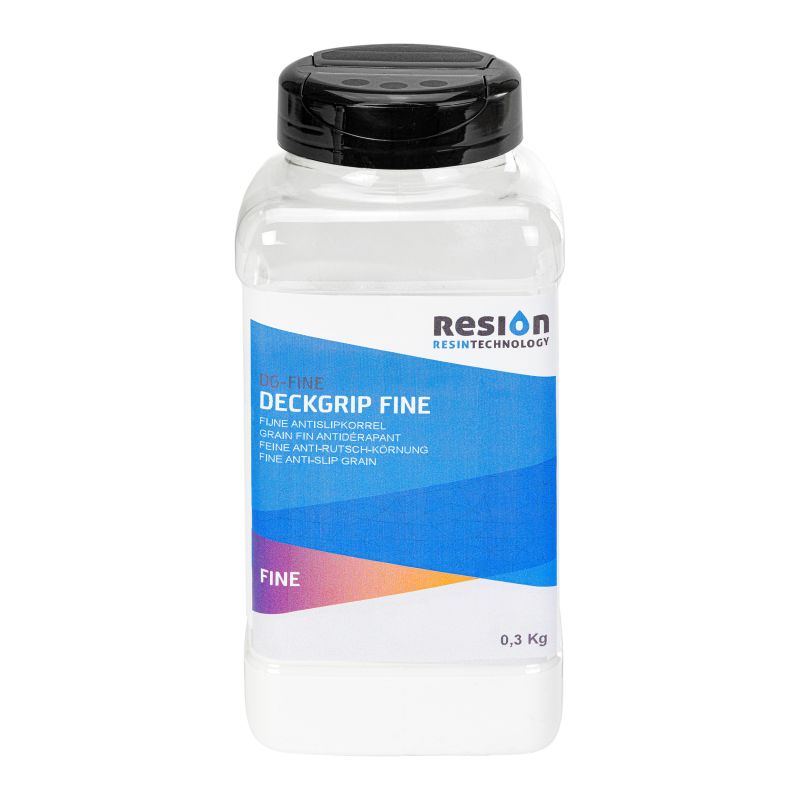
RESION DeckGrip Non-skid Powder
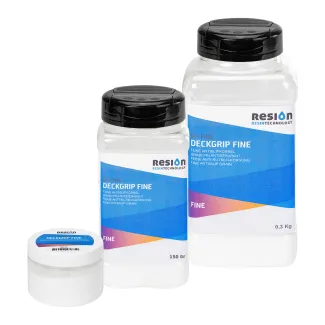
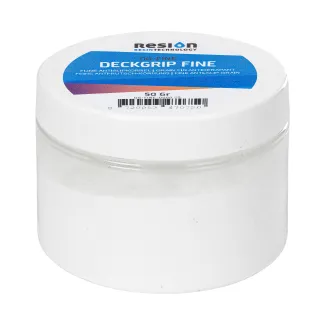
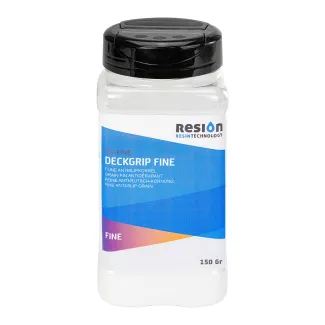
At a glance
- Suitable for boat paints
- Easy processing
- Good non-skid
Fast delivery throughout Europe
Secure payment with PayPal, Mastercard, Visa and more
4.7 out of 5 stars on Trusted Shops
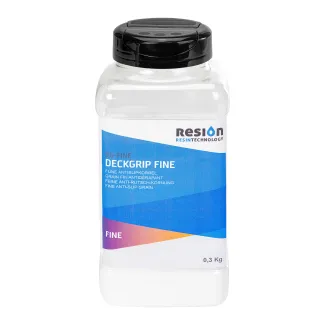
With RESION DeckGrip non-skid powder you can easily create a safe, rough-finished top layer on smooth surfaces. Ideal for boats, decking, surfboards and other places where good grip is important. Add the non-skid powder directly to the paint and apply it according to the processing instructions. The result is a durable non-skid layer that completely blends into the surface.
RESION DeckGrip is suitable as an non-skid powder for DD paint, but also for other boat paints such as Epifanes Mono-urethane, Epifanes Poly-urethane and Epifanes Satin Finish.
Please note: do not apply too much material in one go. This may cause agglomerations.
Benefits of RESION DeckGrip
- Colourless, so the colour of the final coat does not change.
- Very simple and easy to clean.
- Easy to process.
- Suitable for surfaces where an non-skid profile is required, such as decks, gangways, floors in wet areas etc.
Directions for use
Mix approximately 5% DeckGrip non-skid powder by weight into your paint. Then apply the paint as usual. One package is suitable for the following quantities of paint:
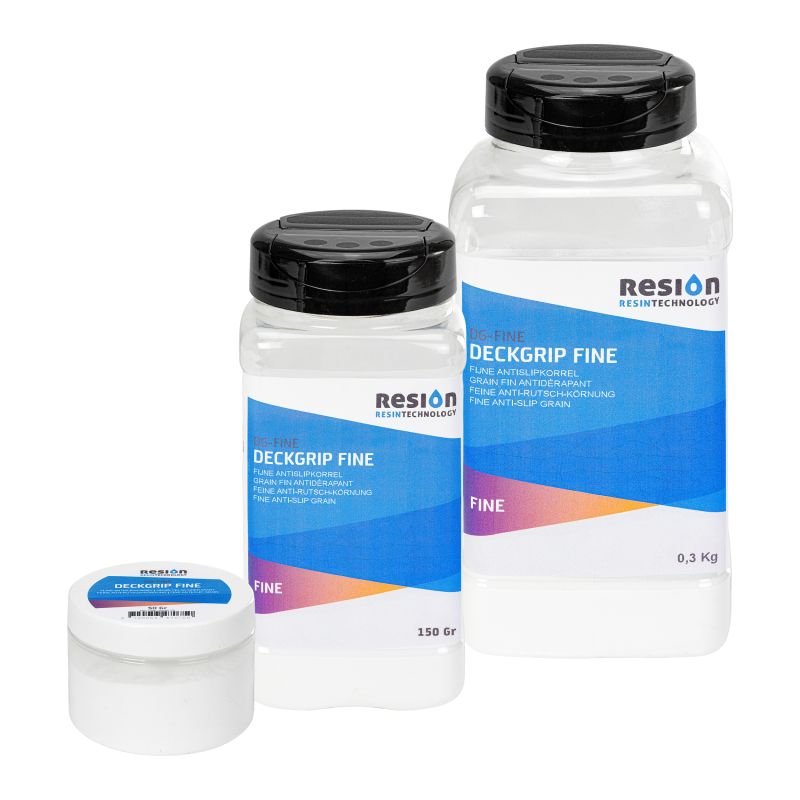
- 50 grams - for approx. 1 kg paint
- 150 grams - for approx. 3 kg paint
- 300 grams - for approx. 6 kg paint
Specifications
Density: approx. 0.9 g/cm3 (mixed)
Solids content: approx. 100 % (volume)
Dosing: approx. 5% by weight
Product properties
The key technical properties clearly listed in one place.
- Article number
- LAK000093
-
The technical product category, such as primer, resin, hardener or cleaner. It explains the product's purpose and helps you find other products with a similar function.
- Anti-slip lacquer, Anti-slip paint
-
Density describes the mass of a material per unit volume. Values may be given in g/cm³, kg/L or kg/m³; 1 g/cm³ equals 1 kg/L. For example, one litre of a liquid with a density of 1.2 kg/L weighs approximately 1.2 kg. Density helps convert between weight and volume, but it can vary with temperature.
- Approximately 0.9 kg/L
-
Dosage indicates how much additive, filler or auxiliary material is added to a base product. It is often given as a percentage (%), grams per kilogram (g/kg) or a ratio between components. Check whether the percentage is based on the resin, hardener or total mixture weight. Adding too much or too little can change the product's properties.
- Approximately 5% (by weight)
-
Solids content is the proportion of material remaining after volatile components have evaporated from a coating. It is stated as a percentage by weight or by volume (%); these are not interchangeable. Volume solids content helps estimate dry film thickness: with 60% volume solids, a 100 µm wet film will theoretically produce approximately 60 µm of dry film.
- Approximately: 100%
- Net contents
- 300 g, 150 g, 50 g
-
Grit size affects how much material an abrasive removes and how fine the resulting scratch pattern is. On the FEPA-P scale, the higher the P number, the finer the abrasive grit.
- P60-P80: coarse sanding, stripping old coatings or removing pronounced unevenness.
- P120-P180: further levelling and intermediate sanding.
- P240-P400: finer sanding before the next finishing stage.
- P600 and finer: very fine sanding or preparation for polishing, depending on the material.
These are general guidelines. Choose the grit based on the substrate, desired finish and instructions for the next coat. Different grit grading standards are not always directly comparable.
- Fine, Coarse
- Colour
- Transparant
Reviews
Frequently bought together
Useful additions for your project.

Recommended

Recommended

Often chosen
