GLOO ARS1125 Epoxy Adhesive
At a glance
- Alternative for Araldite 2011
- Long processing time
- Epoxy adhesive

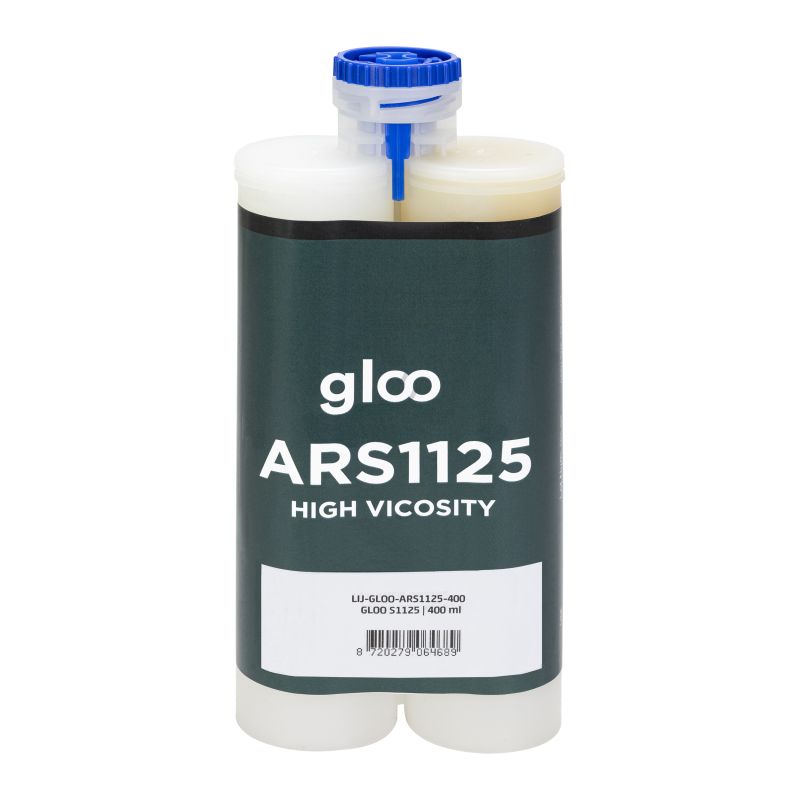
GLOO ARS1125 is a two-component epoxy adhesive. This alternative for Araldite 2011 has a 1:1 mix ratio and offers a long working time. GLOO ARS1125 is highly suitable for bonding metals (under heat curing conditions) and a wide range of plastics.
Features
- Long working time.
- Good resistance to dynamic loads.
- Low shrinkage.
Applications
GLOO ARS1125 is suitable for bonding the following applications:
- Ferrous metals and aluminium, copper, zinc and galvanised products.
- Polystyrene foam and polyurethane foams.
- Ceramic materials, wood, glass fibre-reinforced plastics and epoxy resins.
- Fibre-reinforced polyester and thermosetting composites, acrylates and polycarbonate.
- Rubber materials and glass, quartz and gemstones.
- Applications subject to dynamic loads.
- Bearings, electronics components and printed circuit boards.
- Potting of sensors.
- Grinding stones.
Directions for use
Before bonding, it is important that the surface is dry, grease-free and dust-free. If necessary, the surface can be roughened using P40–P280 sandpaper. Remove any dust and degrease the surface again. Wear gloves to avoid skin contact. Remove the cap from the cartridge and dispense a small amount of adhesive onto a piece of cardboard until both components flow evenly. Close the packaging immediately after use. After approximately 12 hours, the product can be machined (sanded, painted, etc.).
Specifications
Packaging: 50 ml & 400 ml
Colour: beige
Mix ratio: 1:1
Glass Transition Temperature (Tg): 53 - 61°C
Pot life: >60 minutes
Gel time: 254 minutes
Cure time: 12 hours
Application gun: Application gun LS50-1 (50 ml)
Mixing tubes: Mixing nozzle C (50 ml)
Product properties
The key technical properties clearly listed in one place.
- Article number
- LIJ001742
-
Adhesive type describes the family of adhesive or sealant, such as epoxy adhesive, (methyl)methacrylate adhesive, polyurethane adhesive or polymer sealant. Its chemistry affects processing, curing, flexibility and adhesion. Products of the same type may still differ, so check the suitable substrates and application instructions.
- Epoxylijm
-
Open time is the period during which an applied adhesive, sealant or mortar can still be assembled, positioned or adjusted. It is usually given in minutes under specified conditions, often around 20 or 23 °C. Open time generally starts at application and may differ from the working time after mixing.
- 30 tot 60 minuten
-
Heat resistance describes the temperature a material can withstand after correct processing and curing, usually expressed in degrees Celsius (°C). Continuous exposure is different from a brief temperature peak, and mechanical loading may also affect the limit. Heat resistance is not the same as the temperature at which the product can be applied.
- Tot 80 graden
- Colour
- Beige
-
Gel time is the period between mixing a reactive product and the point at which it starts to change from a liquid into a gel. It is usually given in minutes at a specified temperature, such as 20 or 23 °C. Higher temperatures or larger mixed quantities can shorten gel time. Once gelation begins, resin is generally difficult to pour or spread.
- 254 minutes
-
Curing time is the period a product needs to reach a specified stage of cure. It is usually given in hours or days, often at a reference temperature such as 20 °C. A product may be tack-free or safe to handle before reaching its full mechanical and chemical resistance. Film thickness and mixed quantity may also affect the time.
- 12 hours
- Net contents
- 400 ml, 50 ml
-
Working time is the period during which a product remains workable after mixing or activation, usually given in minutes at a specified temperature, often 20 °C. With reactive resins, the chemical reaction also continues in the mixing container, and larger quantities or higher temperatures can shorten this time. Working time is different from gel time and full curing time.
- More than 60 minutes