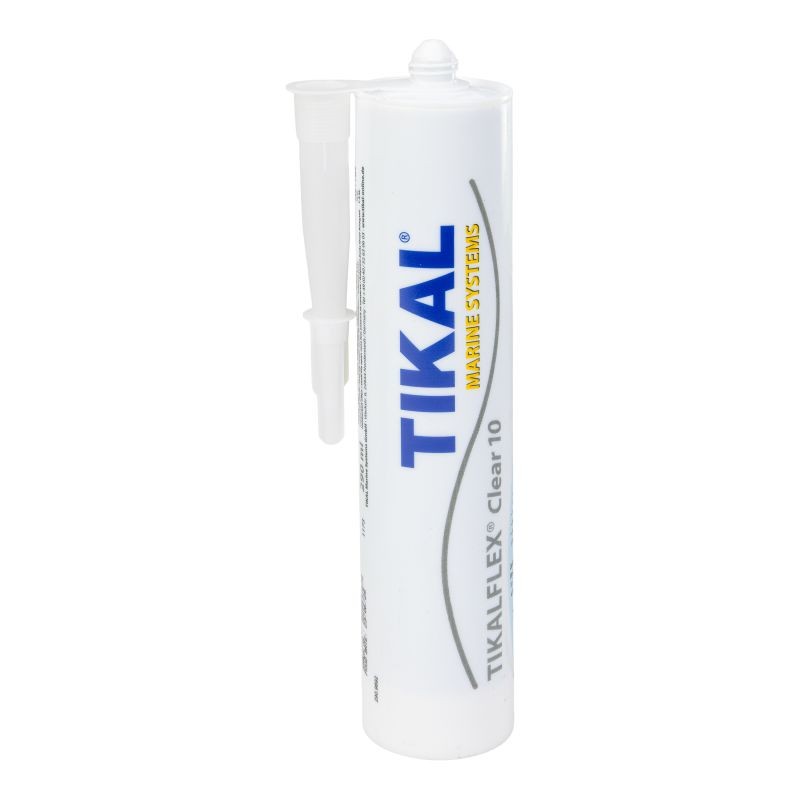
Tikalflex Clear 10 Adhesive Sealant
At a glance
- 1-component adhesive
- Very strong bonding
- Transparent
Fast delivery throughout Europe
Secure payment with PayPal, Mastercard, Visa and more
4.7 out of 5 stars on Trusted Shops
Product description
Tikalflex Clear 10 is a transparent, high-performance MS-polymer adhesive sealant developed for bonding and sealing glass, acrylic (PMMA), polycarbonate and PVC to substrates such as steel, aluminium, GRP and wood. This adhesive meets the high standards required in the construction and yacht building industries and offers excellent initial strength combined with long-lasting elasticity.
Tikalflex Clear 10 provides strong adhesion to a wide range of materials and even cures on damp substrates and under water.
Features of Tikalflex Clear 10
- Odour- and solvent-free.
- Excellent adhesion to wet surfaces.
- Weather-resistant (not UV-resistant).
- Isocyanate-free.
- Elastic after curing.
- High initial strength.
- Paintable.
Applications
You can use Tikalflex sealant for the following applications:
- Bonding vibrating constructions such as metal structures, containers, wagons, ships, caravans and vehicle bodies.
- Bonding and sealing natural stone and mirrors.
- Sealing slightly moving joints, construction seams and joints in wet areas.
- Bonding and sealing countertops and sinks.
- Structural bonding in (prefab) construction, including bonding of façade panels, window sills, insulation boards, tiles etc.
Specifications
Contents: 290 ml cartridge
Colour: transparent
Adheres to: polyester, epoxy, stone, concrete, mortar, glass, mirrors, metal, anodised or painted aluminum, galvanised steel, copper, brass, (hard) PVC, natural stone, wood etc.
Chemical base: MS-polymer
Density: 1.01 g/ml
Processing temperature: 0-40°C
Skin formation time: 15 minutes (at 23°C)
Application method: caulking gun for 290-310 ml cartridges
Temperature resistance: -40°C to +90°C
Shelf life: 18 months when stored at 5-25°C
Product properties
The key technical properties clearly listed in one place.
- Article number
- LIJ000565
- Colour
- Transparant
-
Adhesive type describes the family of adhesive or sealant, such as epoxy adhesive, (methyl)methacrylate adhesive, polyurethane adhesive or polymer sealant. Its chemistry affects processing, curing, flexibility and adhesion. Products of the same type may still differ, so check the suitable substrates and application instructions.
- Polymeerkit
-
The recommended application temperature range indicates the conditions under which the product can generally be applied and cured properly. Three temperatures matter:
- Air: the temperature in the workshop or outdoors.
- Substrate: the temperature of the surface being treated.
- Product: the temperature of the resin, adhesive or coating itself.
A cold substrate can cause condensation and affect adhesion. At higher temperatures, two-component products may react faster, reducing their working time. Check the dew point and follow the product instructions.
- 0-40 °C
-
The chemical base describes the chemistry of an adhesive, sealant, resin or coating, such as epoxy, polyester, polyurethane, (methyl)methacrylate or a hybrid polymer. It affects curing, flexibility and adhesion. Products with the same chemical base are not necessarily suitable for the same applications.
- MS polymer
-
Density describes the mass of a material per unit volume. Values may be given in g/cm³, kg/L or kg/m³; 1 g/cm³ equals 1 kg/L. For example, one litre of a liquid with a density of 1.2 kg/L weighs approximately 1.2 kg. Density helps convert between weight and volume, but it can vary with temperature.
- 1.01 g/ml
-
This property lists the substrates on which an adhesive, resin or coating can achieve strong adhesion according to the product information. The result also depends on surface preparation.
- Cleaning and degreasing: removes dirt, oil and other substances that interfere with bonding.
- Sanding or roughening: can improve adhesion when suitable for the substrate.
- Primer: required or recommended for some surfaces.
Materials such as PE, PP and PTFE are difficult to bond with many conventional adhesives and may need a specialist adhesive or pretreatment. If in doubt, test adhesion on a small area.
- Epoxy, Anodised aluminium, Painted aluminium, Rigid PVC, Metal, Mortar, Natural stone, Polyester, Mirrors
-
The period for which an unopened product remains usable under the specified storage conditions. Check whether the period starts from the manufacturing date or another date. Shelf life may be shorter after opening, especially for products sensitive to air or moisture.
- 18 months
-
The time after application during which a skin forms on the surface of a sealant. Tool the joint before the skin develops, as adjusting it afterwards can affect the finish or adhesion. Temperature and humidity influence this time.
- 15 minutes (23 °C)
- Net contents
- 290 ml
-
Heat resistance describes the temperature a material can withstand after correct processing and curing, usually expressed in degrees Celsius (°C). Continuous exposure is different from a brief temperature peak, and mechanical loading may also affect the limit. Heat resistance is not the same as the temperature at which the product can be applied.
- -40 to 90 °C
Reviews
Frequently bought together
Useful additions for your project.