

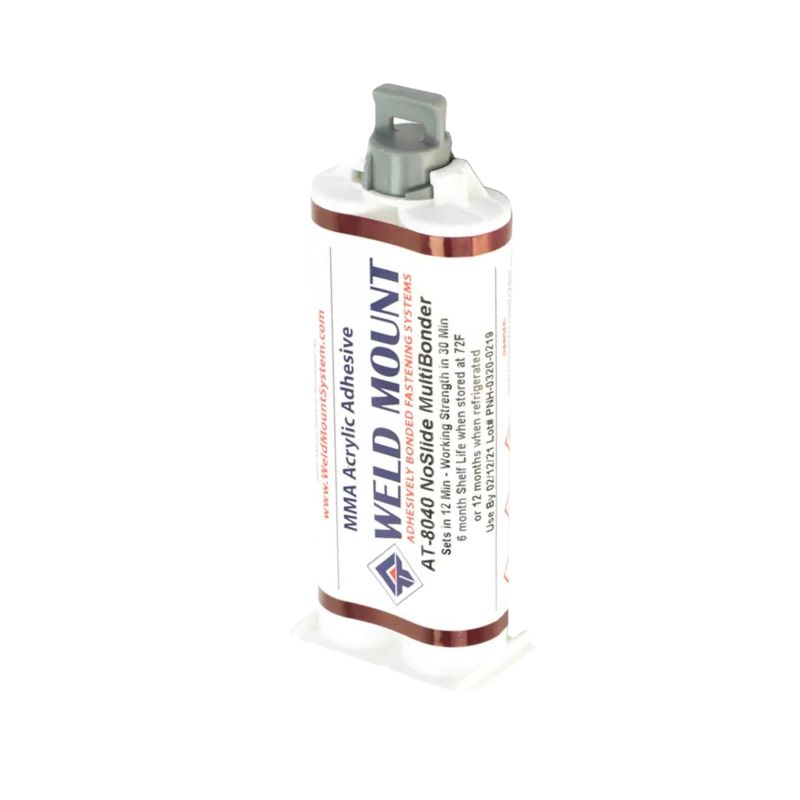
Weld Mount AT-8040 Methacrylate Adhesive
At a glance
- No surface preparation required
- Very high viscosity
- REACH compliant
Fast delivery throughout Europe
Secure payment with PayPal, Mastercard, Visa and more
4.7 out of 5 stars on Trusted Shops
Weld Mount AT-8040 is a structural methacrylate adhesive developed for the durable bonding of plastics, composites, and metals. Thanks to its 1:1 mix ratio and easy application from a cartridge with a static mixing nozzle, this adhesive is ideal for both professional applications and high-volume production environments.
Weld Mount AT-8040 provides excellent adhesion to a wide range of materials, including aluminium, galvanised steel, stainless steel, ABS, PVC, acrylic, polycarbonate and fibreglass-reinforced composites. In many cases, no surface preparation, primer or solvent cleaner is required to achieve a strong bond. The adhesive offers a working time of approximately 3 to 4 minutes, allowing components to be positioned and secured quickly. Its thixotropic, non-sag formulation ensures that the adhesive remains in place on vertical and overhead surfaces. This makes AT-8040 particularly suitable for bonding Weld Mount fastening systems, anchor studs, cable clips and other mounting components to walls and ceilings.
In addition to high tensile and shear strength, the adhesive provides excellent impact resistance and peel strength, even at low temperatures. The formula is REACH-compliant and acid-free.
Benefits of Weld Mount AT-8040
- Excellent adhesion without the need for primer or surface preparation.
- REACH compliant and acid-free.
- High-viscosity, non-sag formula, ideal for vertical and overhead applications.
- Suitable for the structural bonding of plastics, composites and metals.
- Suitable for aluminium, stainless steel, galvanised steel, ABS, PVC, acrylic and polycarbonate.
- Easy to apply using a static mixing nozzle.
Applications
- Installation of Weld Mount fastening systems.
- Bonding of anchor studs, clips and cable mounting systems.
- Structural bonding in composite, automotive, marine and industrial applications.
- Bonding metals and plastics without drilling or welding.
Technical specifications
Adhesive type: methacrylate
Colour: amber
Packaging: 50 ml, 400 ml
Mix ratio: 1:1
Specific gravity: 1.03 g/cm³
Shear strength: 22 MPa
Peel strength: 11.4 N/mm
Working time: 3-4 minutes
Minimum fixture time: 5-6 minutes
75% cure: after 1 hour
Full cure: after 24 hours
Temperature range: -40 °C to 125 °C
Shelf life: 6 months when stored at 20 °C, or up to 12 months when refrigerated.
Product properties
The key technical properties clearly listed in one place.
- Article number
- LIJ002347
-
Adhesive type describes the family of adhesive or sealant, such as epoxy adhesive, (methyl)methacrylate adhesive, polyurethane adhesive or polymer sealant. Its chemistry affects processing, curing, flexibility and adhesion. Products of the same type may still differ, so check the suitable substrates and application instructions.
- Methyl Methacrylaatlijm
-
Open time is the period during which an applied adhesive, sealant or mortar can still be assembled, positioned or adjusted. It is usually given in minutes under specified conditions, often around 20 or 23 °C. Open time generally starts at application and may differ from the working time after mixing.
- 1 tot 10 minuten
- Colour
- Rood
-
Gap-filling capability describes how wide a gap or joint an adhesive or sealant can bridge, usually in millimetres (mm). The stated maximum is not necessarily the recommended adhesive layer thickness: a narrower joint may be needed to achieve good bond strength.
- tot 1mm (dunvloeibaar)
-
Heat resistance describes the temperature a material can withstand after correct processing and curing, usually expressed in degrees Celsius (°C). Continuous exposure is different from a brief temperature peak, and mechanical loading may also affect the limit. Heat resistance is not the same as the temperature at which the product can be applied.
- -40 to 125 °C
-
This property lists the substrates on which an adhesive, resin or coating can achieve strong adhesion according to the product information. The result also depends on surface preparation.
- Cleaning and degreasing: removes dirt, oil and other substances that interfere with bonding.
- Sanding or roughening: can improve adhesion when suitable for the substrate.
- Primer: required or recommended for some surfaces.
Materials such as PE, PP and PTFE are difficult to bond with many conventional adhesives and may need a specialist adhesive or pretreatment. If in doubt, test adhesion on a small area.
- Aluminium, Verzinkt staal, Staal, Roestvast staal (RVS), PVC, ABS, Plexiglas (PMMA), Polycarbonaat (PC), Koolstof/Epoxy (CFRP), Polyester (FRP)
-
Peel strength describes the force required to progressively separate an adhesive joint or tape by peeling the bonded parts apart. It is often expressed in N/mm: newtons per millimetre of bonded width. A higher value indicates greater resistance to peeling under the test conditions. Peel angle, substrate and test method affect the result. N/mm is not the same as N/mm².
- 11.4 N/mm
-
Shear strength indicates how much stress a bonded joint can withstand when forces try to slide the joined parts parallel to the bond line. It is usually expressed in MPa (megapascals) or N/mm² (newtons per square millimetre): 1 MPa = 1 N/mm². A value of 20 MPa therefore represents a test stress of 20 N/mm². Substrate, overlap, adhesive thickness and test conditions affect the measured strength.
- 22 MPa
-
Density describes the mass of a material per unit volume. Values may be given in g/cm³, kg/L or kg/m³; 1 g/cm³ equals 1 kg/L. For example, one litre of a liquid with a density of 1.2 kg/L weighs approximately 1.2 kg. Density helps convert between weight and volume, but it can vary with temperature.
- 1.03 kg/L
-
The period for which an unopened product remains usable under the specified storage conditions. Check whether the period starts from the manufacturing date or another date. Shelf life may be shorter after opening, especially for products sensitive to air or moisture.
- 6 months (at 20 °C; maximum 12 months refrigerated)
-
Curing time is the period a product needs to reach a specified stage of cure. It is usually given in hours or days, often at a reference temperature such as 20 °C. A product may be tack-free or safe to handle before reaching its full mechanical and chemical resistance. Film thickness and mixed quantity may also affect the time.
- 1 day
- Net contents
- 400 ml, 50 ml
-
Working time is the period during which a product remains workable after mixing or activation, usually given in minutes at a specified temperature, often 20 °C. With reactive resins, the chemical reaction also continues in the mixing container, and larger quantities or higher temperatures can shorten this time. Working time is different from gel time and full curing time.
- Approximately 3-4 minutes
Reviews
Frequently bought together
Useful additions for your project.

