Geen
UFI: 5880-C0MR-7006-6XPU
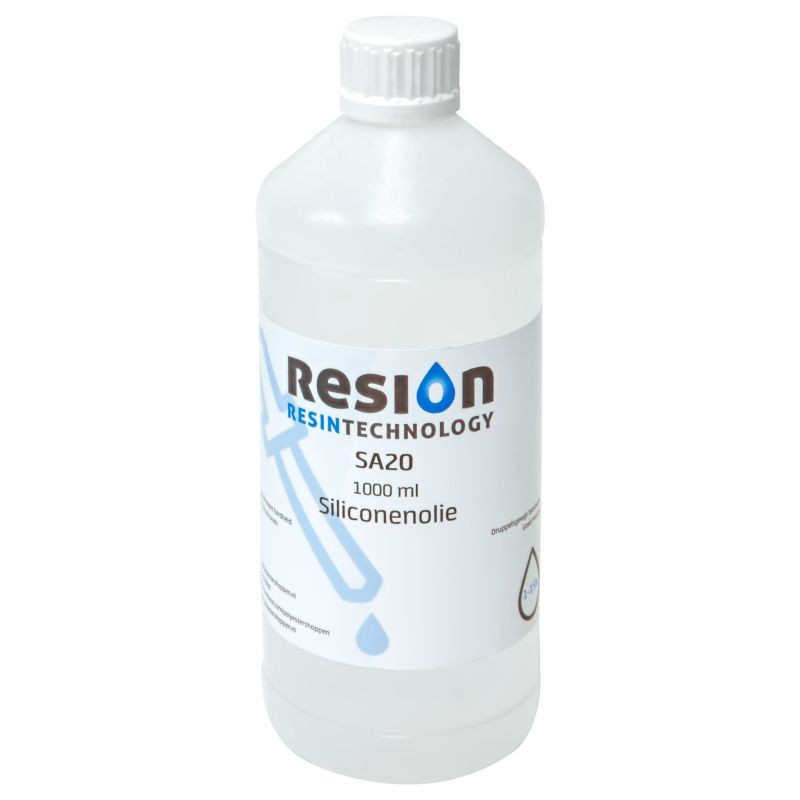
Silicone oil is a diluent for silicone rubber. Silicone rubber can be used to cast candles, chocolate and chess pieces, among other things. Adding this silicone oil results in a more fluid product with a lower shore hardness after curing. The more oil you add, the more flexible the end result will be. A complex shape such as a chess piece can be cast in a more flexible silicone than a simpler shape such as a candle.
Mix the silicone oil into the A component, preferably mechanically, and allow it to rest to allow air bubbles to escape. Then add the B component and pour the silicone rubber.
You can buy RESION silicone oil easily online at Polyestershoppen.com. If you order before 5 pm CET (Central European Time), your order will be shipped the same day! Do you need help buying silicone oil or do you have any questions about the use of this product? Then feel free to contact one of our professionals by calling +3185 0220090 or sending an e-mail to support@polyestershoppen.com.
The key technical properties clearly listed in one place.
The technical product category, such as primer, resin, hardener or cleaner. It explains the product's purpose and helps you find other products with a similar function.
Dosage indicates how much additive, filler or auxiliary material is added to a base product. It is often given as a percentage (%), grams per kilogram (g/kg) or a ratio between components. Check whether the percentage is based on the resin, hardener or total mixture weight. Adding too much or too little can change the product's properties.
The period for which an unopened product remains usable under the specified storage conditions. Check whether the period starts from the manufacturing date or another date. Shelf life may be shorter after opening, especially for products sensitive to air or moisture.
Viscosity measures how easily a liquid flows, or how thick it is. Dynamic viscosity is usually expressed in mPa·s (millipascal-seconds), sometimes in cP (centipoise); 1 mPa·s = 1 cP. A lower value usually means a more free-flowing liquid, while a higher value indicates a thicker product. Temperature and test method strongly affect the value. Note that mPa·s is different from MPa, which is used to express mechanical strength.
Flash point is the lowest temperature at which a liquid releases enough vapour, under specified test conditions, to ignite briefly in the presence of an ignition source. It is usually given in degrees Celsius (°C). Flash point is not the same as autoignition temperature and does not provide a complete assessment of the product's hazards.
Density describes the mass of a material per unit volume. Values may be given in g/cm³, kg/L or kg/m³; 1 g/cm³ equals 1 kg/L. For example, one litre of a liquid with a density of 1.2 kg/L weighs approximately 1.2 kg. Density helps convert between weight and volume, but it can vary with temperature.
Read the warnings and use appropriate protective equipment before handling the product.
UFI: 5880-C0MR-7006-6XPU
Useful additions for your project.