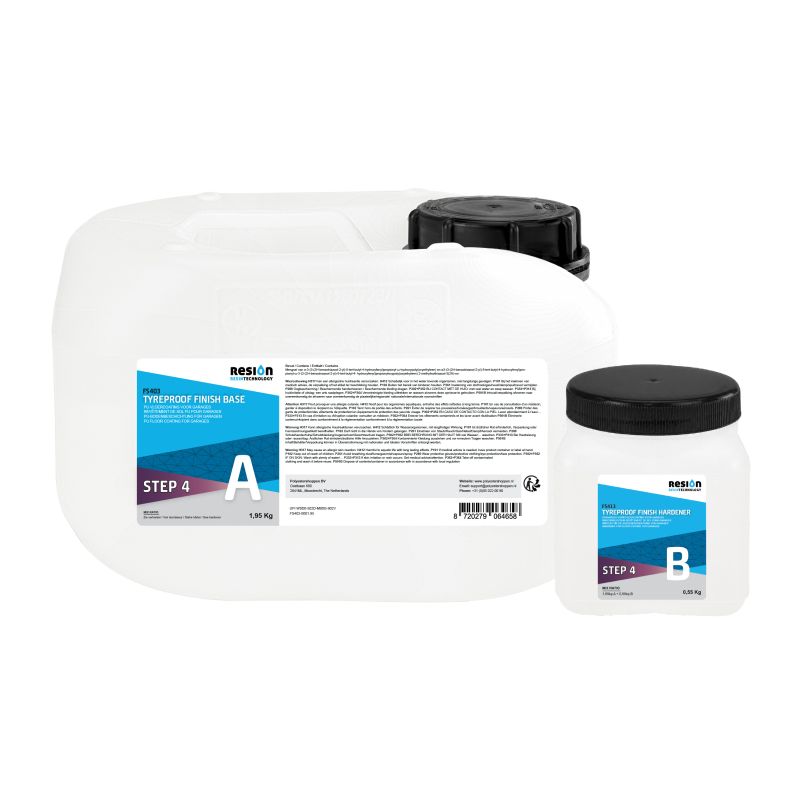

RESION PU Tyre Proof Finish
At a glance
- PU topcoat for resin floors
- Resistant to tyre marks
- Non-yellowing
RESION Tyre Proof Finish is a two-component, water-based, highly durable polyurethane topcoat. This strong PU satin coating extends the lifespan of your epoxy or PU cast floor and increases resistance to chemicals (hair dye, cleaning products, etc.) and plasticizers (for example, from rubber).
PU Tyre Proof Finish is stronger than RESION PU Matt Floor Finish, making it suitable for both indoor and outdoor applications. The polyurethane coating is also resistant to rubber migration from car tyres. Finishing your cast floor with this clear coating also reduces dirt adhesion and simplifies maintenance.
Features of RESION PU Tyre Proof Finish
- Highly abrasion-resistant PU floor coating.
- Suitable as a topcoat for epoxy and PU cast floors.
- Resistant to car tyres, chemicals and plasticizers.
- Water-based with a low VOC content.
- Non-yellowing (aliphatic).
- Transparent finish (satin gloss).
- Easy to clean.
Directions for use
Before you begin, it is important that the substrate is properly pre-treated. The substrate must be sound and have sufficient compressive strength (at least 25 N/mm2), with a minimum bond strength of 1.5 N/mm2. The substrate must be clean, dry, and free of dirt, oil, grease, and other contaminants. If the substrate is more than 48 hours old, an adhesion test should always be performed. Then follow the instructions below to correctly apply RESION PU Tyre Proof Finish:
- Add component B to component A while stirring.
- Mix thoroughly for approximately 3 minutes to obtain a homogeneous mixture. Also scrape the bottom and sides of the container.
- Allow the mixture to pre-react for 10 minutes.
- Pour the mixture through the provided sieve into a clean bucket and mix thoroughly for another minute to avoid unmixed parts.
Tip: make sure the mixing paddle is completely below the liquid level. Always mix at the highest possible speed to ensure the best possible emulsification. While mixing, a vortex should form in the bucket, but under no circumstances should the coating splash or entrain air. Continue mixing at low speed as soon as this happens.
- After mixing, you have a processing time of approximately 30 minutes at a temperature of 20°C.
- Pour the mixed components into a paint tray.
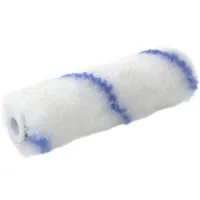
- Apply the coating evenly using a velour roller.
- Work quickly and apply wet-on-wet. Do not work too far ahead to prevent the coating from drying.
- Try to reduce draughts to a minimum during application (keep windows and doors closed). After applying the coating, it is important to ensure adequate ventilation to avoid surface defects.
- Allow the polyurethane coating to cure after application (see technical properties for curing times).
- For increased abrasion resistance and additional UV protection, you can apply an additional coat of Tyre Proof Finish after 24 hours and within 48 hours. The coating can be topcoated with an additional coat of Coating PU TR.
Dew point: also be careful of condensation. The temperature of the substrate and the uncured material must be at least 3ºC above the dew point to avoid the risk of condensation or whitening of the finish.
Specifications
| Contents | Coverage | Basis (FS403) | Hardener (FS413) |
| 2.5 kg | 15-20 m2 | 1.95 kg | 0.55 kg |
Mixing ratio by weight: 78:22
Working time: 30 minutes (at 20 °C)
Dust dry: after 24 hours (at 20 °C)
Walkable: after 48 hours (at 20 °C)
Suitable for light traffic: after 72 hours (at 20 °C)
Fully cured: after 7 days (at 20 °C)
Consumption: 125-150 gr/m2
Solids content: approx. 38 %
Viscosity: 1,200-1,400 mPa.s
Persoz hardness: > 250
Density: 1.04 g/cm3
Abrasion resistance: 50 mg
Adhesion: > 1.5 (concrete fracture)
Shelf life: up to 6 months from production date in original, sealed, unopened and undamaged packaging, stored in dry conditions between +5 ºC and +30 ºC.
Product properties
The key technical properties clearly listed in one place.
- Article number
- VLO001719
-
The technical product category, such as primer, resin, hardener or cleaner. It explains the product's purpose and helps you find other products with a similar function.
- Topcoating
-
The resin family or system that a hardener, additive or reinforcement material can be combined with, such as epoxy, polyester or vinyl ester. Compatibility depends on the complete system, not just the general resin type.
- Polyurethaan (PU)
-
The waiting time before a coating, floor or bonded joint can withstand a specified load, such as light foot traffic or gentle handling. Resistance often increases as curing continues; full mechanical and chemical resistance may be reached later.
- Foot traffic: 2 days (20 °C), Light loading: 3 days (20 °C)
-
Mixing ratio indicates how much of each component is needed, for example resin (A) and hardener (B). A ratio of 100:50 by weight means 100 grams of A to 50 grams of B; by volume you might use millilitres. Weight and volume ratios are not necessarily the same because the components may have different densities. Accurate measuring is important for proper curing.
- 78:22 (by weight)
-
A paint or varnish layer is dust-dry when settling dust is less likely to stick to the surface. It may not yet be touch-dry, ready for overcoating or suitable for loading; these are different stages of drying and curing.
- 1 day (20 °C)
-
Curing time is the period a product needs to reach a specified stage of cure. It is usually given in hours or days, often at a reference temperature such as 20 °C. A product may be tack-free or safe to handle before reaching its full mechanical and chemical resistance. Film thickness and mixed quantity may also affect the time.
- 7 days (20 °C)
-
Solids content is the proportion of material remaining after volatile components have evaporated from a coating. It is stated as a percentage by weight or by volume (%); these are not interchangeable. Volume solids content helps estimate dry film thickness: with 60% volume solids, a 100 µm wet film will theoretically produce approximately 60 µm of dry film.
- Approximately: 38%
-
Consumption or coverage describes how much product is needed for a given surface area. Consumption may be stated in g/m² or kg/m², while coverage is often given in m²/L or m²/kg. A consumption of 0.2 kg/m² means a theoretical 200 grams per square metre. Actual use depends on film thickness, substrate absorbency, application method and waste.
- 125-150 g/m²
- Net contents
- 2.5 kg
-
Working time is the period during which a product remains workable after mixing or activation, usually given in minutes at a specified temperature, often 20 °C. With reactive resins, the chemical reaction also continues in the mixing container, and larger quantities or higher temperatures can shorten this time. Working time is different from gel time and full curing time.
- Approximately 30 minutes (at 20 °C)
-
Viscosity measures how easily a liquid flows, or how thick it is. Dynamic viscosity is usually expressed in mPa·s (millipascal-seconds), sometimes in cP (centipoise); 1 mPa·s = 1 cP. A lower value usually means a more free-flowing liquid, while a higher value indicates a thicker product. Temperature and test method strongly affect the value. Note that mPa·s is different from MPa, which is used to express mechanical strength.
- 1.200-1.400 mPa·s
Safety information
Read the warnings and use appropriate protective equipment before handling the product.
FS413 | PU TyreProof Finish | Hardener | 0,55 kg
Recommended protective equipment
Hazard pictograms
Warnings and precautions
Reviews
Frequently bought together
Useful additions for your project.