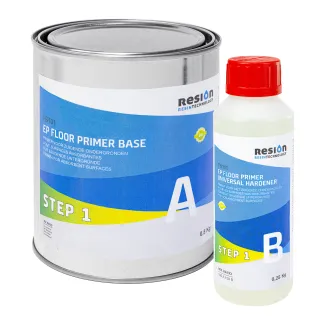
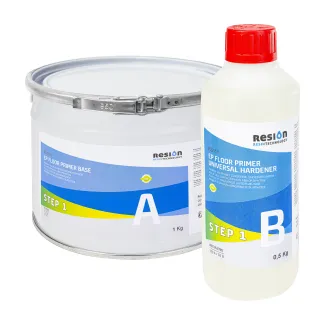
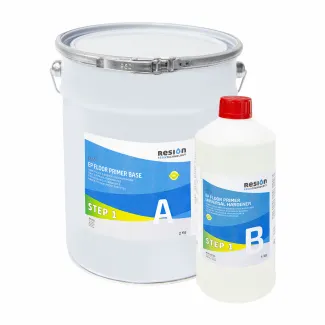
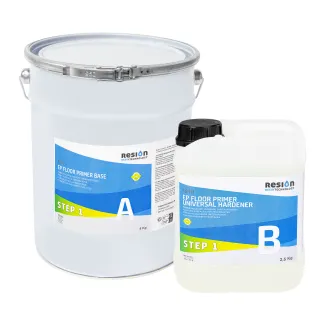
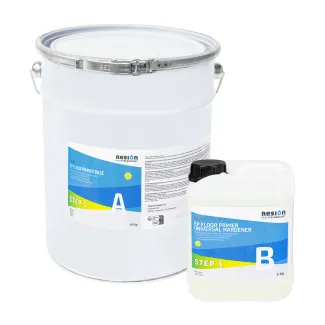
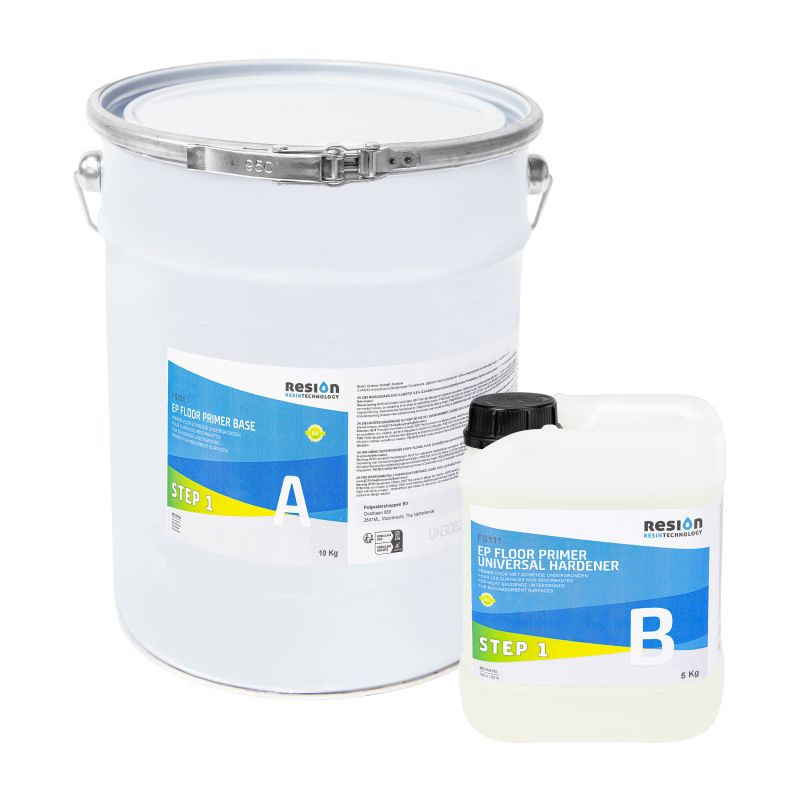

Epoxy floor primer for dry substrates
At a glance
- For porous substrates
- For cement, concrete and wood
- Virtually odourless
This epoxy floor primer has been specially developed to improve adhesion on porous substrates such as sand-cement screeds, wood, concrete and anhydrite. The solvent-free epoxy primer reduces the absorbency of the substrate, allowing you to easily apply a RESION flooring system of your choice.
Suitable substrates
Use this epoxy floor primer exclusively on dry, porous substrates, including:
- Anhydrite
- Concrete
- Sand-cement screeds
- Screed
- Stone
- Wood
Colour options
The epoxy floor primer is available as standard in clear or white. Are you applying an epoxy floor coating in a light colour? We recommend using the white primer. This white variant provides better coverage and prevents the substrate from showing through.
For polyurethane or epoxy resin floors, a coloured primer is usually not necessary. Due to their thicker build-up, these flooring systems generally already provide sufficient coverage.
Would you still like a primer in a specific colour? You can easily tint the primer using epoxy pigments in almost any desired RAL colour.
How to apply the epoxy floor primer SF
Follow the instructions below to apply the floor primer:
- Weigh component A (base) and component B (hardener) in a 100:50 ratio by weight. Mix thoroughly until a clear, homogeneous liquid is obtained. Smaller sets can be mixed in a mixing cup while larger containers provide sufficient space to add component B directly to component A and mix using a spiral mixer.
- After mixing, immediately pour the floor primer onto the substrate. The pot life is approximately 30 minutes, so work quickly and methodically.
- Spread the primer using a floor squeegee and avoid puddle formation. Then cross-roll the primer using a nylon fleece roller to create an even, puddle-free finish.
-
The primer is walkable after approximately 16 hours and can then be overcoated with a flooring system of your choice.
For best results, we recommend working with two people.
Properties
| Packaging | Base (FS101) | Hardener (FS111) |
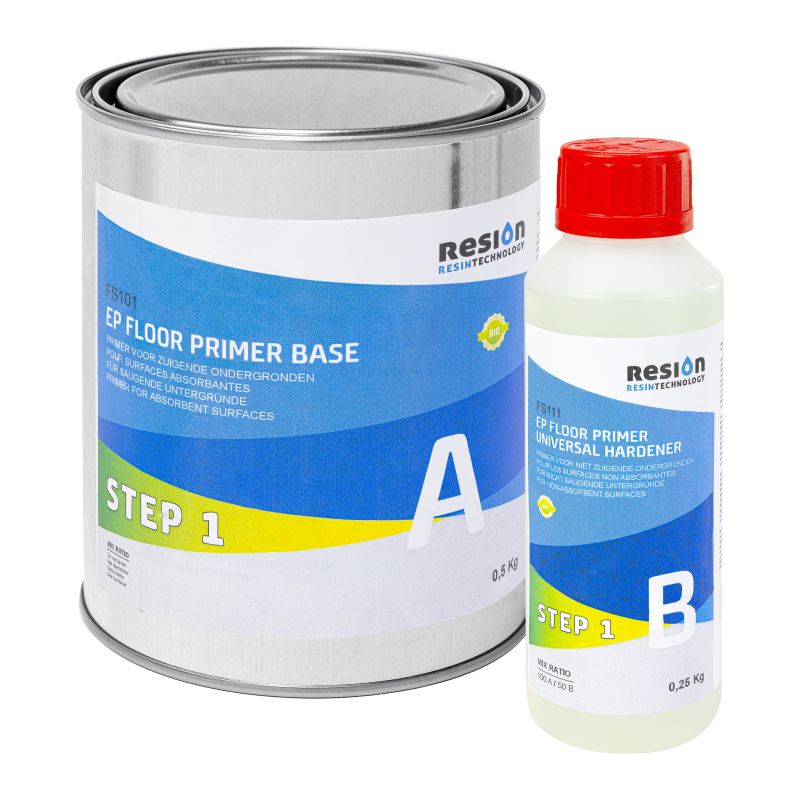
| 0.75 kg (set for approx. 2.5-3.5 m2) | 0.5 kg (tin) | 0.25 kg (bottle) |
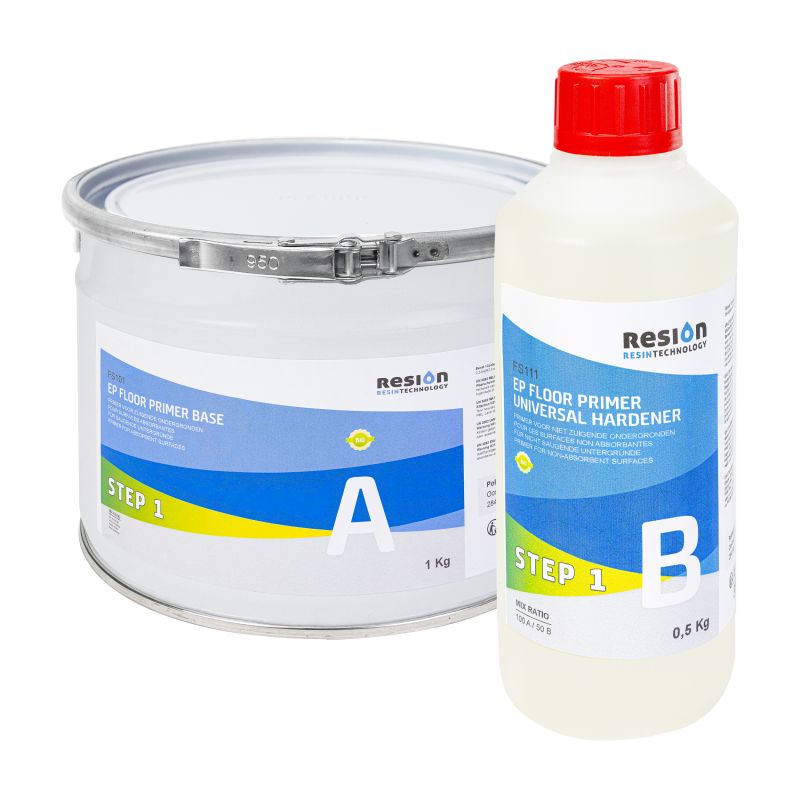
| 1.5 kg (set for approx. 5-7 m2) | 1 kg (tin) | 0.5 kg (bottle) |
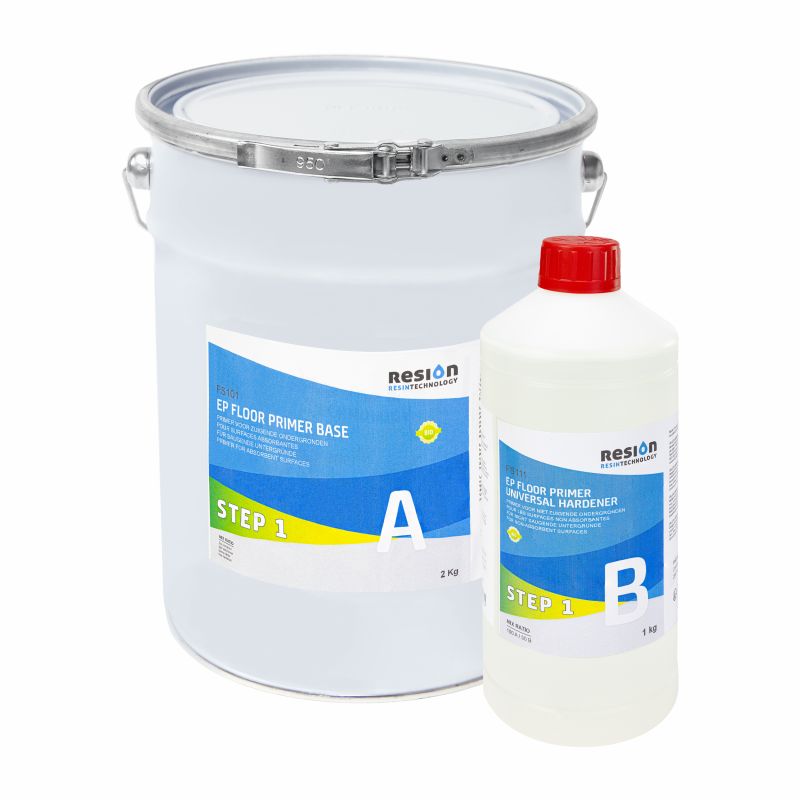
| 3 kg (set for approx. 10-14 m2) | 2 kg (tin) | 1 kg (bottle) |
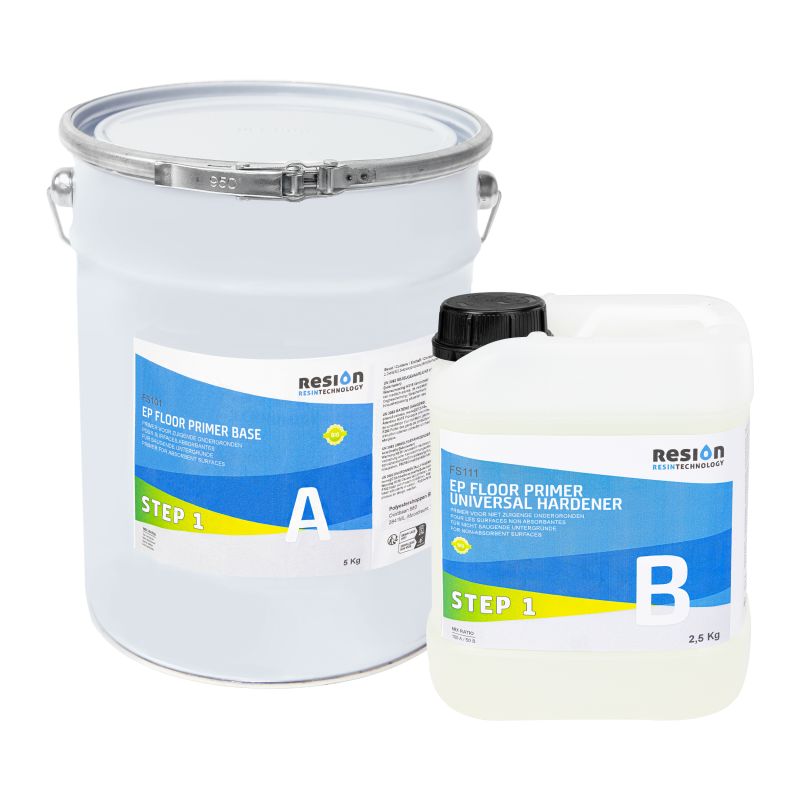
| 7.5 kg (set for approx. 25-35 m2) | 5 kg (tin) | 2.5 kg (jerry can) |
| 15 kg (set for approx. 50-70 m2) | 10 kg (tin) | 5 kg (jerry can) |
Colour: clear or white
Mixing ratio (by weight): 100:50
Coverage: approx. 300 g/m2
Working time: approx. 30 minutes
Walkable/overcoatable: after approx. 16 hours
Viscosity: 600-700 mPa.s at 25°C
Density: 1.15 g/ml
Odour: virtually odourless (suitable for indoor use)
Compatible with: epoxy and polyurethane flooring systems
Shelf life: minimum 12 months (when stored dry and frost-free in original packaging)
More information about the epoxy primer
Do you have questions about working with epoxy primer for porous substrates, or are you unsure which primer or flooring system is most suitable for your project? Our specialists are happy to advise you on the right primer and the most suitable flooring system for your project. You can contact us on weekdays by phone, email or WhatsApp.
Product properties
The key technical properties clearly listed in one place.
- Article number
- VLO000312
-
The technical product category, such as primer, resin, hardener or cleaner. It explains the product's purpose and helps you find other products with a similar function.
- Primer
-
The resin family or system that a hardener, additive or reinforcement material can be combined with, such as epoxy, polyester or vinyl ester. Compatibility depends on the complete system, not just the general resin type.
- Epoxy
-
Density describes the mass of a material per unit volume. Values may be given in g/cm³, kg/L or kg/m³; 1 g/cm³ equals 1 kg/L. For example, one litre of a liquid with a density of 1.2 kg/L weighs approximately 1.2 kg. Density helps convert between weight and volume, but it can vary with temperature.
- 1.15 g/ml
-
The period for which an unopened product remains usable under the specified storage conditions. Check whether the period starts from the manufacturing date or another date. Shelf life may be shorter after opening, especially for products sensitive to air or moisture.
- At least 12 months
-
Mixing ratio indicates how much of each component is needed, for example resin (A) and hardener (B). A ratio of 100:50 by weight means 100 grams of A to 50 grams of B; by volume you might use millilitres. Weight and volume ratios are not necessarily the same because the components may have different densities. Accurate measuring is important for proper curing.
- 2:1 (by weight)
-
Consumption or coverage describes how much product is needed for a given surface area. Consumption may be stated in g/m² or kg/m², while coverage is often given in m²/L or m²/kg. A consumption of 0.2 kg/m² means a theoretical 200 grams per square metre. Actual use depends on film thickness, substrate absorbency, application method and waste.
- Approximately 300 g/m²
- Net contents
- 15 kg, 1.5 kg, 3 kg, 750 g, 7.5 kg
-
Viscosity measures how easily a liquid flows, or how thick it is. Dynamic viscosity is usually expressed in mPa·s (millipascal-seconds), sometimes in cP (centipoise); 1 mPa·s = 1 cP. A lower value usually means a more free-flowing liquid, while a higher value indicates a thicker product. Temperature and test method strongly affect the value. Note that mPa·s is different from MPa, which is used to express mechanical strength.
- 600-700 mPa·s (25 °C)
Safety information
Read the warnings and use appropriate protective equipment before handling the product.
FS101 | EP Floor Primer (Epoxy vloerprimer) | Basis | 500 gr
Recommended protective equipment
Hazard pictograms
Warnings and precautions
Reviews
Frequently bought together
Useful additions for your project.