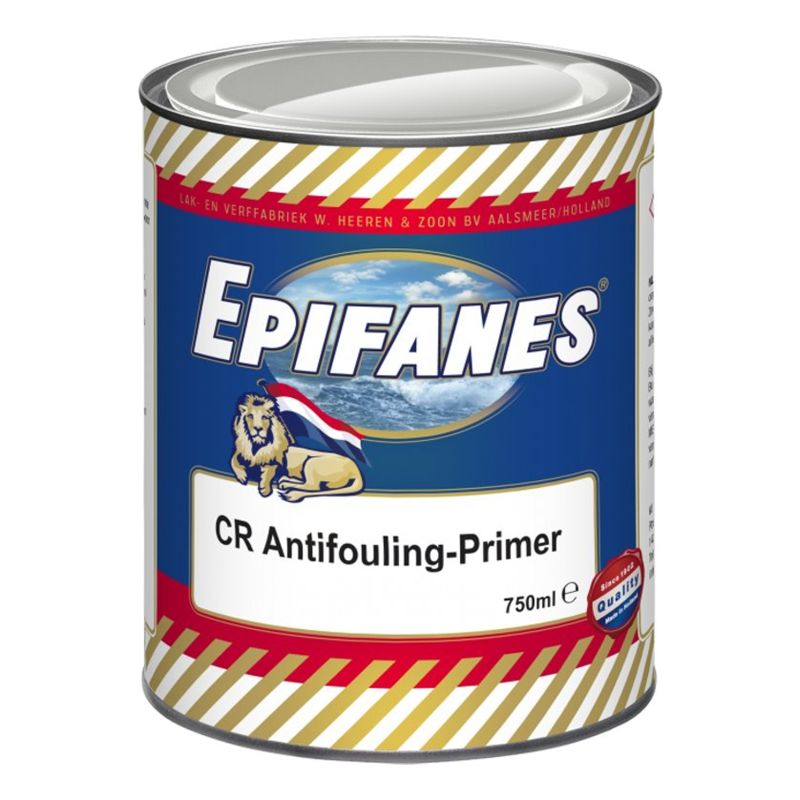
Epifanes CR Antifouling Primer
At a glance
- 1-component primer
- Chlorinated rubber-based paint
- In 0.75 and 2.5 litre packaging
Fast delivery throughout Europe
Secure payment with PayPal, Mastercard, Visa and more
4.7 out of 5 stars on Trusted Shops
Epifanes CR Antifouling primer is an underwater and antifouling primer based on chlorinated rubber. The 1-component primer is quick-drying and widely applicable for various surfaces. With sufficient layer thickness (at least 300 micron = 5 to 6 layers) this primer has excellent rust-preventing and conserving properties. Because the product is based on chlorinated rubber, it has sufficient elasticity to absorb effects on the substrate.
Application of Epifanes Antifouling Primer
Epifanes' primer is suitable for use as an underwater system with protective effect for steel, wood, aluminium and polyester. In addition, the primer can be used as a tie coat over existing antifouling (or remains of it) and tar-based systems to a hard or self-polishing antifouling.
Specifications
Packaging: 0.75 L, 2.5 L, 5 L
Coverage: 9 m2/L
Colour: silver
Finish: semi-gloss
Density: 1.33 kg/dm3
VOC content: 475 g/L
Application method: brush, roller or spray
Recommended film thickness: 100 µm wet = 50 µm dry
Thinner: Epifanes Thinner D-100
Application temperature: 8°C - 28°C
Tack-free after: 4 hours (at 20°C)
Can be overcoated (2nd layer) after: 6 hours at 20°C
Can be overcoated (antifouling) after: 24 hours at 20°C
Shelf life: at least 2 years from production date in unopened original packaging, when stored between 5°C and 30°C
Tip: do not allow this product to cure longer than 7 days before applying antifouling. After 7 days it must be sanded with 150-180 grit sandpaper.
Questions about primers and antifouling?
Do you have any questions or do you need help with the use of Epifanes antifouling and primer? Contact the specialists of Polyestershoppen! We are happy to help. Check the information centre for answers to your questions or contact us directly on +31 85 022 0090. Do you want to be helped as quickly as possible? Send us a chat message. During office hours we will answer your questions immediately.
Product properties
The key technical properties clearly listed in one place.
- Article number
- BOO000754
-
The materials, substrates or tasks a product is intended for. A general claim such as 'suitable for plastics' does not mean it works with every type of plastic; the specific substrate and its preparation still matter.
- Stalen-boten, Aluminium boten, Houten boten
-
The technical product category, such as primer, resin, hardener or cleaner. It explains the product's purpose and helps you find other products with a similar function.
- 1K Primer
-
The recommended layer thickness is the thickness at which you apply each coat of paint, coating or resin. It is usually given in micrometres (µm) or millimetres (mm).
- Wet film thickness: the thickness immediately after application.
- Dry film thickness: the thickness after drying or curing.
For a coating with 60% solids by volume, a wet film of 100 µm will theoretically produce a dry film of approximately 60 µm. Film thickness affects coverage, protection and drying. Always check whether the manufacturer specifies wet or dry film thickness.
- 100 µm wet (= 50 µm dry)
-
The recommended application temperature range indicates the conditions under which the product can generally be applied and cured properly. Three temperatures matter:
- Air: the temperature in the workshop or outdoors.
- Substrate: the temperature of the surface being treated.
- Product: the temperature of the resin, adhesive or coating itself.
A cold substrate can cause condensation and affect adhesion. At higher temperatures, two-component products may react faster, reducing their working time. Check the dew point and follow the product instructions.
- 8-28 °C
-
Density describes the mass of a material per unit volume. Values may be given in g/cm³, kg/L or kg/m³; 1 g/cm³ equals 1 kg/L. For example, one litre of a liquid with a density of 1.2 kg/L weighs approximately 1.2 kg. Density helps convert between weight and volume, but it can vary with temperature.
- 1.33 kg/dm³
-
The period for which an unopened product remains usable under the specified storage conditions. Check whether the period starts from the manufacturing date or another date. Shelf life may be shorter after opening, especially for products sensitive to air or moisture.
- At least 24 months
-
The time until the surface no longer feels tacky to a light touch. The material underneath may still be soft, so tack-free does not mean fully cured or ready for heavy loading.
- 4 hours (20 °C)
-
Consumption or coverage describes how much product is needed for a given surface area. Consumption may be stated in g/m² or kg/m², while coverage is often given in m²/L or m²/kg. A consumption of 0.2 kg/m² means a theoretical 200 grams per square metre. Actual use depends on film thickness, substrate absorbency, application method and waste.
- 9 m²/L
-
A specific thinner that can be used, where permitted, to adjust a product's application properties or viscosity. The correct thinner and maximum quantity depend on the product. Incorrect thinning can affect coverage, drying and curing.
- Epifanes Thinner D-100
- Net contents
- 2.5 L, 5 L, 750 ml
-
The application or processing methods specified by the manufacturer, such as brushing, rolling, spraying, casting or hand laminating. The chosen method can affect consumption, layer thickness and finish.
- Brush, Roller, Spray
-
VOC content (volatile organic compounds) indicates the amount of these substances in a product, usually expressed in g/L (grams per litre). They may evaporate during application and drying. The value describes the composition, but actual exposure also depends on how much is used, ventilation and the application method.
- 475 g/L
Reviews
Frequently bought together
Useful additions for your project.