

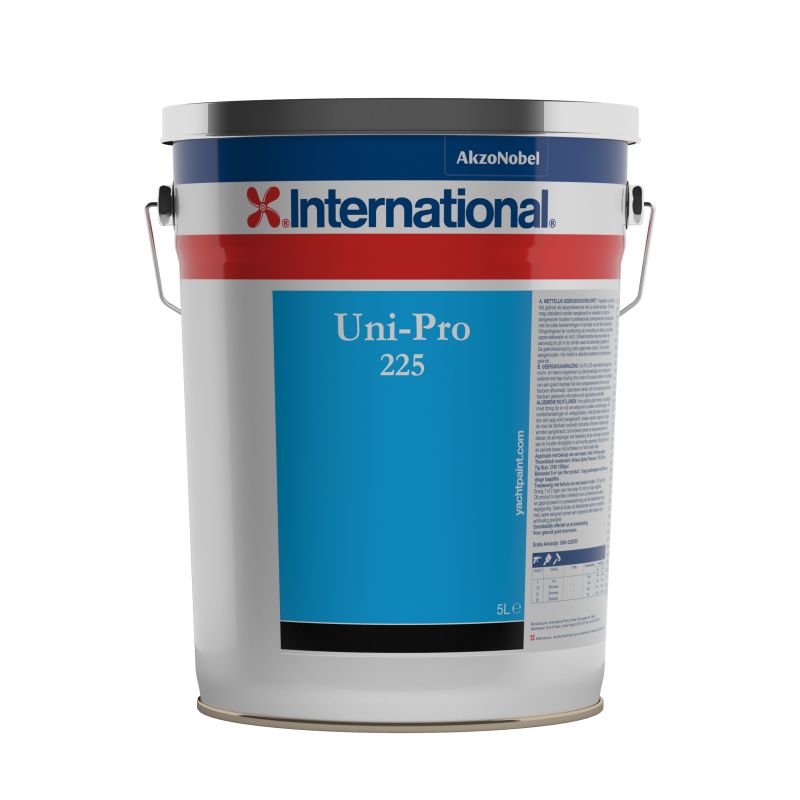
International Uni-Pro 225 Antifouling
At a glance
- Self-polishing antifouling
- Polyester, wood and steel
- For professional use
Fast delivery throughout Europe
Secure payment with PayPal, Mastercard, Visa and more
4.7 out of 5 stars on Trusted Shops
Product description
International Uni-Pro 225 is a self-polishing antifouling suitable for application on vessels in fresh, salt, and brackish water. Uni-Pro 225 is specifically developed for Dutch waters and prevents fouling for up to one sailing season. This antifouling is suitable for use on sailboats and motorboats (up to 25 knots).
Note: this product is intended for professional use only.
Benefits of Uni-Pro 225
- The eroding technology prevents build-up of layer thickness and provides protection against fouling from aquatic plants and animals, and slime for up to one sailing season.
- This antifouling can be applied up to 12 months before launching.
- Improved colours with longer colour retention during use.
Suitable substrates
International Uni-Pro 225 can be used on the following materials:
- Cast iron
- GRP (gelcoat)
- Lead
- Steel
- Wood
Note: this product cannot be used on aluminium.
Specifications
Packaging: 5 L or 20 L
Colour: dover white, red, navy, black
Finish: matt
Density: 1.3 g/L
VOC: 488 g/L
Application: brush, roller or airless spray
Coverage (roller/brush): 9 m2/L
Coverage (spray application): 6 m2/L
Minimum application temperature: 5°C
Thinner: not recommended
Tack-free after: 45 minutes (at 15°C)
Overcoatable after: 10 hours (at 15°C)
Launch window: minimum 6 hours (at 15°C) up to 12 months after application
Approval number: 15568N
Shelf life: 2 years
Product properties
The key technical properties clearly listed in one place.
- Article number
- BOO002295
-
The technical product category, such as primer, resin, hardener or cleaner. It explains the product's purpose and helps you find other products with a similar function.
- Self-sharpening antifouling
-
The materials, substrates or tasks a product is intended for. A general claim such as 'suitable for plastics' does not mean it works with every type of plastic; the specific substrate and its preparation still matter.
- Polyester boten, Stalen-boten, Houten boten
-
Density describes the mass of a material per unit volume. Values may be given in g/cm³, kg/L or kg/m³; 1 g/cm³ equals 1 kg/L. For example, one litre of a liquid with a density of 1.2 kg/L weighs approximately 1.2 kg. Density helps convert between weight and volume, but it can vary with temperature.
- 1.3 g/L
-
The period for which an unopened product remains usable under the specified storage conditions. Check whether the period starts from the manufacturing date or another date. Shelf life may be shorter after opening, especially for products sensitive to air or moisture.
- 24 months
-
The time until the surface no longer feels tacky to a light touch. The material underneath may still be soft, so tack-free does not mean fully cured or ready for heavy loading.
- 45 minutes (15 °C)
-
Minimum application temperature is the lowest temperature at which a product may be used according to the manufacturer. The limit can apply to the air, substrate and product itself.
At lower temperatures, resins and coatings can become thicker and cure more slowly. Moisture can also condense on a cold substrate and reduce adhesion. Check the dew point and measure the surface temperature before starting. A longer drying time does not automatically make application below the specified minimum acceptable.
- 5 °C
-
The overcoating interval tells you when the next layer of paint, varnish or coating may be applied. Many multi-coat systems specify both a minimum and a maximum interval:
- Minimum overcoating time: the previous layer is dry or cured enough to accept another coat.
- Maximum overcoating time: the period during which the next coat can bond without extra surface preparation under the stated conditions.
Overcoating too early can affect drying or the finish. Once the maximum interval has passed, cleaning and sanding may be needed to ensure adhesion between coats. Temperature and film thickness affect the waiting times.
- 10 hours (15 °C)
-
The minimum waiting time between applying an underwater coating or antifouling paint and launching the boat. Some products also specify a maximum time before launch. These times may depend on temperature and applied film thickness.
- At least 6 hours (15 °C) and at most 12 months after application
-
The authorisation number is the official registration number of an approved biocide-containing antifouling product. It can be used to check whether an antifouling product is authorised in a particular country. Dutch authorisation numbers may end with the letter N, such as 14533 N.
An authorisation applies only to the specified uses and conditions. Not every antifouling product is permitted in every country. Check the number and current instructions on the label, especially if you plan to use the antifouling outside the Netherlands.
- 15568 N
-
A specific thinner that can be used, where permitted, to adjust a product's application properties or viscosity. The correct thinner and maximum quantity depend on the product. Incorrect thinning can affect coverage, drying and curing.
- not recommended
- Net contents
- 20 L, 5 L
-
The application or processing methods specified by the manufacturer, such as brushing, rolling, spraying, casting or hand laminating. The chosen method can affect consumption, layer thickness and finish.
- Airless spray, Brush, Roller
-
VOC content (volatile organic compounds) indicates the amount of these substances in a product, usually expressed in g/L (grams per litre). They may evaporate during application and drying. The value describes the composition, but actual exposure also depends on how much is used, ventilation and the application method.
- 488 g/L
Reviews
Frequently bought together
Useful additions for your project.
Often chosen
Popular

Recommended
