Often chosen

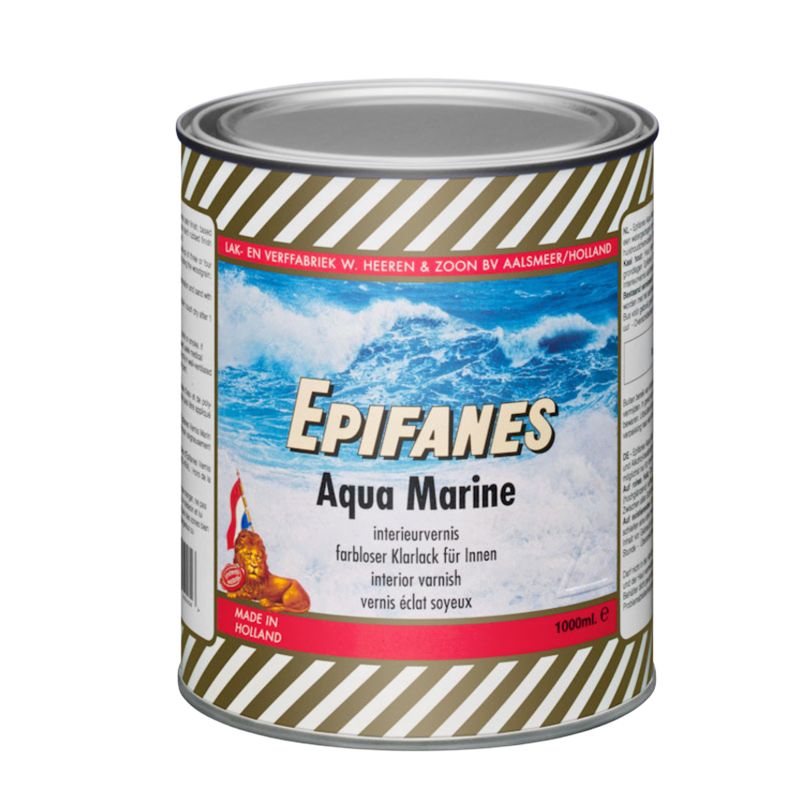
Epifanes Aquamarine Interior Varnish is a high-quality, one-component, water-based interior varnish specially developed for indoor use. This fast-drying varnish provides a beautiful satin sheen, excellent flow, and outstanding resistance to water, alcohol splashes, and household chemicals. Thanks to its virtually odourless formulation, it is also ideal for use in living or working spaces.
Epifanes Aquamarine Interior Varnish is suitable as a satin finishing coat over one- and two-component high-gloss varnishes, such as:
Use this interior varnish on joinery, panels, doors, and floors for durable, wear-resistant protection. The product is also suitable for maintaining existing one- and two-component interior coating systems, making it ideal for renovation or refresh projects.
Refer to the technical documentation.
Contents: 1 litre
Base: water-based
Gloss: satin
Colour: milky when applied; dries completely clear and transparent
VOC content: 32 g/L
Recommended film thickness: 60 µm wet = 20 µm dry
Thinner: tap water
Coverage: 14m2/L
Application temperature: 8°C-30°C
Relative humidity: 50% to 85%
Dust-dry: 1 hour (20°C)
Sandable: 6 hours (20°C)
Recoatable: 6 hours (20°C)
Shelf life: at least 3 years when stored in unopened original packaging, between 5°C and 30°C and kept frost-free.
The key technical properties clearly listed in one place.
The technical product category, such as primer, resin, hardener or cleaner. It explains the product's purpose and helps you find other products with a similar function.
The recommended layer thickness is the thickness at which you apply each coat of paint, coating or resin. It is usually given in micrometres (µm) or millimetres (mm).
For a coating with 60% solids by volume, a wet film of 100 µm will theoretically produce a dry film of approximately 60 µm. Film thickness affects coverage, protection and drying. Always check whether the manufacturer specifies wet or dry film thickness.
The recommended application temperature range indicates the conditions under which the product can generally be applied and cured properly. Three temperatures matter:
A cold substrate can cause condensation and affect adhesion. At higher temperatures, two-component products may react faster, reducing their working time. Check the dew point and follow the product instructions.
The chemical base describes the chemistry of an adhesive, sealant, resin or coating, such as epoxy, polyester, polyurethane, (methyl)methacrylate or a hybrid polymer. It affects curing, flexibility and adhesion. Products with the same chemical base are not necessarily suitable for the same applications.
The period for which an unopened product remains usable under the specified storage conditions. Check whether the period starts from the manufacturing date or another date. Shelf life may be shorter after opening, especially for products sensitive to air or moisture.
Humidity during application is given as relative humidity, usually in percent (% RH). It indicates how much water vapour the air contains compared with the maximum it can hold at that temperature. Excessive humidity can interfere with drying or adhesion of some coatings. Also check that the substrate is dry enough and free from condensation.
The overcoating interval tells you when the next layer of paint, varnish or coating may be applied. Many multi-coat systems specify both a minimum and a maximum interval:
Overcoating too early can affect drying or the finish. Once the maximum interval has passed, cleaning and sanding may be needed to ensure adhesion between coats. Temperature and film thickness affect the waiting times.
The waiting time before an applied layer is dry or hard enough to sand without smearing or damage. Sanding too early can also clog the abrasive quickly. Layer thickness and temperature affect this time.
A paint or varnish layer is dust-dry when settling dust is less likely to stick to the surface. It may not yet be touch-dry, ready for overcoating or suitable for loading; these are different stages of drying and curing.
Consumption or coverage describes how much product is needed for a given surface area. Consumption may be stated in g/m² or kg/m², while coverage is often given in m²/L or m²/kg. A consumption of 0.2 kg/m² means a theoretical 200 grams per square metre. Actual use depends on film thickness, substrate absorbency, application method and waste.
A specific thinner that can be used, where permitted, to adjust a product's application properties or viscosity. The correct thinner and maximum quantity depend on the product. Incorrect thinning can affect coverage, drying and curing.
VOC content (volatile organic compounds) indicates the amount of these substances in a product, usually expressed in g/L (grams per litre). They may evaporate during application and drying. The value describes the composition, but actual exposure also depends on how much is used, ventilation and the application method.
Useful additions for your project.