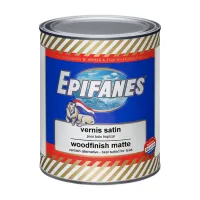
Epifanes Woodfinish Gloss

At a glance
- UV-resistant clear varnish
- Suitable for oily wood types
- High-gloss result
Fast delivery throughout Europe
Secure payment with PayPal, Mastercard, Visa and more
4.7 out of 5 stars on Trusted Shops
Epifanes Woodfinish Gloss with UV Filter is a particularly high-gloss, protective one-component varnish, specially developed for teak and other oil-rich hardwoods. This wood oil varnish provides long-lasting gloss and excellent adhesion to well-degreased and sanded wood.
Thanks to its special formulation, the varnish regulates the natural substances present in tropical hardwoods, ensuring durable protection. The integrated UV filter prevents discoloration and protects the wood from sunlight, weather, and water. This ensures a strong, glossy finish that lasts, making it ideal for outdoor use.
Features Epifanes Woodfinish Gloss
- High-gloss, durable wood finish.
- Excellent adhesion to teak and oil-rich hardwoods.
- UV filter to prevent discoloration from sunlight.
- Weather and water-resistant.
- Easy and pleasant to apply.
Applications
You can excellently use Epifanes Woodfinish Gloss for:
- New woodwork on teak, oak, and other oily hardwoods, both indoors and outdoors (above the waterline).
- Maintenance of existing, intact oil and varnish systems.
- A durable alternative to the frequent maintenance required by pure wood oil systems.
- Finishing and protecting neutral wood types.
Prefer a matt finish? Top off the hardwood oil varnish with several coats of Epifanes Woodfinish Matte.
Specifications
Contents: 500 ml, 1 litre
Gloss: high-gloss
Base: phenolic resin / alkyd resin / tung oil, inert regulating components
Colour: appears milky in the can, dries transparent
Density: 940 gr /dm3 (at 20°C)
VOC content: 374 gram/litre
Recommended film thickness: 60 - 70 µm wet = 30 - 35 µm dry
Coverage: 14 m2/L
Dust dry: 3 hours (20°C)
Sandable: 24 hours (20°C)
Recoatable: 24 hours (20°C)
Minimum application temperature: 8 °C
Brush thinner: Epifanes brush thinner (paint thinner)
Spray thinner: Epifanes 1C spray thinner
Shelf life: at least 3 years from the production date, provided stored at a temperature between 5°C and 30°C in unopened packaging.
Product properties
The key technical properties clearly listed in one place.
- Article number
- LAK002238
-
Gloss level indicates how much light a dry paint or coating reflects and how the finished surface looks.
- Matt: little reflection and a subdued appearance.
- Satin: a gentle sheen between matt and high gloss.
- High gloss: stronger reflections and a more pronounced colour, although surface imperfections may become more visible.
Gloss can be measured in gloss units (GU) at a specified angle. Terms such as matt and satin do not necessarily mean exactly the same thing across manufacturers. Substrate condition and application also affect the final appearance.
- High gloss
-
The technical product category, such as primer, resin, hardener or cleaner. It explains the product's purpose and helps you find other products with a similar function.
- 1K clear coat
-
The recommended layer thickness is the thickness at which you apply each coat of paint, coating or resin. It is usually given in micrometres (µm) or millimetres (mm).
- Wet film thickness: the thickness immediately after application.
- Dry film thickness: the thickness after drying or curing.
For a coating with 60% solids by volume, a wet film of 100 µm will theoretically produce a dry film of approximately 60 µm. Film thickness affects coverage, protection and drying. Always check whether the manufacturer specifies wet or dry film thickness.
- 60-70 µm wet (= 30-35 µm dry)
-
The chemical base describes the chemistry of an adhesive, sealant, resin or coating, such as epoxy, polyester, polyurethane, (methyl)methacrylate or a hybrid polymer. It affects curing, flexibility and adhesion. Products with the same chemical base are not necessarily suitable for the same applications.
- Wood oil/phenolic resin/alkyd resin
-
Density describes the mass of a material per unit volume. Values may be given in g/cm³, kg/L or kg/m³; 1 g/cm³ equals 1 kg/L. For example, one litre of a liquid with a density of 1.2 kg/L weighs approximately 1.2 kg. Density helps convert between weight and volume, but it can vary with temperature.
- 940 g/dm³ (20 °C)
-
The period for which an unopened product remains usable under the specified storage conditions. Check whether the period starts from the manufacturing date or another date. Shelf life may be shorter after opening, especially for products sensitive to air or moisture.
- At least 36 months
-
Minimum application temperature is the lowest temperature at which a product may be used according to the manufacturer. The limit can apply to the air, substrate and product itself.
At lower temperatures, resins and coatings can become thicker and cure more slowly. Moisture can also condense on a cold substrate and reduce adhesion. Check the dew point and measure the surface temperature before starting. A longer drying time does not automatically make application below the specified minimum acceptable.
- 8 °C
-
The overcoating interval tells you when the next layer of paint, varnish or coating may be applied. Many multi-coat systems specify both a minimum and a maximum interval:
- Minimum overcoating time: the previous layer is dry or cured enough to accept another coat.
- Maximum overcoating time: the period during which the next coat can bond without extra surface preparation under the stated conditions.
Overcoating too early can affect drying or the finish. Once the maximum interval has passed, cleaning and sanding may be needed to ensure adhesion between coats. Temperature and film thickness affect the waiting times.
- 1 day (20 °C)
-
The waiting time before an applied layer is dry or hard enough to sand without smearing or damage. Sanding too early can also clog the abrasive quickly. Layer thickness and temperature affect this time.
- 1 day (20 °C)
-
A paint or varnish layer is dust-dry when settling dust is less likely to stick to the surface. It may not yet be touch-dry, ready for overcoating or suitable for loading; these are different stages of drying and curing.
- 3 hours (20 °C)
-
Consumption or coverage describes how much product is needed for a given surface area. Consumption may be stated in g/m² or kg/m², while coverage is often given in m²/L or m²/kg. A consumption of 0.2 kg/m² means a theoretical 200 grams per square metre. Actual use depends on film thickness, substrate absorbency, application method and waste.
- 14 m²/L
-
A specific thinner that can be used, where permitted, to adjust a product's application properties or viscosity. The correct thinner and maximum quantity depend on the product. Incorrect thinning can affect coverage, drying and curing.
- Brush: Epifanes Brush Thinner, Spray: Epifanes 1C Spray Thinner
- Net contents
- 1 L, 500 ml
-
VOC content (volatile organic compounds) indicates the amount of these substances in a product, usually expressed in g/L (grams per litre). They may evaporate during application and drying. The value describes the composition, but actual exposure also depends on how much is used, ventilation and the application method.
- 374 g/L
Reviews
Frequently bought together
Useful additions for your project.