
UFI: 1DH5-D07F-X003-5W03 + JQH5-E002-5003-T8AC
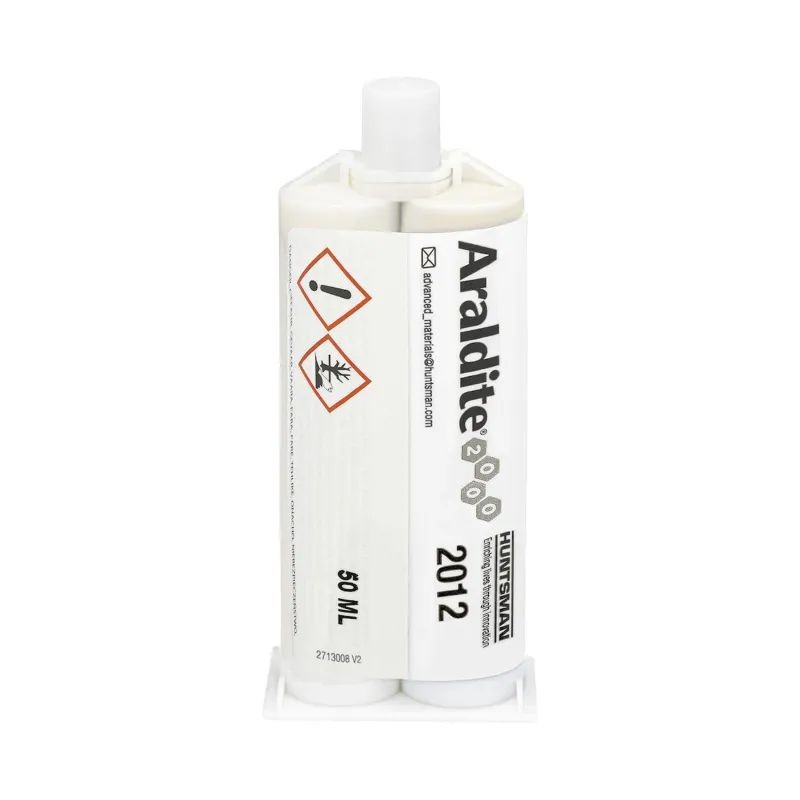
Araldite 2012 Epoxy Adhesive
At a glance
- Strong 2-component epoxy adhesive
- Fast curing
Not sure about your choice?
Want to know which Araldite adhesive you need? Use our selection tool!
Fast delivery throughout Europe
Secure payment with PayPal, Mastercard, Visa and more
4.7 out of 5 stars on Trusted Shops
Please note: due to a change in the classification of one of the raw materials, this product is being replaced by Araldite 2012-1 epoxy adhesive. The adhesive’s properties, workability and performance have remained virtually unchanged.
Araldite 2012 is the faster-curing version of Araldite 2011. This two-component epoxy adhesive has a low viscosity, cures quickly and provides a strong and resilient bond. Thanks to its excellent adhesion to a wide range of materials, Araldite 2012 is suitable for most industrial applications. The adhesive offers excellent adhesion to metals, plastics, ceramics, glass and rubber, among other materials.
Note: this is the non-aerospace version of Araldite 2012. Are you looking for the version suitable for aerospace applications? Please contact our customer service team.
Features of Araldite 2012 epoxy adhesive
- Fast curing and high strength.
- Low shrinkage and excellent impact resistance.
- Strong and resilient bond.
- Bonds a wide range of materials.
Materials
Araldite 2012 is suitable for bonding the following materials:
- Ferrous metals, aluminium, copper, zinc and galvanised materials.
- Polystyrene foams and polyurethane foams.
- Ceramic materials, wood, glass fibre-reinforced plastics and epoxy resins.
- Fibre-reinforced polyester, thermoset composites, acrylics and polycarbonate.
- Various types of rubber, glass, quartz and gemstones.
Applications
Araldite 2012 is suitable for the following applications, among others:
- Bonds subjected to dynamic loads.
- Bonding bearings, electronic components and printed circuit boards.
- Potting sensors.
- Bonding grinding wheels.
Specifications
Colour: yellow
Mixing ratio: 1:1
Specific gravity: 1.05 g/cm3
Shear strength: 19 N/mm2
Peel strength: 5 N/mm
Viscosity: 35.000 mPa.s
Gap-filling capacity: up to 1 mm
Temperature resistance: -60 °C to +100 °C
Initial strength: approx. 20 minutes to achieve 1 N/mm2 on aluminium at 23 °C
Packaging:
- 50 ml cartridge (application gun and mixing nozzles required)
- 200 ml cartridge (application gun and mixing nozzles required)
Application gun:
Mixing nozzles:
Product properties
The key technical properties clearly listed in one place.
- Article number
- LIJ002356
-
Adhesive type describes the family of adhesive or sealant, such as epoxy adhesive, (methyl)methacrylate adhesive, polyurethane adhesive or polymer sealant. Its chemistry affects processing, curing, flexibility and adhesion. Products of the same type may still differ, so check the suitable substrates and application instructions.
- Epoxylijm
-
Initial strength is the strength an adhesive joint develops shortly after the parts are joined. For some adhesives, the specification gives the time needed to reach a certain strength, for example 20 minutes to reach 1 N/mm² on aluminium at 23 °C. N/mm² (newtons per square millimetre) measures stress and is equivalent to MPa. The joint may not have reached its final strength at that point.
- 20 minutes (for 1 N/mm² on aluminium at 23 °C)
-
Peel strength describes the force required to progressively separate an adhesive joint or tape by peeling the bonded parts apart. It is often expressed in N/mm: newtons per millimetre of bonded width. A higher value indicates greater resistance to peeling under the test conditions. Peel angle, substrate and test method affect the result. N/mm is not the same as N/mm².
- 5 N/mm
-
Shear strength indicates how much stress a bonded joint can withstand when forces try to slide the joined parts parallel to the bond line. It is usually expressed in MPa (megapascals) or N/mm² (newtons per square millimetre): 1 MPa = 1 N/mm². A value of 20 MPa therefore represents a test stress of 20 N/mm². Substrate, overlap, adhesive thickness and test conditions affect the measured strength.
- 19 MPa
-
Density describes the mass of a material per unit volume. Values may be given in g/cm³, kg/L or kg/m³; 1 g/cm³ equals 1 kg/L. For example, one litre of a liquid with a density of 1.2 kg/L weighs approximately 1.2 kg. Density helps convert between weight and volume, but it can vary with temperature.
- 1.05 kg/L
- Net contents
- 50 ml
-
Viscosity measures how easily a liquid flows, or how thick it is. Dynamic viscosity is usually expressed in mPa·s (millipascal-seconds), sometimes in cP (centipoise); 1 mPa·s = 1 cP. A lower value usually means a more free-flowing liquid, while a higher value indicates a thicker product. Temperature and test method strongly affect the value. Note that mPa·s is different from MPa, which is used to express mechanical strength.
- 35.000 mPa·s
-
Heat resistance describes the temperature a material can withstand after correct processing and curing, usually expressed in degrees Celsius (°C). Continuous exposure is different from a brief temperature peak, and mechanical loading may also affect the limit. Heat resistance is not the same as the temperature at which the product can be applied.
- -60 to 100 °C
Safety information
Read the warnings and use appropriate protective equipment before handling the product.
Reviews
Frequently bought together
Useful additions for your project.

Often chosen