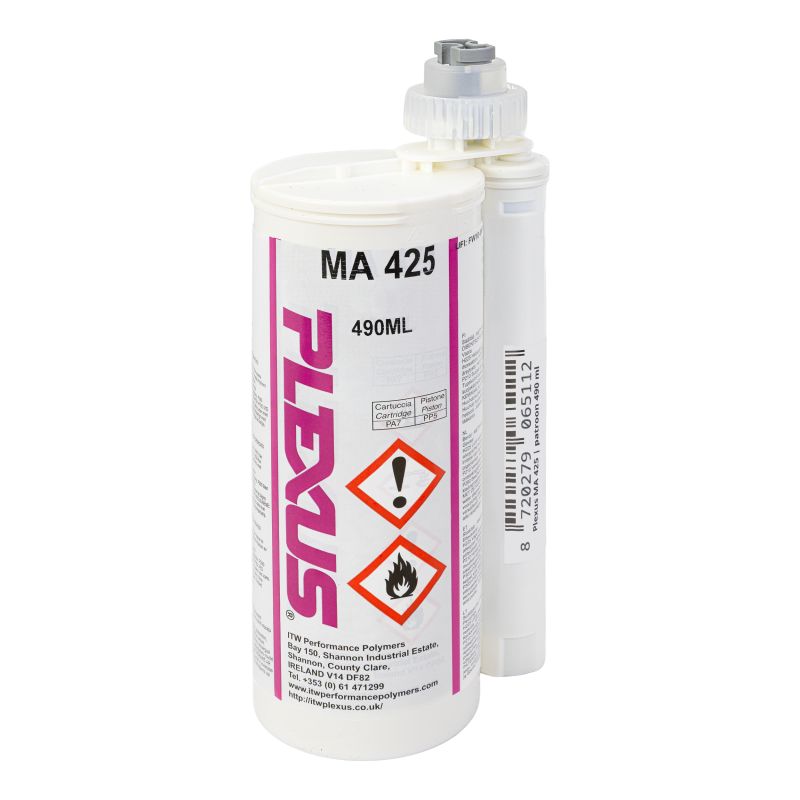

Plexus MA425 Methacrylate adhesive
At a glance
- 2-component methacrylate adhesive
- Long open time
- Contents: 490 ml
Product description
Plexus MA425 is a 2 part methacrylate adhesive designed for structural bonding of thermoplastic, metal, and composite assemblies. Unlike Plexus MA420, this adhesive has a long open time of 30 to 35 minutes. This adhesive is finding wide usage for composites bonding applications in the transportation and marine industries, because it requires virtually no surface preparation. In addition, this product provides a unique combination of excellent fatigue endurance, outstanding impact resistance, and superior toughness.
Plexus MA425 is supplied as standard in a 490 ml cartridge (component A + B). Don't forget to order the correct application gun (LS480) and the correct mixing nozzle.
Applications
Plexus MA425 is recommended for use on:
- Aluminum
- Stainless Steel
- Metal
- ABS Plastic
- PMMA
- Polyester (PBT, PET)
- PVC
- Polyurethane
- PDCPD
- Gelcoat
- Fibreglass
- SMC
- Laminate
Directions for use of Plexus MA425
Follow the instructions below to correctly apply Plexus MA425:
- Open the cartridge and screw on the mixing nozzle. Make sure the central partition is in place so that the components remain properly separated.
- Insert the cartridge into the appropriate application gun.
- First, dispense some adhesive onto a piece of cardboard to allow the components to mix thoroughly. When the adhesive turns blue, it is ready for bonding.
- Ensure that the surfaces are joined within the specified working time (30–35 minutes) to achieve maximum adhesion.
- Hold the parts in place until the adhesive has developed sufficient bond strength.
- Apply enough material to completely fill the joint once the parts are assembled and secured.
Specifications
Packaging: 490 ml
Mixing ratio: 10:1
Application gun: LS480
Mixing nozzle: mixing nozzle F
Colour: blue
Working time: 30-35 minutes
Fixture time: 80-90 minutes
Product properties
The key technical properties clearly listed in one place.
- Article number
- LIJ001778
-
Adhesive type describes the family of adhesive or sealant, such as epoxy adhesive, (methyl)methacrylate adhesive, polyurethane adhesive or polymer sealant. Its chemistry affects processing, curing, flexibility and adhesion. Products of the same type may still differ, so check the suitable substrates and application instructions.
- Methyl Methacrylaatlijm
-
Open time is the period during which an applied adhesive, sealant or mortar can still be assembled, positioned or adjusted. It is usually given in minutes under specified conditions, often around 20 or 23 °C. Open time generally starts at application and may differ from the working time after mixing.
- 30 tot 60 minuten
-
Gap-filling capability describes how wide a gap or joint an adhesive or sealant can bridge, usually in millimetres (mm). The stated maximum is not necessarily the recommended adhesive layer thickness: a narrower joint may be needed to achieve good bond strength.
- 6mm tot 10mm
-
This property lists the substrates on which an adhesive, resin or coating can achieve strong adhesion according to the product information. The result also depends on surface preparation.
- Cleaning and degreasing: removes dirt, oil and other substances that interfere with bonding.
- Sanding or roughening: can improve adhesion when suitable for the substrate.
- Primer: required or recommended for some surfaces.
Materials such as PE, PP and PTFE are difficult to bond with many conventional adhesives and may need a specialist adhesive or pretreatment. If in doubt, test adhesion on a small area.
- Aluminium, Roestvast staal (RVS), ABS, Plexiglas (PMMA), Polyester (FRP), PVC, Polyurethaanschuim (PUR/PIR), SMC, Glas/Epoxy (GRE)
-
Mixing ratio indicates how much of each component is needed, for example resin (A) and hardener (B). A ratio of 100:50 by weight means 100 grams of A to 50 grams of B; by volume you might use millilitres. Weight and volume ratios are not necessarily the same because the components may have different densities. Accurate measuring is important for proper curing.
- 10:1 (by volume)
-
Curing time is the period a product needs to reach a specified stage of cure. It is usually given in hours or days, often at a reference temperature such as 20 °C. A product may be tack-free or safe to handle before reaching its full mechanical and chemical resistance. Film thickness and mixed quantity may also affect the time.
- 80-90 minutes
- Net contents
- 490 ml
-
Working time is the period during which a product remains workable after mixing or activation, usually given in minutes at a specified temperature, often 20 °C. With reactive resins, the chemical reaction also continues in the mixing container, and larger quantities or higher temperatures can shorten this time. Working time is different from gel time and full curing time.
- Approximately 30-35 minutes
Safety information
Read the warnings and use appropriate protective equipment before handling the product.