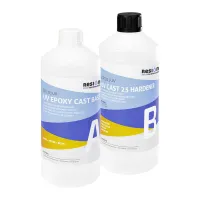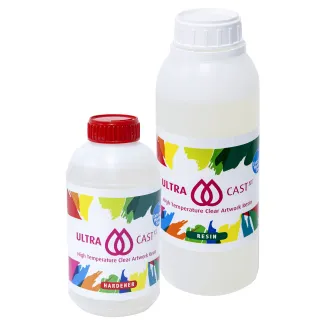
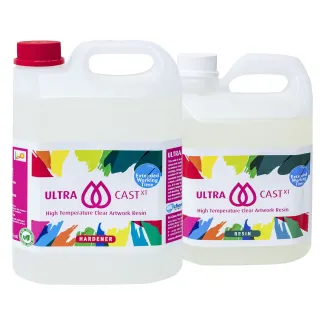
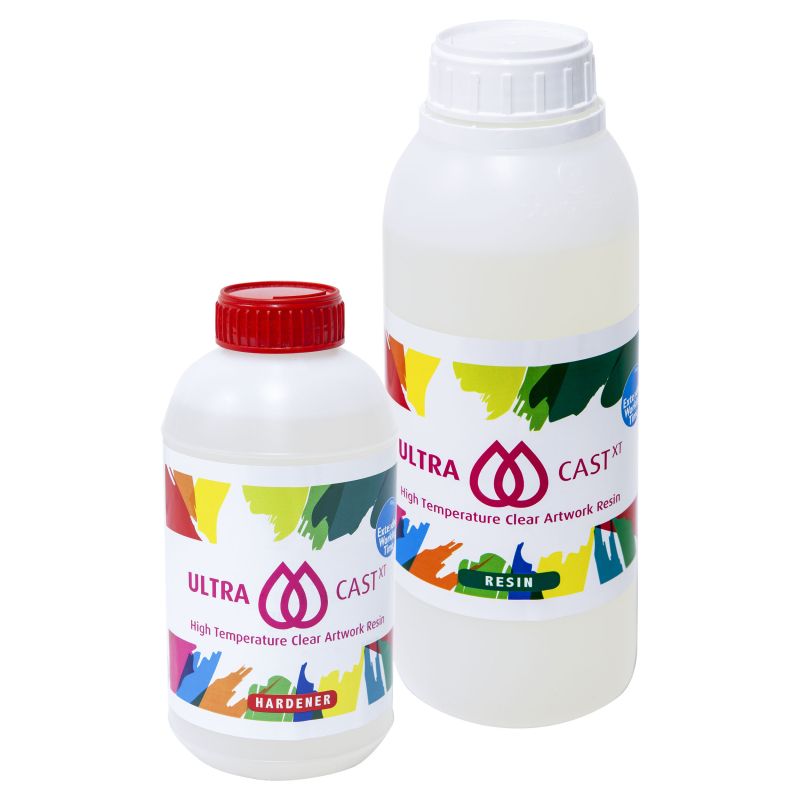
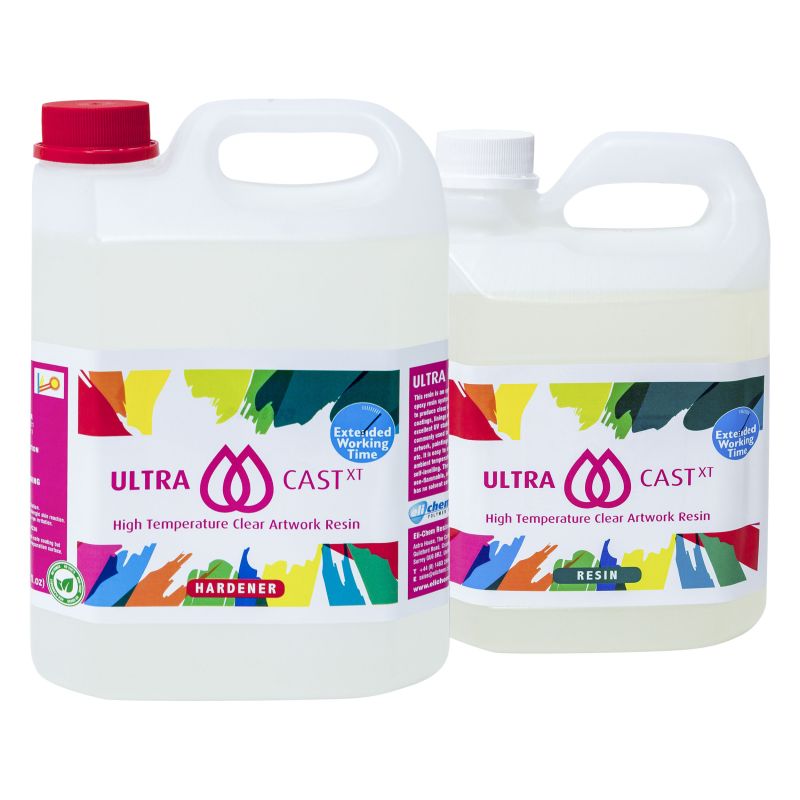

Ultra-Cast XT | A | 500 gr
UFI: E600-6059-M007-5S7F
UltraCast XT Epoxy Resin is the ideal casting resin for coating for example, table tops, bar tops, counters or kitchen blades but can also be used for casting of coasters, resin-art or a coin floor. Characteristic of this epoxy resin is its high temperature resistance (70-75ºC) and the transparent end result.
UltraCast XT is easy to process by carefully mixing the two components in a 2:1 mixing ratio. The epoxy has a long processing time of approx. 90 minutes, while curing is relatively fast. This allows you to quickly finish the surface.
Please note: adding colour pigments or other additives can negatively affect the temperature resistance of the epoxy. Due to the long processing time, UltraCast XT is sensitive to amine blush (a waxy layer on the surface) under certain conditions. This risk is greater in high humidity, low ambient temperatures (15°C or lower) and draughty or windy conditions, such as with air conditioning. To prevent this effect, we recommend preheating the resin component (component A) slightly before mixing. Also ensure a stable work space with a constant temperature and humidity during curing.
Ultracast XT Epoxy casting resin is suitable for coating such items as:
| Packaging | Resin | Hardener |
| 0.75 kg | 0.5 kg | 0.25 kg |
| 1.5 kg | 1 kg | 0.5 kg |
| 7.5 kg | 5 kg | 2.5 kg |
| 15 kg | 10 kg | 5 kg |
Mixing ratio: 2:1 (2 parts epoxy and 1 part hardener)
Processing time: 90 minutes
Dust dry: 12 hours
Time to fully cure: 7-10 days
Temperature resistance: 70-75°C
Chemical and temperature resistant: after at least 7 days at 20°C
Shelf life: 1 year in closed packaging
UltraCast XT Epoxy Resin and all other Epoxy products can be easily purchased at Polyestershoppen.com. If you order today before 5:00 pm CET (Central European Time), your order will be shipped today. Do you have a question about the UltraCast epoxy resin or can we help you with something else? Our specialists provide free advice. Please contact our customer service for this.
The key technical properties clearly listed in one place.
Working time is the period during which a product remains workable after mixing or activation, usually given in minutes at a specified temperature, often 20 °C. With reactive resins, the chemical reaction also continues in the mixing container, and larger quantities or higher temperatures can shorten this time. Working time is different from gel time and full curing time.
UV stabilisation helps a material better withstand the effects of sunlight, including yellowing and deterioration of its properties. It slows ageing but does not make a resin or plastic completely resistant to UV exposure. The degree of protection varies by product.
The technical product category, such as primer, resin, hardener or cleaner. It explains the product's purpose and helps you find other products with a similar function.
The tasks a product is intended for, such as laminating, casting, bonding, sealing or protecting. Products intended for the same application can differ considerably in processing, curing time and final properties.
Mixing ratio indicates how much of each component is needed, for example resin (A) and hardener (B). A ratio of 100:50 by weight means 100 grams of A to 50 grams of B; by volume you might use millilitres. Weight and volume ratios are not necessarily the same because the components may have different densities. Accurate measuring is important for proper curing.
The period for which an unopened product remains usable under the specified storage conditions. Check whether the period starts from the manufacturing date or another date. Shelf life may be shorter after opening, especially for products sensitive to air or moisture.
A paint or varnish layer is dust-dry when settling dust is less likely to stick to the surface. It may not yet be touch-dry, ready for overcoating or suitable for loading; these are different stages of drying and curing.
Curing time is the period a product needs to reach a specified stage of cure. It is usually given in hours or days, often at a reference temperature such as 20 °C. A product may be tack-free or safe to handle before reaching its full mechanical and chemical resistance. Film thickness and mixed quantity may also affect the time.
Heat resistance describes the temperature a material can withstand after correct processing and curing, usually expressed in degrees Celsius (°C). Continuous exposure is different from a brief temperature peak, and mechanical loading may also affect the limit. Heat resistance is not the same as the temperature at which the product can be applied.
Read the warnings and use appropriate protective equipment before handling the product.
UFI: E600-6059-M007-5S7F
UFI: G300-P0FW-900R-GEND
Useful additions for your project.