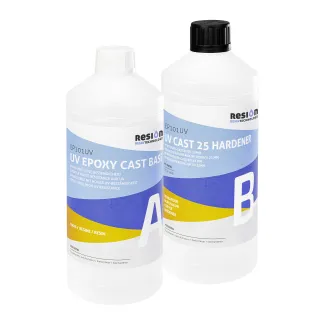
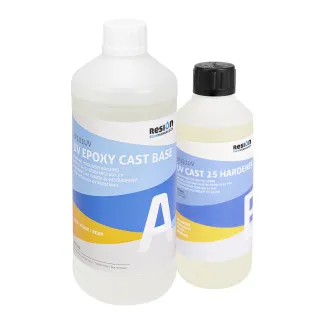
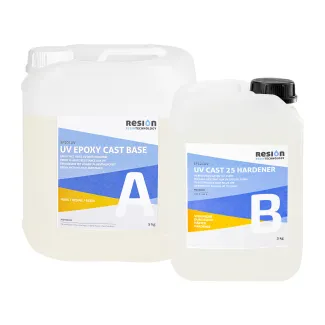
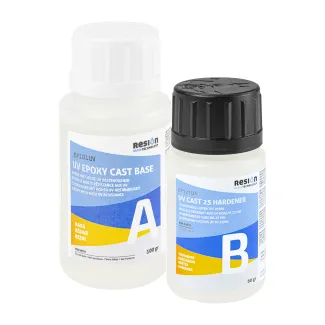
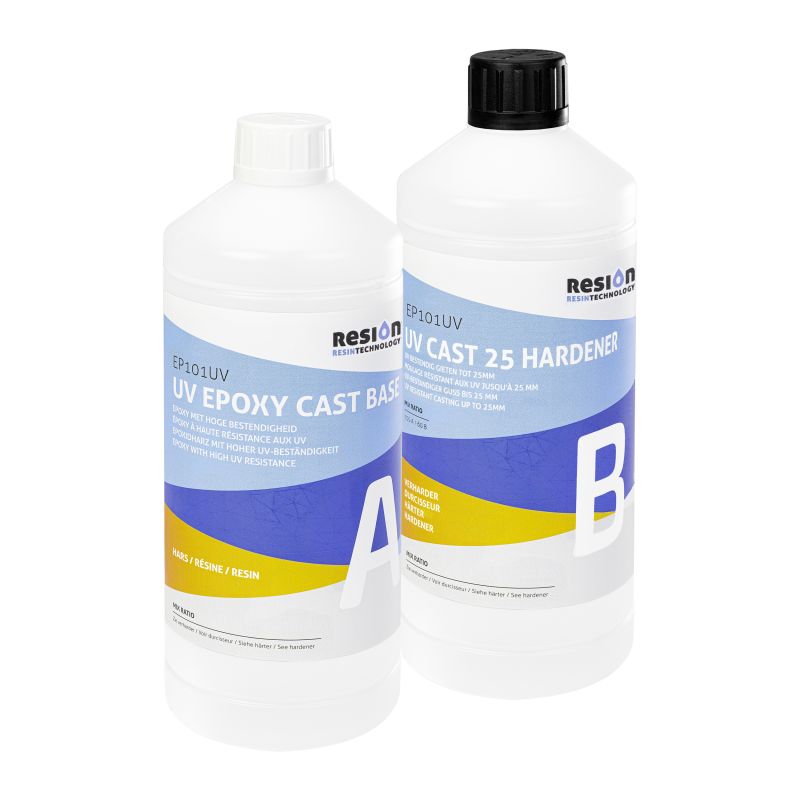
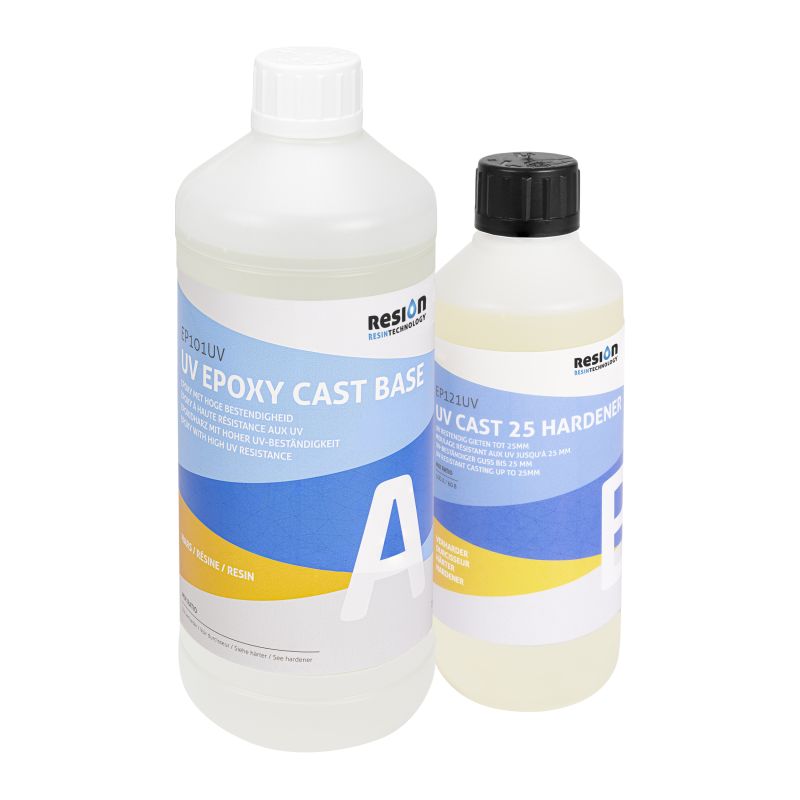
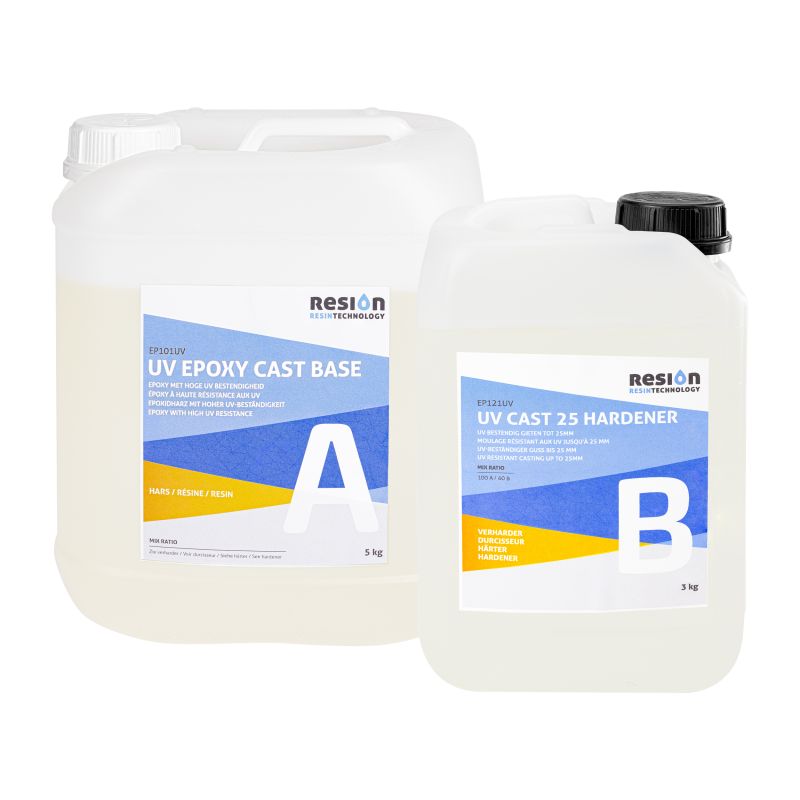
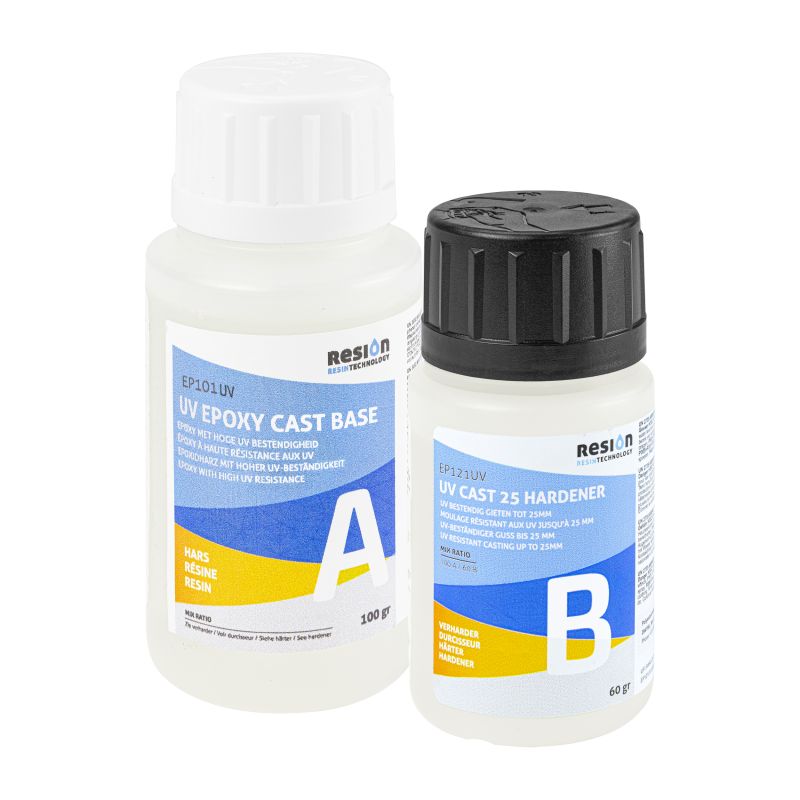

EP101UV | UV Epoxy BASE | 100 grams
UFI: Q8J0-H03E-D005-NSVM
Are you looking for epoxy for creating artwork? Please check out our RESION UV Epoxy resin. This is the epoxy with the highest quality and very high UV resistance. This epoxy resin has been specially developed to be resistant to sunlight for a long period of time. Therefore no UV stabiliser is needed. The quality of the resin has also been greatly improved. This epoxy resin is very suitable for making Resin Art, jewelry and coasters.
When you buy epoxy resin, you're guaranteed a crystal clear and solvent-free casting resin. Ideal for making resin art. Epoxy consists of two components that need to be mixed and allowed to harden. Want to know how much epoxy resin you need? Use the handy calculator on the right and buy the right amount of epoxy resin right away.
RESION's epoxy resin has undergone numerous UV resistance tests. By intensively testing the resin over a long period of time in a specially designed UV booth, we can guarantee the highest quality and wide applicability. Polyestershoppen's epoxy resin is truly crystal clear.

Epoxy resin is very easy to use. Mix the base and hardener according to the ratio. Mix well for three minutes and use a scale to weigh everything thoroughly.
Contents: 160 gram, 0,8 kg, 1,6 kg, 8 kg, 16 kg, 32 kg, 64 kg (sets with epoxy resin and hardener)
Mixing ratio: 100:60 (100 grams of resin, 60 grams of hardener)
Pot life: 30 to 60 minutes (20℃)
Dust dry after: approx. 6-12 hours (20℃)
Can be handled after: 12-18 hours (20℃)
Minimum processing temperature: 12℃
Full cure: 3-5 days
All proportions in a diagram? Check our Mixing schedule epoxy resin (100:60).
Do you want more information or advice on how to use RESION epoxy resin? No problem, we are happy to help and give advice! Check the information centre for an answer to your question or contact us directly on +31 85 022 0090. Need immediate assistance? Then send us a chat message. We are at your service and are happy to advise you.
The key technical properties clearly listed in one place.
The technical product category, such as primer, resin, hardener or cleaner. It explains the product's purpose and helps you find other products with a similar function.
UV stabilisation helps a material better withstand the effects of sunlight, including yellowing and deterioration of its properties. It slows ageing but does not make a resin or plastic completely resistant to UV exposure. The degree of protection varies by product.
The tasks a product is intended for, such as laminating, casting, bonding, sealing or protecting. Products intended for the same application can differ considerably in processing, curing time and final properties.
Working time is the period during which a product remains workable after mixing or activation, usually given in minutes at a specified temperature, often 20 °C. With reactive resins, the chemical reaction also continues in the mixing container, and larger quantities or higher temperatures can shorten this time. Working time is different from gel time and full curing time.
Mixing ratio indicates how much of each component is needed, for example resin (A) and hardener (B). A ratio of 100:50 by weight means 100 grams of A to 50 grams of B; by volume you might use millilitres. Weight and volume ratios are not necessarily the same because the components may have different densities. Accurate measuring is important for proper curing.
Minimum application temperature is the lowest temperature at which a product may be used according to the manufacturer. The limit can apply to the air, substrate and product itself.
At lower temperatures, resins and coatings can become thicker and cure more slowly. Moisture can also condense on a cold substrate and reduce adhesion. Check the dew point and measure the surface temperature before starting. A longer drying time does not automatically make application below the specified minimum acceptable.
At this point, the material is generally firm enough to handle carefully, move or remove from a mould. Sanding, heavier loads or extended use may require further curing.
The period for which an unopened product remains usable under the specified storage conditions. Check whether the period starts from the manufacturing date or another date. Shelf life may be shorter after opening, especially for products sensitive to air or moisture.
Maximum casting thickness is the depth of resin that can be poured in one operation, usually in millimetres (mm) or centimetres (cm). In overly thick or large casts, heat from the reaction can build up and cause discolouration, cracking or distortion. The limit also depends on total casting volume, mould shape and temperature.
A solvent-free product contains no added solvents according to the manufacturer's specification. This does not automatically mean it is odourless, emission-free or safe to use without protective measures.
A paint or varnish layer is dust-dry when settling dust is less likely to stick to the surface. It may not yet be touch-dry, ready for overcoating or suitable for loading; these are different stages of drying and curing.
Curing time is the period a product needs to reach a specified stage of cure. It is usually given in hours or days, often at a reference temperature such as 20 °C. A product may be tack-free or safe to handle before reaching its full mechanical and chemical resistance. Film thickness and mixed quantity may also affect the time.
Viscosity measures how easily a liquid flows, or how thick it is. Dynamic viscosity is usually expressed in mPa·s (millipascal-seconds), sometimes in cP (centipoise); 1 mPa·s = 1 cP. A lower value usually means a more free-flowing liquid, while a higher value indicates a thicker product. Temperature and test method strongly affect the value. Note that mPa·s is different from MPa, which is used to express mechanical strength.
Heat resistance describes the temperature a material can withstand after correct processing and curing, usually expressed in degrees Celsius (°C). Continuous exposure is different from a brief temperature peak, and mechanical loading may also affect the limit. Heat resistance is not the same as the temperature at which the product can be applied.
Read the warnings and use appropriate protective equipment before handling the product.
UFI: Q8J0-H03E-D005-NSVM
UFI: FWA0-2011-Q00J-QHRU
Useful additions for your project.