Mirka Interface Pad (Ø150 mm)
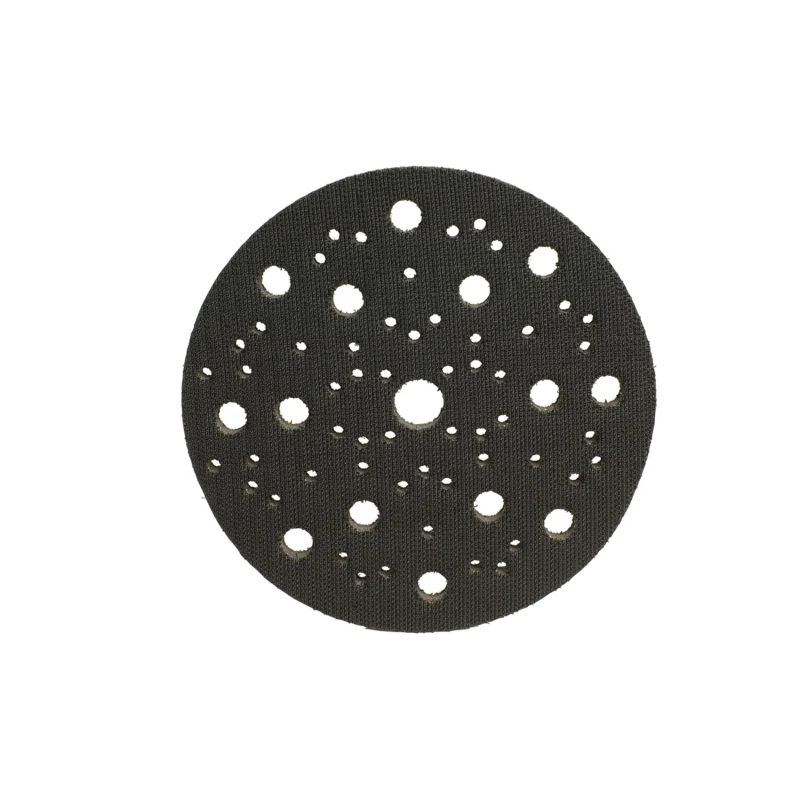
At a glance
- Softer sanding on curved areas
- 67 dust extraction holes
- 5 or 10 mm thick

The Mirka Interface Pad Ø150 mm is a soft intermediate pad that allows you to sand curved and rounded surfaces more evenly. It is easily attached between the backing pad and sanding disc of your sander. This provides a softer sanding action and allows the sanding disc to follow the shape of the surface more easily. The interface pad is available in two thicknesses: 5 mm and 10 mm.
Benefits of the Mirka Interface Pad
- Provides a softer sanding action.
- Suitable for sanding larger curves and contours.
- Available in 5 mm and 10 mm thicknesses.
- Easy to attach with hook-and-loop fastening.
What is the Mirka Interface Pad Ø150 mm used for?
This Mirka Interface Pad is suitable for sanding larger curved surfaces, rounded shapes and contours. The soft intermediate layer allows the sanding disc to flex more easily during sanding. This is particularly useful when working on surfaces that are not completely flat.
The interface pad is compatible with Mirka DEROS 625, 650 and 680 sanders. It can also be used with the Mirka DEROS 5650 equipped with a 150 mm backing pad.
Which thickness should you choose?
- 5 mm: suitable when you need a thin, soft intermediate pad for sanding gently curved surfaces.
- 10 mm: suitable when you need a thicker intermediate pad that provides more flexibility when sanding pronounced curves and contours.
Product properties
The key technical properties clearly listed in one place.
- Article number
- SCH002384
- Diameter
- 150 mm
-
The number of individual products or parts supplied in one set. A set may contain several identical items or a mixture of components; check the package contents for exactly what is included.
- 1 piece
-
The physical thickness of the supplied material, such as a panel, pad, film or foam sheet. This differs from the thickness of a liquid coating applied to a surface.
- 5 mm or 10 mm
-
The arrangement of extraction holes in a sanding disc or backing pad. A matching hole pattern helps remove sanding dust. Check that the holes line up with the backing pad and dust extraction system.
- 67
-
How an accessory or material is attached, for example with hook-and-loop fastening, a threaded connection, a clamp or a self-adhesive layer. The fastening method must match the machine, tool or substrate.
- Hook and loop