Body casting silicone rubber
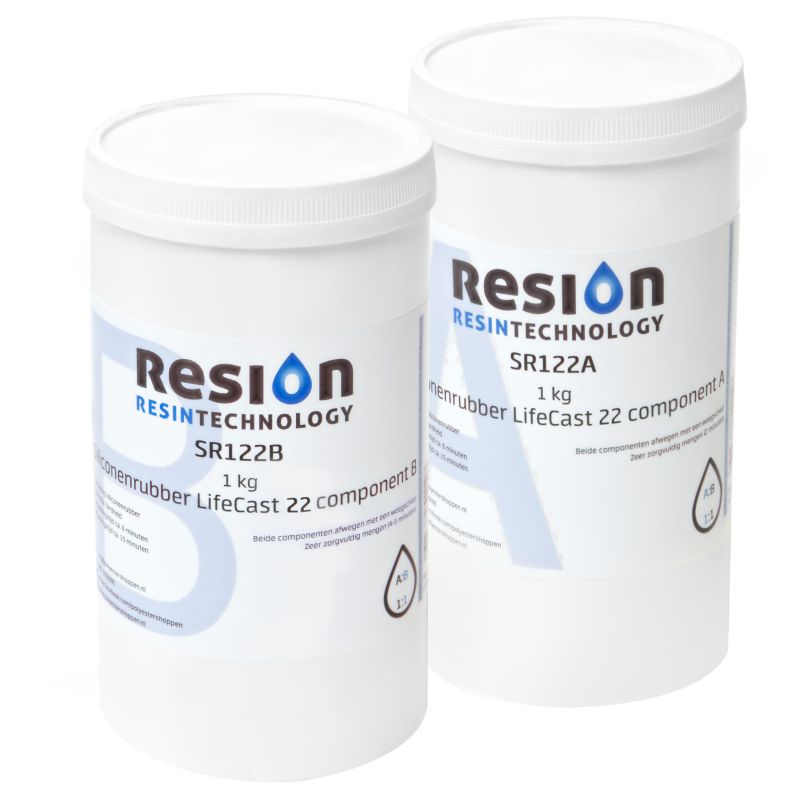
At a glance
- Cures in 25 minutes
- Suitable for skin contact
- Flexible silicone rubber

Product description
Body Casting Silicone 22 is a skin-safe RTV-2 silicone rubber specially developed for applications where the material comes into temporary direct contact with the skin. This thixotropic silicone rubber is widely used for body casting, life casting, skin impressions and creating highly detailed body moulds where comfort and accurate detail reproduction are important.
Thanks to its soft and flexible properties, the silicone rubber feels comfortable on the skin and accurately captures even the finest details. Its thixotropic formulation ensures the silicone stays in place on vertical surfaces without sagging or running during application.
The silicone rubber is easy to use thanks to its 1:1 mixing ratio and short curing time. This makes it suitable for professional applications, workshops and creative home projects.
Key features of Body Casting Silicone 22
- Suitable for temporary skin contact.
- Thixotropic; will not sag on vertical surfaces.
- High tensile and tear strength.
- Excellent detail reproduction.
- Flexible and comfortable during use.
- Excellent ageing resistance.
What is skin-safe silicone rubber?
Skin-safe silicone rubber is a two-component addition-cure silicone specially developed for applications where skin contact and comfort are important. Unlike standard silicone rubbers, this formulation is suitable for temporary skin contact, making it ideal for taking impressions of hands, feet, faces and other body parts.
After mixing, the material forms a spreadable compound that can be applied easily to the skin. The silicone accurately captures fine details and forms a flexible, tear-resistant mould that can be carefully removed from the skin once cured.
How to use Body Casting Silicone 22 - for beginners and professionals
- Thoroughly stir both components separately in their containers before use.
- Weigh the base (component A) and hardener (component B) in a 1:1 ratio by weight (a maximum deviation of 5% is acceptable).
- Ensure the mixing container and tools are clean, dry and free from grease.
- Mix both components thoroughly, scraping the sides and bottom of the mixing container until a homogeneous pink colour is achieved.
- Apply the silicone rubber to the skin within the 10-minute working time.
- Please note: certain types of petroleum jelly, oils or other substances may inhibit curing. If in doubt, always carry out a small test beforehand.
- Allow the silicone to cure completely, then carefully remove the mould from the skin.
Specifications
| Packaging | Base (SR1-BC-22A) | Hardener (SR1-BC-22B) |
| 2 kg set | 1 kg | 1 kg |
| 5 kg set | 2.5 kg | 2.5 kg |
| 50 kg set | 25 kg | 25 kg |
Type: Addition-cure silicone (RTV-2)
Colour: pink (mixed)
Mixing ratio: 1:1 (by weight)
Density: 1.14 g/cm³ (at 23 °C)
Working time: 10 minutes (at 23 °C)
Curing time: 25 minutes (at 23 °C)
Hardness: Shore A 22
Tensile strength (ASTM D412): 2.5 N/mm²
Elongation at break (ASTM D412): 360%
Tear strength (ASTM D624): 14 N/mm
Temperature resistance (cured): -40 °C to +200 °C
Product properties
The key technical properties clearly listed in one place.
- Article number
- SIL000319
-
The technical product category, such as primer, resin, hardener or cleaner. It explains the product's purpose and helps you find other products with a similar function.
- Silicone casting rubber
-
Mixing ratio indicates how much of each component is needed, for example resin (A) and hardener (B). A ratio of 100:50 by weight means 100 grams of A to 50 grams of B; by volume you might use millilitres. Weight and volume ratios are not necessarily the same because the components may have different densities. Accurate measuring is important for proper curing.
- 1:1 (by weight)
-
The tasks a product is intended for, such as laminating, casting, bonding, sealing or protecting. Products intended for the same application can differ considerably in processing, curing time and final properties.
- Making a plaster hand
-
Hardness describes a material's resistance to indentation. For silicone rubber and other elastomers, the Shore A scale is commonly used: Shore A 15, for example, is softer than Shore A 40. Harder plastics may be rated on the Shore D scale. The number belongs to its Shore scale and is not a unit like MPa; values on different scales cannot be directly compared.
- Shore 22
-
Density describes the mass of a material per unit volume. Values may be given in g/cm³, kg/L or kg/m³; 1 g/cm³ equals 1 kg/L. For example, one litre of a liquid with a density of 1.2 kg/L weighs approximately 1.2 kg. Density helps convert between weight and volume, but it can vary with temperature.
- 1.14 kg/L (23 °C)
-
Curing time is the period a product needs to reach a specified stage of cure. It is usually given in hours or days, often at a reference temperature such as 20 °C. A product may be tack-free or safe to handle before reaching its full mechanical and chemical resistance. Film thickness and mixed quantity may also affect the time.
- 25 minutes (at 23 °C)
- Net contents
- 2 kg, 50 kg, 5 kg
-
Working time is the period during which a product remains workable after mixing or activation, usually given in minutes at a specified temperature, often 20 °C. With reactive resins, the chemical reaction also continues in the mixing container, and larger quantities or higher temperatures can shorten this time. Working time is different from gel time and full curing time.
- Approximately 10 minutes (at 23 °C)