
UFI: E1G0-C053-E009-FWQX
RESION Pavistone Gravel Binder
At a glance
- 1K gravel binder
- High UV resistance
- Water-permeable
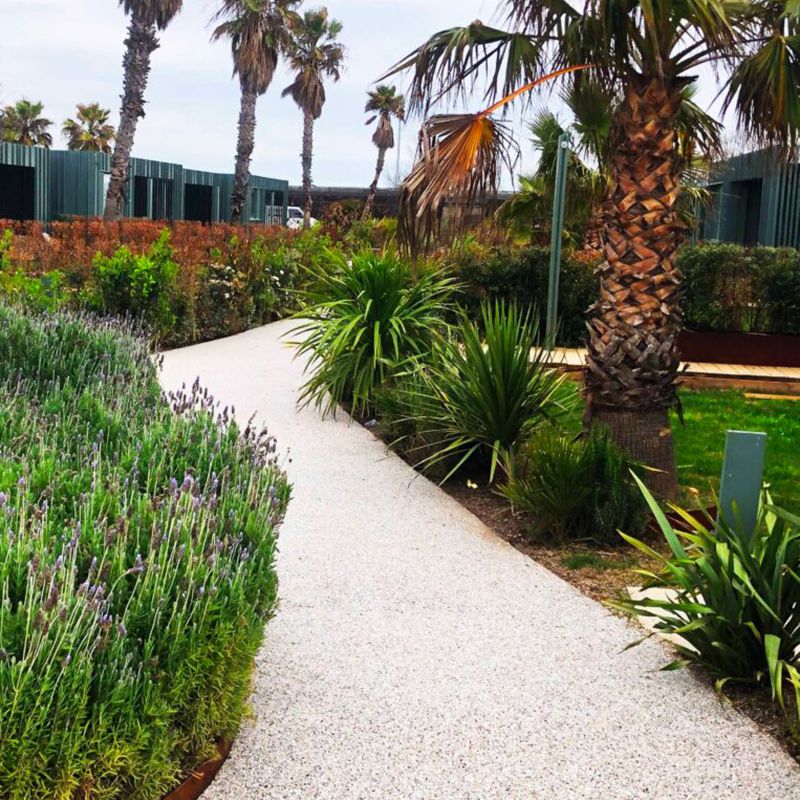
RESION Pavistone is a 1-component aliphatic polyurethane resin, suitable for use as gravel binder. In combination with gravel, Pavistone creates a smooth, modern, sturdy and easy-to-maintain floor with porous or semi-porous properties, ideal for outdoor use. Pavistone is therefore ideal for garden paths, cycle paths and as a walking path in parks. The floor finish is clear, seamless, flexible, water-permeable and crack-resistant.
Pavistone is an excellent 1-component alternative to Fixmaster Gravel Bonding Resin.
Features Pavistone Gravel Binder
- High UV resistance (non-yellowing).
- Easy to apply (1-component).
- Elastic.
- Water-permeable.
Applications
RESION Pavistone Gravel Binder is very suitable for use in treating:
- Paths
- Parking decks
- Bike lanes
- Ramps
- Pedestrian areas
- Parks
- Roads
- Footbridges
- Residential areas
Directions for use
Follow the instructions below to apply RESION Pavistone correctly.
Surface preparation
To create good adhesion, it is important to prepare the surface properly. Therefore, always ensure that the surface is flat and leveled. Previously repair cracks and fissures and make sure the surface is clean, dry and free of grease.
Pavistone mixratio
We recommend mixing Pavistone in the proportions shown in the table below:
| Gravel | Pavistone |
| Normal, soft, coarse gravel | 3-5% |
| Small or porous parts | 5-7% |
| Irregular sizes | 5-7% |
Application
- Stir the resin into a homogeneous mass.
- Mix the resin with the gravel using a mechanical mixer (not a cordless drill). Use the table below as a guideline for consumption estimations:
| Gravel | Desired thickness | Totaal gewicht (Pavistone + grind) |
| 6-10 mm | 15 mm | 30 kg/m2 |
| 6-10 mm | 20 mm | 40 kg/m2 |
| 6-10 mm | 25 mm | 50 kg/m2 |
| 6-10 mm | 30 mm | 60 kg/m2 |
- Mix the resin and gravel thoroughly for a few minutes to prevent colour differences.
- Spread the mixture evenly using a trowel, making sure to achieve the desired thickness.
- Press the layer gently to obtain a smooth surface.
- Allow the mixture to harden thoroughly. The hardening time depends greatly on the local conditions. At high temperatures the hardening time is faster than at low ambient temperatures.
After approximately 24 hours the surface is fully hardened and can be lightly loaded after approximately 48 hours.
Specifications
Chemical description: aliphatic polyurethane
Contents: 5 kg, 25 kg
Colour: clear (transparent)
Solid density: 1.12 g/cm3
Application: trowel
Potlife: 90-120 minutes (at 20°C)
Processing temperature: 10°C - 25°C
Dust dry: after 7 hours
Curing time: 24 hours
Surface can be loaded: after 48 hours
Shelf life: 12 months (stored at temperatures between 10°C and 30°C)
Product properties
The key technical properties clearly listed in one place.
- Article number
- VLO001809
-
The recommended application temperature range indicates the conditions under which the product can generally be applied and cured properly. Three temperatures matter:
- Air: the temperature in the workshop or outdoors.
- Substrate: the temperature of the surface being treated.
- Product: the temperature of the resin, adhesive or coating itself.
A cold substrate can cause condensation and affect adhesion. At higher temperatures, two-component products may react faster, reducing their working time. Check the dew point and follow the product instructions.
- 10-25 °C
-
The chemical base describes the chemistry of an adhesive, sealant, resin or coating, such as epoxy, polyester, polyurethane, (methyl)methacrylate or a hybrid polymer. It affects curing, flexibility and adhesion. Products with the same chemical base are not necessarily suitable for the same applications.
- Aliphatic polyurethane
-
Density describes the mass of a material per unit volume. Values may be given in g/cm³, kg/L or kg/m³; 1 g/cm³ equals 1 kg/L. For example, one litre of a liquid with a density of 1.2 kg/L weighs approximately 1.2 kg. Density helps convert between weight and volume, but it can vary with temperature.
- 1.12 kg/L
-
The period for which an unopened product remains usable under the specified storage conditions. Check whether the period starts from the manufacturing date or another date. Shelf life may be shorter after opening, especially for products sensitive to air or moisture.
- 12 months
-
A paint or varnish layer is dust-dry when settling dust is less likely to stick to the surface. It may not yet be touch-dry, ready for overcoating or suitable for loading; these are different stages of drying and curing.
- 7 hours
-
Curing time is the period a product needs to reach a specified stage of cure. It is usually given in hours or days, often at a reference temperature such as 20 °C. A product may be tack-free or safe to handle before reaching its full mechanical and chemical resistance. Film thickness and mixed quantity may also affect the time.
- 1 day
- Net contents
- 25 kg, 5 kg
-
The application or processing methods specified by the manufacturer, such as brushing, rolling, spraying, casting or hand laminating. The chosen method can affect consumption, layer thickness and finish.
- Trowel
-
Working time is the period during which a product remains workable after mixing or activation, usually given in minutes at a specified temperature, often 20 °C. With reactive resins, the chemical reaction also continues in the mixing container, and larger quantities or higher temperatures can shorten this time. Working time is different from gel time and full curing time.
- Approximately 90-120 minutes (at 20 °C)
- Colour
- Transparant
Safety information
Read the warnings and use appropriate protective equipment before handling the product.