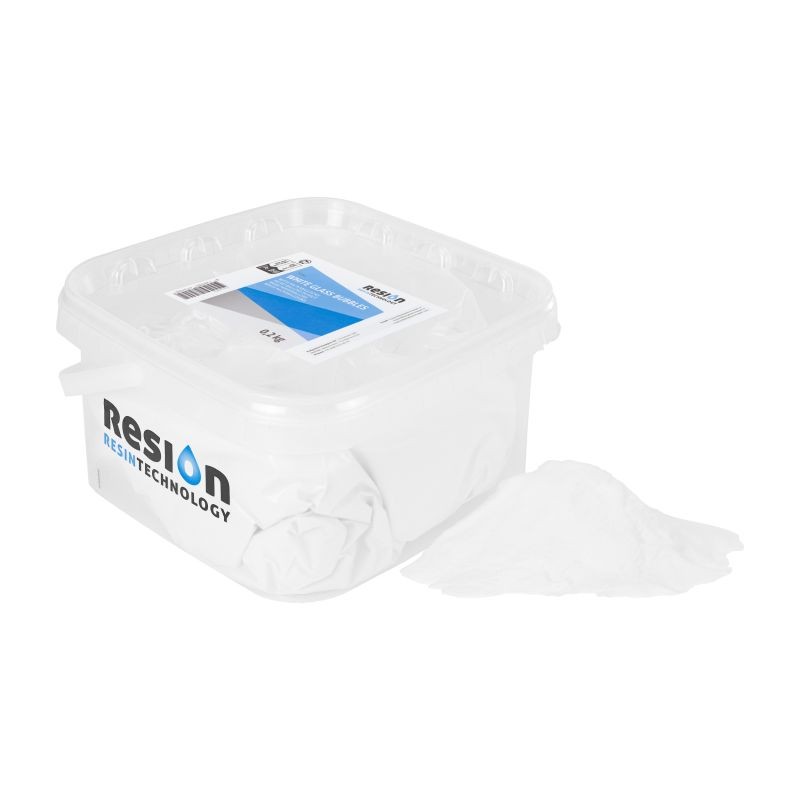
White microballoons (Glass Bubbles)
At a glance
- Lightweight filler for epoxy
- Easy to sand
- Can be mixed with polyurethane

Fast delivery throughout Europe
Secure payment with PayPal, Mastercard, Visa and more
4.7 out of 5 stars on Trusted Shops
Product description
White microballoons, also called glass bubbles, are super light hollow glass spheres that are ideal for thickening epoxy and PU resins into easily sandable fillers. Thanks to their low specific weight (0.10-0.20 g/cc) you can easily make light fillers that are excellent to work with.
Microballoons are often used for making fillers, adhesives and lighter casting compounds. For optimum workability, a mixture of 1 part white microballoons and 1 part red microballoons (by volume) is often used.
Applications
Thanks to their round structure and low density, white microballoons are versatile in use:
- In epoxy resin for making easy-to-sand fillers.
- In PU casting resin for making lightweight castings that can float.
- In epoxy foam for a finer and more even cell structure.
- In combination with red microballoons for an optimum balance between strength and sandability.
Benefits of white microballoons
- Very low density (0.10 - 0.20 g/cc).
- Limited influence on viscosity.
- Very good sandability after curing.
- Lightweight end result.
- Easy to process.
Dosage
- Castings: approx. 10%
- Adhesives: approx. 15%
- Putties: approx. 25%
Product properties
The key technical properties clearly listed in one place.
- Article number
- VUL000151
-
The materials, substrates or tasks a product is intended for. A general claim such as 'suitable for plastics' does not mean it works with every type of plastic; the specific substrate and its preparation still matter.
- Epoxy, Polyurethane
-
The tasks a product is intended for, such as laminating, casting, bonding, sealing or protecting. Products intended for the same application can differ considerably in processing, curing time and final properties.
- Putty, Casting
- Net contents
- 12.5 kg, 1 kg, 200 g
-
Density describes the mass of a material per unit volume. Values may be given in g/cm³, kg/L or kg/m³; 1 g/cm³ equals 1 kg/L. For example, one litre of a liquid with a density of 1.2 kg/L weighs approximately 1.2 kg. Density helps convert between weight and volume, but it can vary with temperature.
- 0,10-0,20 gr/cc
Safety information
Read the warnings and use appropriate protective equipment before handling the product.

Reviews
Frequently bought together
Useful additions for your project.
Recommended

Often chosen

Often chosen