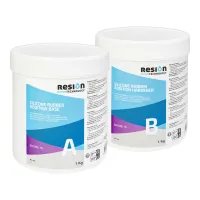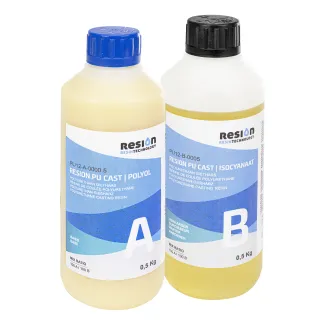
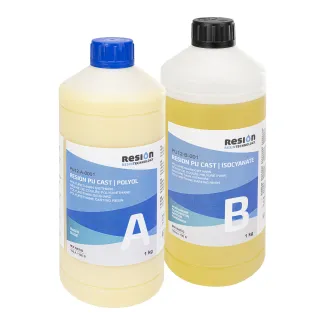
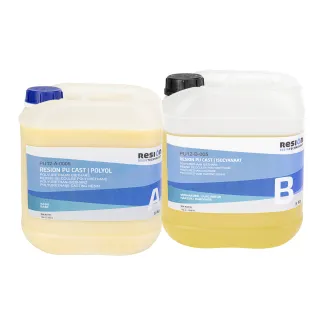
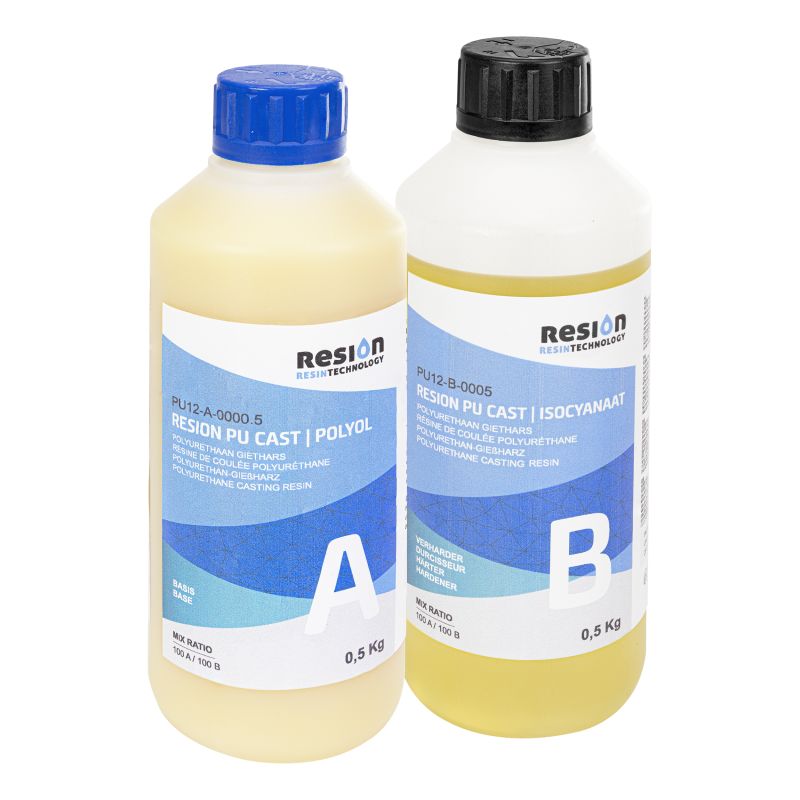
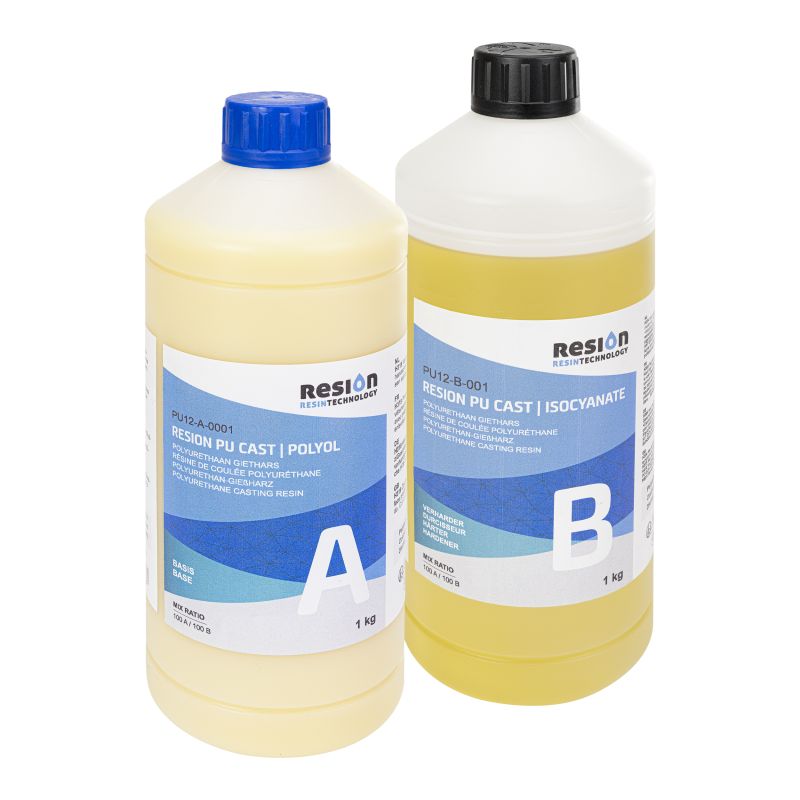
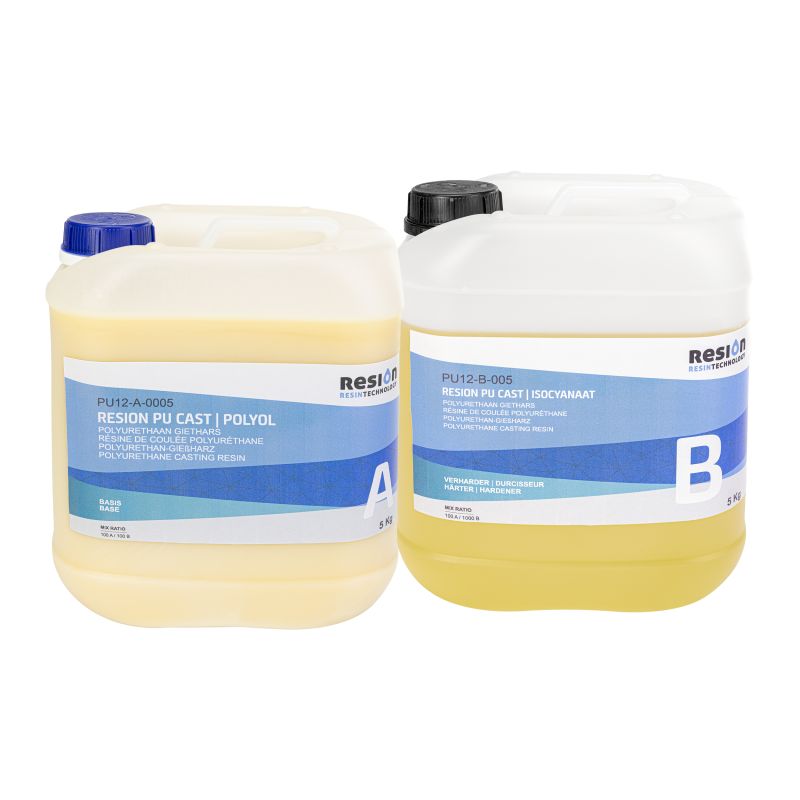

RESION PU Casting Resin
At a glance
- For model making and industry
- 1:1 mixing ratio
- Fast curing
Product description
RESION PU casting resin is a fast-hardening 2-component polyurethane casting resin. The resin enables excellent reproduction of details and is therefore suitable for a wide range of applications in model making and mechanical engineering.
PU casting resin from RESION is characterised by easy processing (1:1 mixing ratio), fast curing, low viscosity and high temperature resistance. This makes the polyurethane resin extremely suitable for producing moulds, replicas and prototypes. RESION polyurethane casting resin is a comparable alternative to Rencast FC52/FC53.
Features RESION PU Casting Resin
- Easy processing (1:1 mixing ratio).
- Rapid curing.
- Excellent reproduction of details.
- High temperature resistance.
-
Suitable for castings up to 10 cm thick.
Directions for use
Polyurethane casting resin is easy to use. Just follow the steps below.
- Weigh components A and B accurately using the correct mixing ratio (1:1 by weight).
- Mix the two components carefully until the mixture has a uniform color.
- Process the resin according to the intended application (processing time is approximately 7-8 minutes).
- Allow the PU resin to harden (fully cured after approximately 24 hours).
Applications
You can use this casting resin for the following applications:
- Casting models
- Art objects
- Model making
- Fishing lures
- Core boxes
- Negative moulds
- Pattern plates
- Inspection models
- Master models
-
Prototype machining test pieces
Specifications
| Packaging | Polyol (A) | Isocyanate (B) |
| 1 kg | 0.5 kg | 0.5 kg |
| 2 kg | 1 kg | 1 kg |
| 10 kg | 5 kg | 5 kg |
| 50 kg | 25 kg | 25 kg |
| 400 kg* | 200 kg | 200 kg |
Article code: PU12
Colour: ivory
Base: Ebalta SG 2000 L
Mixing ratio: 1:1 (weight)
Working time: 7-8 minutes
Demoulding time: 60-90 minutes
Viscosity: 55 mPas.
Density: 1.1 g/cm³
Heat resistance: 89°C
Hardness: Shore 72D
Shelf life: 12 months when stored in the original unopened packaging at temperatures between 18°C and 25°C.
*The 400 kg set is supplied in open steel drums. Thoroughly stir component A before use.
Product properties
The key technical properties clearly listed in one place.
- Article number
- POL001365
-
The technical product category, such as primer, resin, hardener or cleaner. It explains the product's purpose and helps you find other products with a similar function.
- PU casting resin
-
The chemical base describes the chemistry of an adhesive, sealant, resin or coating, such as epoxy, polyester, polyurethane, (methyl)methacrylate or a hybrid polymer. It affects curing, flexibility and adhesion. Products with the same chemical base are not necessarily suitable for the same applications.
- Ebalta SG 2000 L
-
Density describes the mass of a material per unit volume. Values may be given in g/cm³, kg/L or kg/m³; 1 g/cm³ equals 1 kg/L. For example, one litre of a liquid with a density of 1.2 kg/L weighs approximately 1.2 kg. Density helps convert between weight and volume, but it can vary with temperature.
- 1.1 kg/L
-
Hardness describes a material's resistance to indentation. For silicone rubber and other elastomers, the Shore A scale is commonly used: Shore A 15, for example, is softer than Shore A 40. Harder plastics may be rated on the Shore D scale. The number belongs to its Shore scale and is not a unit like MPa; values on different scales cannot be directly compared.
- Shore D 72
-
The period for which an unopened product remains usable under the specified storage conditions. Check whether the period starts from the manufacturing date or another date. Shelf life may be shorter after opening, especially for products sensitive to air or moisture.
- 12 months
-
Mixing ratio indicates how much of each component is needed, for example resin (A) and hardener (B). A ratio of 100:50 by weight means 100 grams of A to 50 grams of B; by volume you might use millilitres. Weight and volume ratios are not necessarily the same because the components may have different densities. Accurate measuring is important for proper curing.
- 1:1 (by weight)
- Net contents
- 10 kg, 1 kg, 2 kg, 50 kg
-
Working time is the period during which a product remains workable after mixing or activation, usually given in minutes at a specified temperature, often 20 °C. With reactive resins, the chemical reaction also continues in the mixing container, and larger quantities or higher temperatures can shorten this time. Working time is different from gel time and full curing time.
- Approximately 7-8 minutes
-
Viscosity measures how easily a liquid flows, or how thick it is. Dynamic viscosity is usually expressed in mPa·s (millipascal-seconds), sometimes in cP (centipoise); 1 mPa·s = 1 cP. A lower value usually means a more free-flowing liquid, while a higher value indicates a thicker product. Temperature and test method strongly affect the value. Note that mPa·s is different from MPa, which is used to express mechanical strength.
- 55 mPa·s
-
Heat resistance describes the temperature a material can withstand after correct processing and curing, usually expressed in degrees Celsius (°C). Continuous exposure is different from a brief temperature peak, and mechanical loading may also affect the limit. Heat resistance is not the same as the temperature at which the product can be applied.
- Up to 89 °C
Safety information
Read the warnings and use appropriate protective equipment before handling the product.
RESION PU Cast | Isocyanaat (B) | 0,5 kg
Recommended protective equipment
Hazard pictograms
Warnings and precautions
Reviews
Frequently bought together
Useful additions for your project.