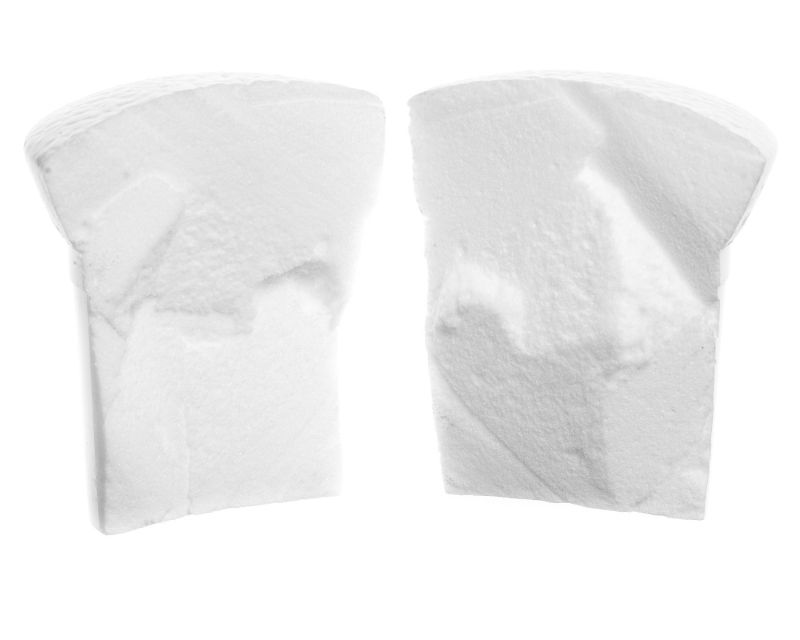

Epoxy foam
At a glance
- High strength/very hard
- Can be screwed in
- Foam factor approx. 6 times
Epoxy foam is a hard, water-resistant and rot-free foam that can be used for various applications such as canoe paddles, filling hollow spaces (even in wet environments), repairing boat rudder blades, making lures and more.
Benefits of epoxy foam
- Rot-free.
- Hard and strong.
- High breakout strength of screwes.
- Adheres to most materials.
Directions for use
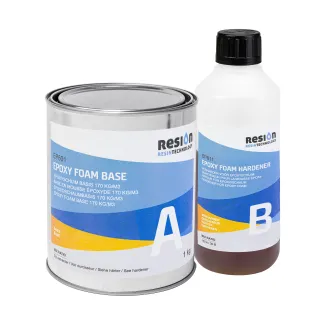
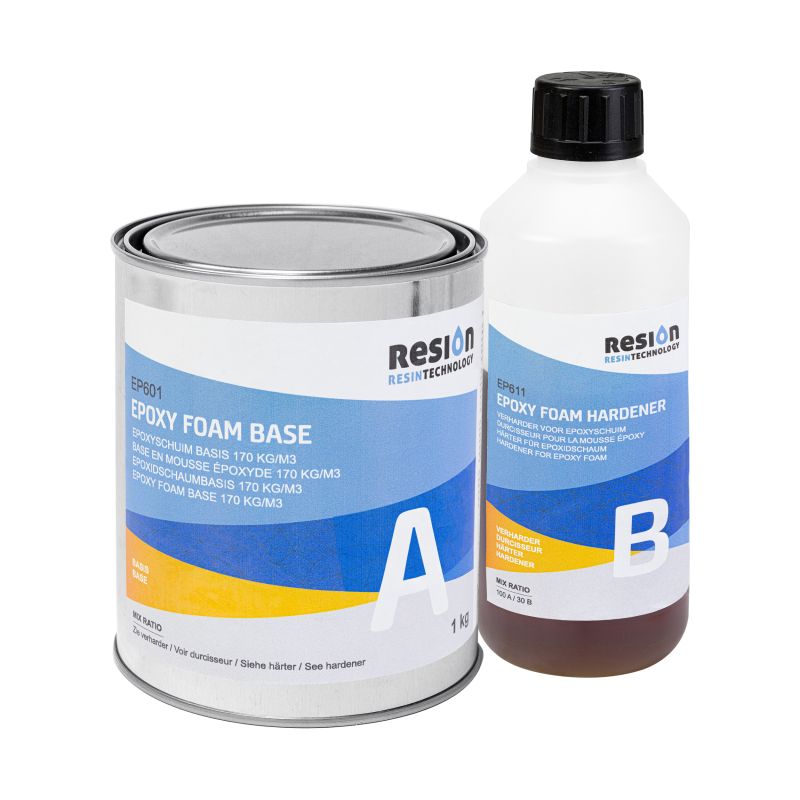
Weigh the amount of basic component in a mixing cup. Add the correct amount of hardener. Mix briefly but carefully, including the sides and bottom of the mixing cup. The epoxy foam will start foaming up in a short time. This frothing proceeds gently and without developing much force so that no damage occurs to the object being poured into. After a few minutes, curing begins and the epoxy foam hardens into a hard, impermeable material.
Specifications
| Packaging | Resin (EP601) | Hardener (EP613) | Liters total (foamed out) |
| 1.25 kg | 1 kg | 0.25 kg | 7 litres |
| 6.25 kg | 5 kg | 1.25 kg | 35 litres |
| 25 kg | 20 kg | 5 kg | 140 litres |
Is insulation important and hardness and water resistance less important? Then it might be cheaper to buy PU foam or PUR foam for complex application.
Buy epoxy foam
RESION Epoxy foam and all other Epoxy products can be easily purchased at Polyestershoppen.com. Would you like more information about Epoxy foam? We are happy to give advice. Get in touch and call +31850220090, send an email to support@polyestershoppen.com or use our live chat.
Product properties
The key technical properties clearly listed in one place.
- Article number
- EPO000342
-
Working time is the period during which a product remains workable after mixing or activation, usually given in minutes at a specified temperature, often 20 °C. With reactive resins, the chemical reaction also continues in the mixing container, and larger quantities or higher temperatures can shorten this time. Working time is different from gel time and full curing time.
- Approximately 4-6 minutes
-
Heat resistance describes the temperature a material can withstand after correct processing and curing, usually expressed in degrees Celsius (°C). Continuous exposure is different from a brief temperature peak, and mechanical loading may also affect the limit. Heat resistance is not the same as the temperature at which the product can be applied.
- Up to 75 degrees celcius
-
UV stabilisation helps a material better withstand the effects of sunlight, including yellowing and deterioration of its properties. It slows ageing but does not make a resin or plastic completely resistant to UV exposure. The degree of protection varies by product.
- Not applicable
-
The technical product category, such as primer, resin, hardener or cleaner. It explains the product's purpose and helps you find other products with a similar function.
- Epoxy system
-
The tasks a product is intended for, such as laminating, casting, bonding, sealing or protecting. Products intended for the same application can differ considerably in processing, curing time and final properties.
- Foam
-
Mixing ratio indicates how much of each component is needed, for example resin (A) and hardener (B). A ratio of 100:50 by weight means 100 grams of A to 50 grams of B; by volume you might use millilitres. Weight and volume ratios are not necessarily the same because the components may have different densities. Accurate measuring is important for proper curing.
- 100:25
-
The recommended application temperature range indicates the conditions under which the product can generally be applied and cured properly. Three temperatures matter:
- Air: the temperature in the workshop or outdoors.
- Substrate: the temperature of the surface being treated.
- Product: the temperature of the resin, adhesive or coating itself.
A cold substrate can cause condensation and affect adhesion. At higher temperatures, two-component products may react faster, reducing their working time. Check the dew point and follow the product instructions.
- 25-30 °C
-
Density describes the mass of a material per unit volume. Values may be given in g/cm³, kg/L or kg/m³; 1 g/cm³ equals 1 kg/L. For example, one litre of a liquid with a density of 1.2 kg/L weighs approximately 1.2 kg. Density helps convert between weight and volume, but it can vary with temperature.
- Approximately 170 kg/m³
-
The period for which an unopened product remains usable under the specified storage conditions. Check whether the period starts from the manufacturing date or another date. Shelf life may be shorter after opening, especially for products sensitive to air or moisture.
- At least 24 months
-
Curing time is the period a product needs to reach a specified stage of cure. It is usually given in hours or days, often at a reference temperature such as 20 °C. A product may be tack-free or safe to handle before reaching its full mechanical and chemical resistance. Film thickness and mixed quantity may also affect the time.
- 24-48 hours
- Net contents
- 1.25 kg, 25 kg, 6.25 kg
Safety information
Read the warnings and use appropriate protective equipment before handling the product.
EP613 | Epoxy Foam Hardener 25 | 0,25 kg
Recommended protective equipment
Hazard pictograms
Warnings and precautions
Reviews
Frequently bought together
Useful additions for your project.