

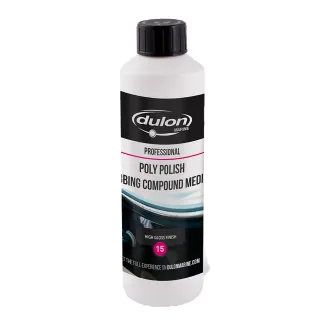
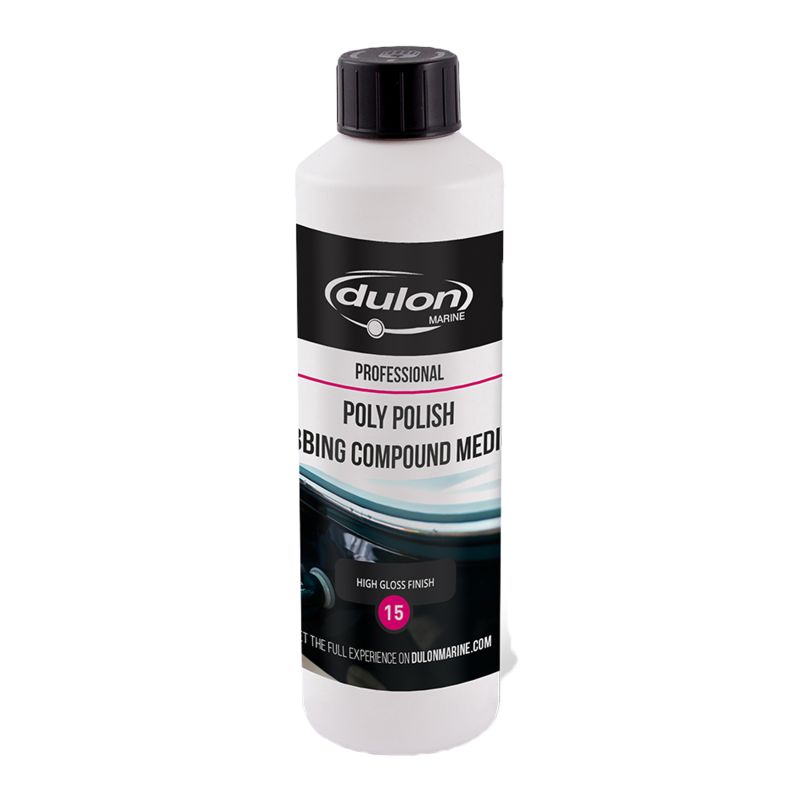
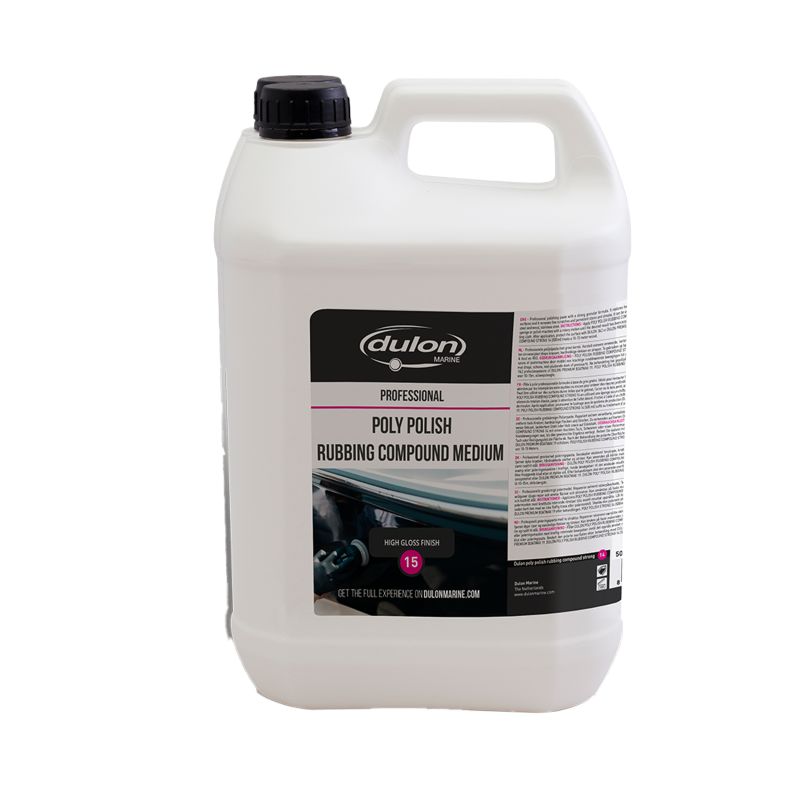
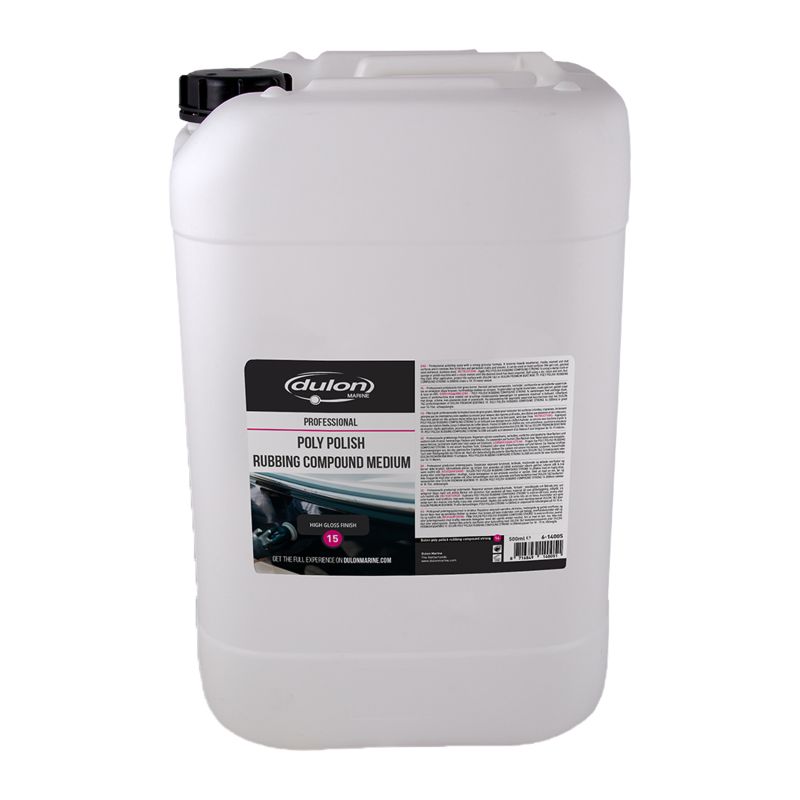
Dulon 15 Rubbing Compound Medium
At a glance
- Professional polishing paste
- Medium grain
- Restores the surface to new
Fast delivery throughout Europe
Secure payment with PayPal, Mastercard, Visa and more
4.7 out of 5 stars on Trusted Shops
Give your boat a beautiful shine with Dulon 15 Rubbing Compound Medium. Dulon 15 is a professional polishing compound with a medium-grit formula. It restores weathered, chalky, discoloured, aged and dull surfaces. It can be used on hard surfaces like gelcoat, painted steel, wood and stainless steel. In addition, Dulon 15 is used to remove scratches, streaks and stubborn stains.
Tip: for heavily weathered surfaces, use Dulon 14 (Compound Strong) and for slightly weathered surfaces, use Dulon 16 (Compound Fine).
Benefits of Dulon 15 Rubbing Compound Medium
- Restores surfaces to new condition.
- Removes scratches, stubborn stains and stripes.
- Easy to use and economical to use.
- Can be used manually or mechanically.
Directions for use
Dulon 15 Rubbing Compound Medium is easy to use. You can easily apply it manually or mechanically. 500 ml treats a vessel 10-15 metres long. If necessary, pre-treat the surface with Dulon 22 (Hull & Waterline Clean) to remove limescale and brownish/yellow marine deposits.
- Use Predulon 00 to clean the surface of dirt, grease, oils and traces of old wax and silicone coatings.
- Apply Dulon 15 with a damp cloth, sponge or polishing machine using rotary motions.
- Do this until the desired result is achieved.
- Let the polishing paste dry until a white haze appears.
- Buff off the residue using a dry, clean, lint-free cloth.
- Treat the polished surface afterwards with Dulon 1&2 or Dulon 19 (Premium Boat Wax) for long-lasting protection.
For mechanical application, please refer to the technical documentation of Dulon 15.
Specifications
Consumption: 500 ml is suitable for a boat of 10-15 metres long
Grit: medium
Application temperature: 5-25 °C
Storage: store in a dry, dark and frost-free place
Packaging:
- 0.5 L
- 5 L
- 25 L
Product properties
The key technical properties clearly listed in one place.
- Article number
- BOO001232
-
The technical product category, such as primer, resin, hardener or cleaner. It explains the product's purpose and helps you find other products with a similar function.
- Polishing
-
The recommended application temperature range indicates the conditions under which the product can generally be applied and cured properly. Three temperatures matter:
- Air: the temperature in the workshop or outdoors.
- Substrate: the temperature of the surface being treated.
- Product: the temperature of the resin, adhesive or coating itself.
A cold substrate can cause condensation and affect adhesion. At higher temperatures, two-component products may react faster, reducing their working time. Check the dew point and follow the product instructions.
- 5-25 °C
-
Grit size affects how much material an abrasive removes and how fine the resulting scratch pattern is. On the FEPA-P scale, the higher the P number, the finer the abrasive grit.
- P60-P80: coarse sanding, stripping old coatings or removing pronounced unevenness.
- P120-P180: further levelling and intermediate sanding.
- P240-P400: finer sanding before the next finishing stage.
- P600 and finer: very fine sanding or preparation for polishing, depending on the material.
These are general guidelines. Choose the grit based on the substrate, desired finish and instructions for the next coat. Different grit grading standards are not always directly comparable.
- Medium
-
The conditions under which a product best retains its quality, including temperature, humidity and protection from direct sunlight. Keeping containers tightly closed is particularly important for moisture-sensitive or volatile products.
- Store dry, away from light and frost-free
-
Consumption or coverage describes how much product is needed for a given surface area. Consumption may be stated in g/m² or kg/m², while coverage is often given in m²/L or m²/kg. A consumption of 0.2 kg/m² means a theoretical 200 grams per square metre. Actual use depends on film thickness, substrate absorbency, application method and waste.
- 500 ml treats a boat 10-15 metres long
- Net contents
- 500 ml
Reviews
Frequently bought together
Useful additions for your project.


Often chosen
