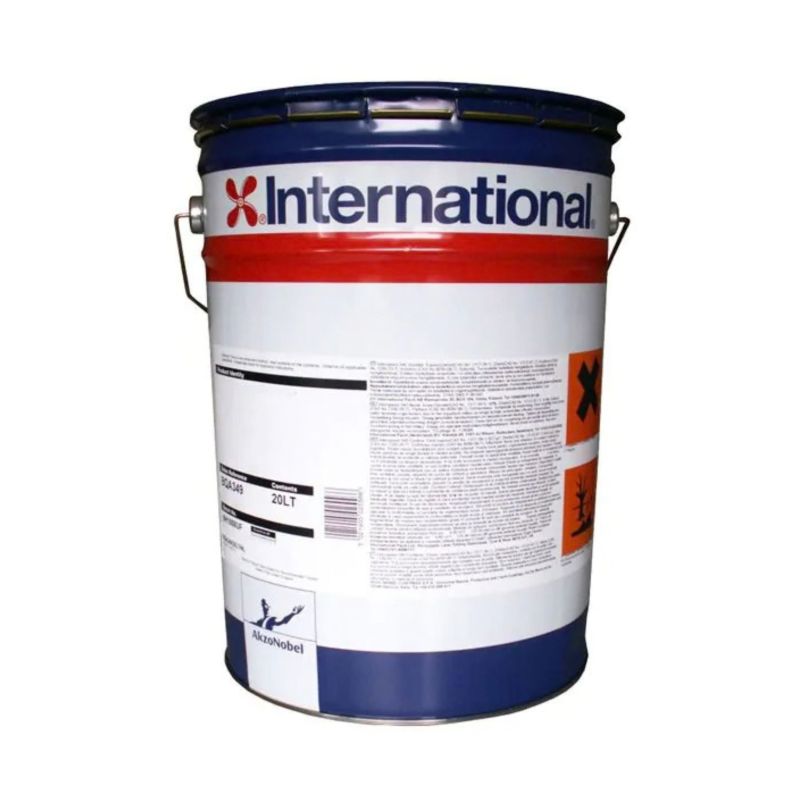

International Interspeed Extra (20 litre)
At a glance
- Hard antifouling
- For fresh and brackish/salt water
- Suitable for all substrates
International Interspeed Extra is a hard antifouling that protects the underwater hull against fouling and algae for a full season. The antifouling is suitable for use in fresh, brackish and salt water and can be applied to both sailing boats and motorboats.
You can use this antifouling on virtually all common substrates, including GRP, wood, steel and aluminium. An important advantage is that Interspeed Extra can be applied up to six months before launching. This gives you the flexibility to carry out maintenance on your boat well in advance.
This 20-litre pack is available in red and black. Other colours are available in smaller pack sizes (0.75 litres or 2.5 litres).
Benefits of International Interspeed Extra
- Easy to apply (1-component).
- High-quality hard antifouling to prevent fouling.
- Can be polished (very finely sanded) for a smooth finish.
- Suitable for use on all substrates, including aluminium.
- Can be applied up to six months before launching.
Suitable substrates
International Interspeed Extra is suitable for use on the following materials:
- Aluminium / galvanised steel
- Bronze / stainless steel
- GRP (gelcoat)
- Lead
- Steel
- Wood
Directions for use
When applying this antifouling over an unknown antifouling, we recommend applying International Primocon first. This primer acts as a barrier over the existing coating and ensures good adhesion. If the existing antifouling is in poor condition, we recommend removing it first with a vacuum scraper. Once the primer has fully cured, you can apply the antifouling without sanding for up to one month after applying the primer. After one month, the primer must first be sanded with P80-P180 grit.
This antifouling is a 1-component product and can therefore be applied easily without mixing. Refer to the technical documentation for any specific substrate preparation requirements. Interspeed Extra antifouling can be applied easily with a paint roller or brush. One coat per season is sufficient, but in areas subject to high turbulence, such as the bow, waterline, keel and rudder, it is advisable to apply an additional coat for optimum protection.
Also watch the video below about International’s best-selling antifouling.
Specifications
Packaging: 20 litres
Colour: red, black
Antifouling type: hard
Coverage: approx. 10 m²/l per coat
Application: brush or roller
VOC: 445 g/l
Thinning: not recommended
Min. application temperature: 5 °C
Tack-free: after 30 minutes (23 °C)
Overcoatable: after approx. 10–15 hours
Launching: after 8 hours (23 °C)
Shelf life: 2 years
Authorisation number: 14533 N
Product properties
The key technical properties clearly listed in one place.
- Article number
- BOO002372
-
The technical product category, such as primer, resin, hardener or cleaner. It explains the product's purpose and helps you find other products with a similar function.
- Hard anti-fouling
-
The materials, substrates or tasks a product is intended for. A general claim such as 'suitable for plastics' does not mean it works with every type of plastic; the specific substrate and its preparation still matter.
- Polyester boten, Stalen-boten, Aluminium boten
-
The period for which an unopened product remains usable under the specified storage conditions. Check whether the period starts from the manufacturing date or another date. Shelf life may be shorter after opening, especially for products sensitive to air or moisture.
- 24 months
-
The time until the surface no longer feels tacky to a light touch. The material underneath may still be soft, so tack-free does not mean fully cured or ready for heavy loading.
- 30 minutes (23 °C)
-
Minimum application temperature is the lowest temperature at which a product may be used according to the manufacturer. The limit can apply to the air, substrate and product itself.
At lower temperatures, resins and coatings can become thicker and cure more slowly. Moisture can also condense on a cold substrate and reduce adhesion. Check the dew point and measure the surface temperature before starting. A longer drying time does not automatically make application below the specified minimum acceptable.
- 5 °C
-
The overcoating interval tells you when the next layer of paint, varnish or coating may be applied. Many multi-coat systems specify both a minimum and a maximum interval:
- Minimum overcoating time: the previous layer is dry or cured enough to accept another coat.
- Maximum overcoating time: the period during which the next coat can bond without extra surface preparation under the stated conditions.
Overcoating too early can affect drying or the finish. Once the maximum interval has passed, cleaning and sanding may be needed to ensure adhesion between coats. Temperature and film thickness affect the waiting times.
- Approximately 10-15 hours
-
The minimum waiting time between applying an underwater coating or antifouling paint and launching the boat. Some products also specify a maximum time before launch. These times may depend on temperature and applied film thickness.
- 8 hours (23 °C)
-
The authorisation number is the official registration number of an approved biocide-containing antifouling product. It can be used to check whether an antifouling product is authorised in a particular country. Dutch authorisation numbers may end with the letter N, such as 14533 N.
An authorisation applies only to the specified uses and conditions. Not every antifouling product is permitted in every country. Check the number and current instructions on the label, especially if you plan to use the antifouling outside the Netherlands.
- 14533 N
-
Consumption or coverage describes how much product is needed for a given surface area. Consumption may be stated in g/m² or kg/m², while coverage is often given in m²/L or m²/kg. A consumption of 0.2 kg/m² means a theoretical 200 grams per square metre. Actual use depends on film thickness, substrate absorbency, application method and waste.
- Approximately 10 m²/L
-
A specific thinner that can be used, where permitted, to adjust a product's application properties or viscosity. The correct thinner and maximum quantity depend on the product. Incorrect thinning can affect coverage, drying and curing.
- not recommended
- Net contents
- 20 L
-
The application or processing methods specified by the manufacturer, such as brushing, rolling, spraying, casting or hand laminating. The chosen method can affect consumption, layer thickness and finish.
- Brush, Roller
-
VOC content (volatile organic compounds) indicates the amount of these substances in a product, usually expressed in g/L (grams per litre). They may evaporate during application and drying. The value describes the composition, but actual exposure also depends on how much is used, ventilation and the application method.
- 445 g/L
Safety information
Read the warnings and use appropriate protective equipment before handling the product.