
Windowsill Repair Kit
At a glance
- Complete repair kit
- Available in 3 colours
- No primer needed
Over time, windowsills may develop cracks, often in the back corners or in the middle, which can lead to leaks. With the windowsill repair kit, you have everything you need to restore damaged or weathered windowsills. This prevents further damage and makes your windowsills look like new again! The kit includes a high-quality polyaspartic coating in your chosen colour and all necessary application materials so you can get started right away.
Benefits of this repair kit
- Durable and wear-resistant.
- Provides waterproof protection.
- Available in four standard colours.
- Easy to apply - no primer required.
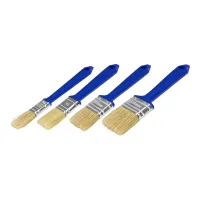
- Complete set with all essential materials.
Contents of the windowsill repair kit
| Product | Quantity/Volume |
| SillFix Polyaspartic (colour of choice) | 1 kg (0.7 kg A + 0.3 kg B) |
| Mixing cups (600 ml) | 2 x |
| Mixing spatulas | 10 x |
| Nitrile gloves | 10 x |
Coverage
With 1 kg of SillFix Polyaspartic, you can repair approximately 1-1.5 m² (about 2-3 metres in length).
Directions for use
Follow the instructions below to repair a windowsill using the windowsill repair kit:
- Clean the windowsill to be repaired by degreasing it (with acetone) and removing all loose parts.
- Open Component A and stir it thoroughly with a mixing spatula (the pigment may have settled at the bottom).
- Pour the desired amount of Component A into a mixing cup. Prepare only small quantities (300–500 g), as the pot life is approximately 20 minutes.
- Add Component B to Component A and mix carefully until a homogeneous mixture is obtained. Scrape along the sides and bottom of the cup while mixing.
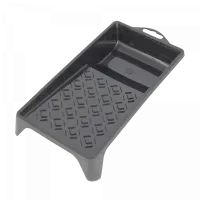
- Pour the mixture into a clean paint tray and stir again.
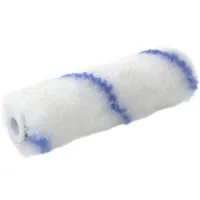
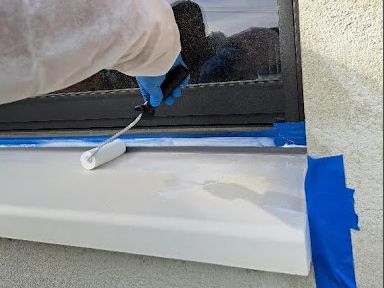
- Apply SillFix Polyaspartic generously. Use a brush for hard-to-reach areas and a short-nap roller for larger surfaces.
- Allow the coating to cure.
- Repeat the above steps to apply a second layer.
Specifications
Colour: RAL 7035 (light grey), RAL 9016 (white), RAL 9010 (pure white), RAL 1001 (beige)
Mixing ratio (by weight): 100:49
Mixing ratio (by volume): 100:46
Pot life: 20-25 minutes (at 25°C)
Dust dry: after 45 minutes (at 20°C)
Fully cured: after 3 hours (at 20°C)
Consumption: 250-300 gr/m2
Viscosity: 320 mPa.s (20°C)
Persoz hardness: > 275
Density: 1.08 g/cm3
Shelf life: up to 12 months from production when stored in original, sealed, unopened, and undamaged packaging, kept dry at +10ºC to +30ºC.
Surface texture: roller texture
Product properties
The key technical properties clearly listed in one place.
- Article number
- DAK002244
-
Density describes the mass of a material per unit volume. Values may be given in g/cm³, kg/L or kg/m³; 1 g/cm³ equals 1 kg/L. For example, one litre of a liquid with a density of 1.2 kg/L weighs approximately 1.2 kg. Density helps convert between weight and volume, but it can vary with temperature.
- 1.08 kg/L
-
Mixing ratio indicates how much of each component is needed, for example resin (A) and hardener (B). A ratio of 100:50 by weight means 100 grams of A to 50 grams of B; by volume you might use millilitres. Weight and volume ratios are not necessarily the same because the components may have different densities. Accurate measuring is important for proper curing.
- 100:46 (by volume), 100:49 (by weight)
-
The visible or tactile texture of a surface, such as smooth, rough or patterned. Surface texture can affect grip, appearance and preparation for a subsequent layer.
- Roller texture
-
A paint or varnish layer is dust-dry when settling dust is less likely to stick to the surface. It may not yet be touch-dry, ready for overcoating or suitable for loading; these are different stages of drying and curing.
- 45 minutes (20 °C)
-
Curing time is the period a product needs to reach a specified stage of cure. It is usually given in hours or days, often at a reference temperature such as 20 °C. A product may be tack-free or safe to handle before reaching its full mechanical and chemical resistance. Film thickness and mixed quantity may also affect the time.
- 3 hours (20 °C)
-
Consumption or coverage describes how much product is needed for a given surface area. Consumption may be stated in g/m² or kg/m², while coverage is often given in m²/L or m²/kg. A consumption of 0.2 kg/m² means a theoretical 200 grams per square metre. Actual use depends on film thickness, substrate absorbency, application method and waste.
- 250-300 g/m²
-
Working time is the period during which a product remains workable after mixing or activation, usually given in minutes at a specified temperature, often 20 °C. With reactive resins, the chemical reaction also continues in the mixing container, and larger quantities or higher temperatures can shorten this time. Working time is different from gel time and full curing time.
- Approximately 20-25 minutes (at 25 °C)
-
Viscosity measures how easily a liquid flows, or how thick it is. Dynamic viscosity is usually expressed in mPa·s (millipascal-seconds), sometimes in cP (centipoise); 1 mPa·s = 1 cP. A lower value usually means a more free-flowing liquid, while a higher value indicates a thicker product. Temperature and test method strongly affect the value. Note that mPa·s is different from MPa, which is used to express mechanical strength.
- 320 mPa·s (20 °C)
Safety information
Read the warnings and use appropriate protective equipment before handling the product.
SillFix Polyaspartic | RAL 9016 | Base (A) | 0,7 kg
Recommended protective equipment
Hazard pictograms
Warnings and precautions
Reviews
Frequently bought together
Useful additions for your project.