

TopCoat Clear Epoxy Coating Resin
At a glance
- Clear epoxy coating
- Good UV resistance
- High transparency
Fast delivery throughout Europe
Secure payment with PayPal, Mastercard, Visa and more
4.67 out of 5 stars on Trusted Shops
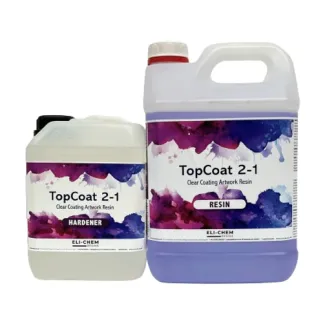
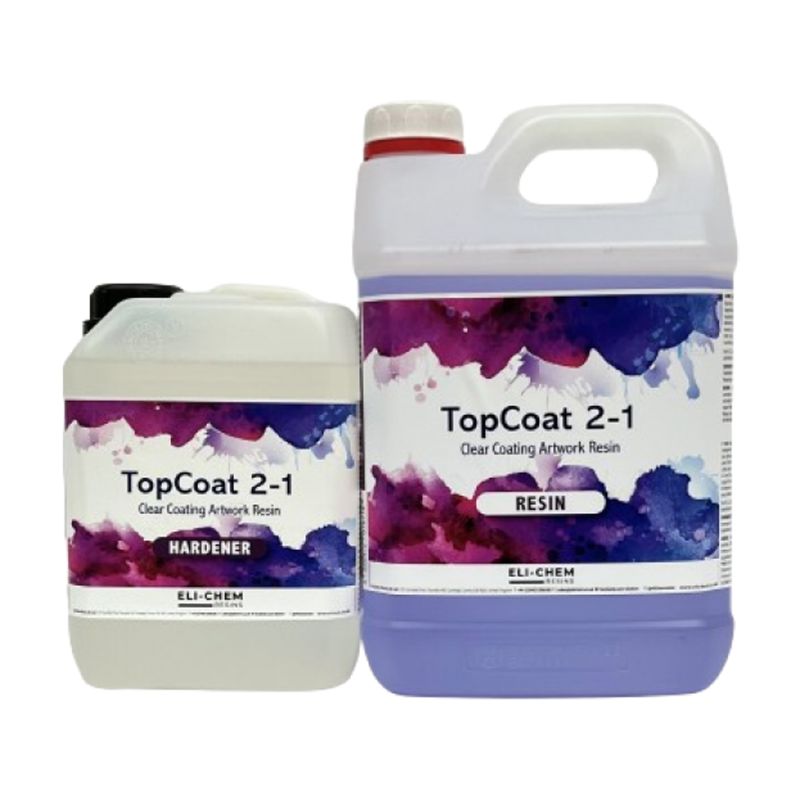
Finish your artwork, painting or woodwork with a clear topcoat with Eli-Chem TopCoat Clear Epoxy Coating Resin. This clear artwork resin is very suitable for finishing paintings, sculptures, souvenirs, table tops and other creations. With a high-gloss finish, your work will remain protected and beautiful to look at for years.
This epoxy coating has been specially developed for finishing artworks but is also suitable as a clear coating for all kinds of surfaces such as wood, paper and ceramics (1-3 mm thickness).
Benefits of 2-1 TopCoat Clear Epoxy Coating Resin
- Solvent and odour free.
- Uitstekende oppervlaktekwaliteit.
- High transparency.
- Easy mixing ratio 2:1.
- Good UV resistance.
- Non-flammable.
Applications
Use this epoxy as a topcoat on your projects.
- High gloss finish of paintings and sculptures.
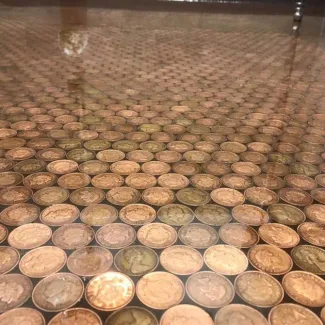
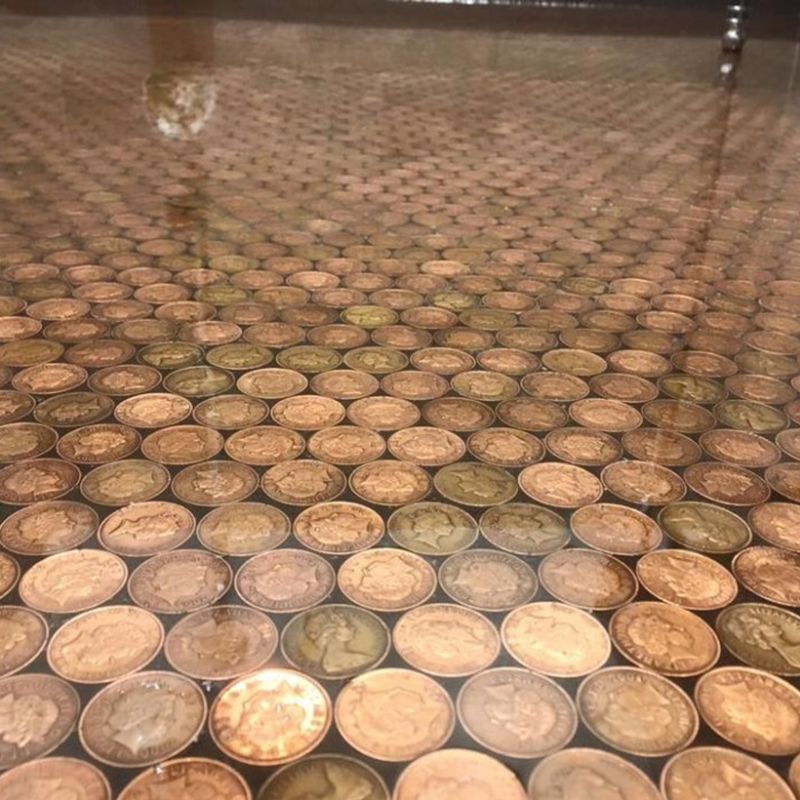
- Encapsulation of objects such as coins.
- Coating of wood, paper, ceramics, canvas and more.
Directions for use
To properly process this Eli-Chem epoxy, please follow the steps below:
- Weigh both components accurately in a mixing ratio of 100:50 (2 to 1). Preferably use a digital scale for this.
- Mix for 3 to 4 minutes until the mixture is completely uniform in colour and consistency. Regularly scrape along the side and bottom of the mixing cup to mix everything well.
- Ensure your piece is perfectly flat and level and apply by hand pouring or brush/roller.
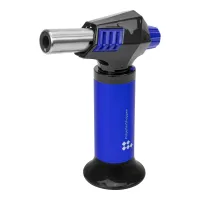
- Easily remove air bubbles that form on the surface with RESION Bubble Burst or carefully with a gas burner.
- Then let the epoxy cure for 12 to 24 hours.
Please note: TopCoat Clear Epoxy has a purple colour in the bottle. This is due to the strong UV blocker and is not visible in the end result.
Packaging
| Packaging | Resin | Hardener |
| 1.5 kg | 1 kg | 500 kg |
| 3 kg | 2 kg | 1 kg |
| 7.5 kg | 5 kg | 2.5 kg |
| 15 kg | 10 kg | 5 kg |
Product properties
The key technical properties clearly listed in one place.
- Article number
- EPO002165
-
The technical product category, such as primer, resin, hardener or cleaner. It explains the product's purpose and helps you find other products with a similar function.
- Epoxy system
-
The period for which an unopened product remains usable under the specified storage conditions. Check whether the period starts from the manufacturing date or another date. Shelf life may be shorter after opening, especially for products sensitive to air or moisture.
- 12 months
-
Maximum casting thickness is the depth of resin that can be poured in one operation, usually in millimetres (mm) or centimetres (cm). In overly thick or large casts, heat from the reaction can build up and cause discolouration, cracking or distortion. The limit also depends on total casting volume, mould shape and temperature.
- 1-10 mm
-
A paint or varnish layer is dust-dry when settling dust is less likely to stick to the surface. It may not yet be touch-dry, ready for overcoating or suitable for loading; these are different stages of drying and curing.
- Approximately 6-7 hours
-
Curing time is the period a product needs to reach a specified stage of cure. It is usually given in hours or days, often at a reference temperature such as 20 °C. A product may be tack-free or safe to handle before reaching its full mechanical and chemical resistance. Film thickness and mixed quantity may also affect the time.
- 7 days
-
Consumption or coverage describes how much product is needed for a given surface area. Consumption may be stated in g/m² or kg/m², while coverage is often given in m²/L or m²/kg. A consumption of 0.2 kg/m² means a theoretical 200 grams per square metre. Actual use depends on film thickness, substrate absorbency, application method and waste.
- 1 litre/m² (for 1mm thickness)
- Net contents
- 15 kg, 1.5 kg, 3 kg, 7.5 kg
-
Working time is the period during which a product remains workable after mixing or activation, usually given in minutes at a specified temperature, often 20 °C. With reactive resins, the chemical reaction also continues in the mixing container, and larger quantities or higher temperatures can shorten this time. Working time is different from gel time and full curing time.
- Approximately 40 minutes (at 25 °C)
-
Viscosity measures how easily a liquid flows, or how thick it is. Dynamic viscosity is usually expressed in mPa·s (millipascal-seconds), sometimes in cP (centipoise); 1 mPa·s = 1 cP. A lower value usually means a more free-flowing liquid, while a higher value indicates a thicker product. Temperature and test method strongly affect the value. Note that mPa·s is different from MPa, which is used to express mechanical strength.
- 1.500 mPa·s
- Colour
- Transparant
-
Mixing ratio indicates how much of each component is needed, for example resin (A) and hardener (B). A ratio of 100:50 by weight means 100 grams of A to 50 grams of B; by volume you might use millilitres. Weight and volume ratios are not necessarily the same because the components may have different densities. Accurate measuring is important for proper curing.
- 100:50
Reviews
Frequently bought together
Useful additions for your project.

Recommended

Popular
