Drone development is moving at lightning speed. From FPV (First Person View) racing drones to professional inspection UAVs: ever-increasing performance demands lighter and stronger structures. That is why more and more drone builders choose composite materials such as epoxy and carbon fiber. This combination delivers an exceptionally strong construction with minimal weight—exactly what you need for an agile drone with long flight time.
In this article, you will read why epoxy and carbon fiber have become the standard in drone construction, which manufacturing techniques you can apply, and how to build a carbon drone frame step by step.
Why choose epoxy and carbon fiber?
Composite materials have been used in aviation for decades. For drones as well, they offer major advantages over aluminum or plastic. A carbon frame is not only lighter, but also stiffer and better resistant to vibrations and long-term loads.
The advantages of carbon fiber
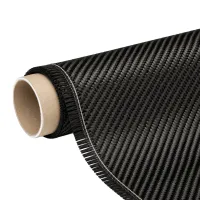
Carbon consists of extremely strong carbon fibers woven into a fabric. Combined with epoxy, it creates a highly rigid composite material that is ideal for drone frames.
Key advantages include:
- Very high strength at a low weight.
- High stiffness for precise flight characteristics.
- Excellent vibration damping.
- High fatigue strength.
- Professional appearance thanks to the characteristic carbon weave pattern.
Why use epoxy?
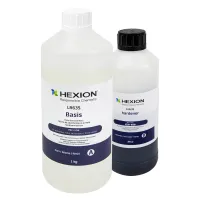
Carbon only obtains its final properties once it is impregnated with epoxy resin. Epoxy forms the matrix that binds all fibers together and distributes the forces.
Epoxy offers among other things:
- Minimal shrinkage during curing.
- Outstanding mechanical properties.
- Extremely strong adhesion to carbon fibers.
- High chemical resistance.
- Suitable for both hand lamination and vacuum infusion (ideal for DIYers and professionals alike).
Building a carbon drone frame step by step
Developing a composite drone frame consists of several steps. Below is the standard process followed by both hobbyists and professional drone builders.
Step 1. Create the design
Almost every drone frame starts as a digital design in CAD software such as Fusion 360. Flat parts are usually CNC-milled from 1.5 to 3 mm carbon fiber sheets.
Do you want to make an aerodynamic fuselage, motor canopies, or other three-dimensional parts? Then you will work with a mold in which you process the carbon fiber and epoxy.
Step 2. Prepare the mold
Proper mold preparation prevents damage during demolding.
Prepare the mold as follows:
- Apply a suitable release agent.
- Optionally use a gelcoat for a smooth surface finish.
- Pre-cut the carbon fabric to size.
- Take the desired fiber orientation into account.
This fiber orientation has a major influence on the final strength of the part.
Step 3. Laminating carbon fiber
Two main techniques are used for processing carbon fiber.
Hand lamination
With hand lamination, epoxy is worked into the carbon fabric using a roller or brush. This method is relatively simple and ideal for prototypes or small projects.
Advantages:
- Few tools required.
- Low initial investment costs.
- Suitable for beginners.
Disadvantage:
- The resin-to-fiber ratio is less precise, resulting in slightly lower mechanical properties.
Vacuum infusion
For high-end composite parts, vacuum infusion is the professional standard. With this technique, dry carbon fabric is first placed in the mold. A vacuum is then drawn, after which the epoxy automatically flows through the laminate.
This provides major benefits:
- Optimal resin-to-fiber ratio.
- Higher strength and stiffness.
- Less excess resin (clean production method).
- Reproducible quality.
- Ideal for series production.
Step 4. Curing
After lamination, the epoxy must cure completely. Many systems cure at room temperature, but some epoxies can be post-cured in an oven afterwards. Post-curing increases the glass transition temperature (Tg), making the part better able to withstand the heat generated by motors and electronics during long flights.
After curing, the part is demolded, trimmed, and finished as needed.
Step 5. Assembly and testing
Once all carbon parts are ready, they can be assembled with other components such as:
- Motor mounts.
- Electronics.
- Propeller guards.
- Standoffs.
- Fasteners.
Depending on the design, parts are bonded with epoxy or mechanically fastened. Before the drone actually takes to the air, it is wise to mechanically test the frame first for stiffness, vibrations, and structural load.
The right fiber orientation makes all the difference
A strong drone frame is determined not only by the quality of the carbon fiber, but also by the layup of the laminate. By combining different fiber orientations, you create a frame optimized for both bending and torsional resistance.
Common layups include:
- Square (0°/90°)
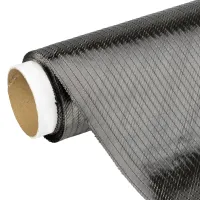
Square weave is suitable for parts subjected primarily to bending loads. - Biaxial ±45°
Biaxial carbon fabric is ideal for components that must absorb high torsional forces, such as drone arms. - Quasi-isotropic (0°/45°/-45°/90°)
A versatile layup offering nearly equal strength in multiple directions. This configuration is widely used when loads come from various directions.
For drone arms, a combination of unidirectional carbon (UD) and twill weave is often used, providing an optimal balance between stiffness, weight, and torsional strength.
What materials do you need?
To build a carbon drone frame, you generally need the following materials:
- Carbon fiber fabric.
- Epoxy laminating resin or vacuum injection resin.
- Release agent.
- Vacuum materials (vacuum pump, peel ply, vacuum bag film, vacuum hose, etc.).
- Various auxiliary supplies such as mixing cups, rollers, brushes, and a scale.
- Protective gloves and safety equipment.
Polyestershoppen: your partner for composite drone prototyping
A successful drone project starts with the right materials and a partner who thinks along with you. Whether you are building your first prototype, optimizing an existing design, or preparing for series production: Polyestershoppen supports you at every step of the composite process.
When developing a new drone frame, you don't want to buy massive quantities of material right away. That is why we also supply small quantities of carbon fiber, epoxy, and other composite materials directly from stock. This allows you to start testing and prototyping quickly without high inventory costs. From initial test laminates to a reproducible production process: our specialists are happy to advise you on the best approach for your application. Ordered before 17:30? Shipped today!
Everything for your drone prototype
Our product range is tailored to both hobby builders and professional developers and includes:
- Carbon fabrics such as 2x2 twill carbon, 3K carbon, UD carbon, and hybrid fabrics. Available in wide rolls as well as narrow tape for small projects and localized reinforcement.
- Epoxy systems for hand lamination, vacuum infusion, and repairs.
- Vacuum materials such as vacuum film, sealant tape, peel ply, infusion mesh, and connectors.
- Release agents, gelcoats, and mold-making supplies.
- Tools and consumables for composite processing.
Thanks to the option to order small packages as well as larger volumes, you can scale up easily. Start with a single prototype and grow into a more efficient production process without unnecessary material waste.
Technical support for your composite process
Composite construction is not just about having the right materials, but also applying the proper processing technique. Our specialists have extensive knowledge of epoxy, carbon, and vacuum techniques, and are ready to assist you with technical challenges.
We can advise you on:
- Selecting the right epoxy based on working time, temperature limits, and desired properties.
- Optimal fiber orientation and laminate layup for your drone frame.
- Setting up a vacuum infusion process.
- The correct sequence of materials during vacuum bagging.
- Troubleshooting issues like dry spots, air inclusions, or leaks.
- Scaling up from a prototype to a reliable production process.
With our combination of stock, technical knowledge, and practical experience, we are more than just a supplier of composite materials. We help makers, engineers, and manufacturers further develop their drone concepts and successfully bring them into production. Questions? Feel free to contact us!