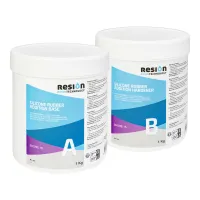
Silicone rubber is one of the most versatile materials for making molds and castings. However, anyone buying silicone for the first time quickly encounters a fundamental choice: condensation cure or addition cure (platinum)? The names sound technical, but the difference is easy to explain, and the choice has a major impact on the final result. In this article, we clearly explain both types so you can make the right decision for your application.
Both types fall under the category of RTV-2 silicones (Room Temperature Vulcanizing, two-component). The difference lies not in the RTV-2 designation, but in the curing mechanism and the corresponding catalyst: tin for condensation cure, platinum for addition cure.
What is condensation cure silicone rubber?
Condensation cure silicones, also known as tin-catalyzed silicones or RTV-2 condensation silicones, are among the most commonly used types of casting rubber. The name refers to the curing process: during curing, a condensation reaction takes place where tin salts are released and a small amount of material evaporates. This causes slight shrinkage, averaging around 1% per year.
Condensation cure silicones cure with the aid of moisture. They extract this moisture from within themselves and from the ambient air. As a result, curing proceeds faster at higher humidity levels. It is important to seal the product properly after use so that moisture does not evaporate and cause the silicone to cure prematurely.
The mixing ratio of condensation silicones is relatively easy to handle. While a small deviation in the amount of catalyst affects the curing time, it generally does not lead directly to a failed mold. This makes condensation cure silicones accessible for beginners and hobbyists, but certainly also attractive for professionals who want to work quickly and efficiently.
What are condensation cure silicones used for?
Condensation cure silicones are ideally suited for large concrete molds in the construction industry. Think of facade panels, stairs, columns, ornamental stones, and decorative concrete. The combination of flexibility, tear resistance, and a low cost per casting makes this type of silicone ideal for applications requiring many releases per mold. Tens to hundreds of concrete castings can be produced from a single mold, quickly yielding a return on investment.
Other applications include plaster and cement molds, wax casting for candles, and reproducing ornaments and architectural details.
What is addition cure (platinum) silicone rubber?
Addition cure silicones are also called platinum silicones, named after the platinum catalyst that drives the curing process. Like condensation silicones, they are RTV-2 products, but the curing mechanism is fundamentally different. During curing, long molecular chains are formed without releasing or evaporating any substances. The result is a virtually shrink-free final product with excellent dimensional accuracy—a major advantage for precision work.
Platinum silicones cure through heat. At higher temperatures, the process speeds up: a general rule of thumb is that the working time and cure time roughly halve with every 10°C increase in temperature, and double with every 10°C drop. At temperatures below 18°C, many platinum silicones may cure poorly or not at all. Keep this in mind when working in a cold space or during winter.
For full curing and optimal properties, it is recommended to post-cure platinum silicones in an oven at 80-100°C. This process, also known as post-curing, ensures that any unreacted material fully cures.
What are platinum silicones used for?
Platinum silicones are the preferred choice when dimensional accuracy and detail fidelity are crucial. They are widely used for:
- Precision casting molds for jewelry, prototypes, and technical parts.
- Prosthetics and medical devices.
- Special cosmetic effects in film and theater.
- Food-safe molds for chocolate, sugar, and other food items.
- High-quality reproduction of art objects.
Thanks to the virtual absence of shrinkage, platinum silicones remain dimensionally accurate even after years of intensive use. They generally last longer than condensation silicones and are slightly more expensive to purchase, but that investment pays off in a longer mold lifespan.
Condensation vs. platinum: key differences at a glance
When choosing the right silicone for a mold, it is important to clearly understand the differences between condensation and platinum silicones. Both systems have their own properties, advantages, and limitations, making them suitable for different applications. Where condensation silicones are often used for larger and less critical molds, platinum silicones offer maximum precision and durability. In the table below, we summarize the main differences so you can quickly determine which type best fits your project.
| Property | Condensation cure silicones (tin) | Addition cure silicones (platinum) |
| Catalyst | Tin | Platinum |
| Shrinkage | Slight shrinkage (approx. 1% per year) | Virtually shrink-free |
| Curing | Cures with ambient moisture | Cures with heat; sensitive below ±18°C |
| Mixing ratio | Less critical | Requires precise weighing |
| Food safety | Not food-safe | Can be food-safe (depending on product) |
| Sensitivity to contamination (inhibition) | Rarely | Sensitive to contamination (e.g., sulfur, tin salts) |
| Application | Suitable for large molds and high volumes | Suitable for precision work, long lifespan, and food-safe applications |
| Price | More affordable | More expensive, but more durable and precise |
Which type of silicone suits your project?
For large concrete molds, construction projects, and applications where price and ease of processing are important, condensation cure silicone rubber is the logical choice. Its low cost per mold, high number of potential releases, and easy handling make it ideally suited for the construction sector and production-oriented applications.
Are you working on precision molds, food-safe molds, or applications where shrinkage is completely unacceptable? Then platinum silicones are the better investment. The higher purchase price is well worth the longer lifespan and superior dimensional accuracy.
More information or order?
Still unsure which type of silicone best fits your application? The specialists at Polyestershoppen are happy to help you with tailored advice. Feel free to contact us via the website. Both types of silicone rubber—condensation cure and platinum—can easily be ordered in our webshop at polyestershoppen.nl.