Secure payment with PayPal, Mastercard, Visa and more
4.7 out of 5 stars on Trusted Shops
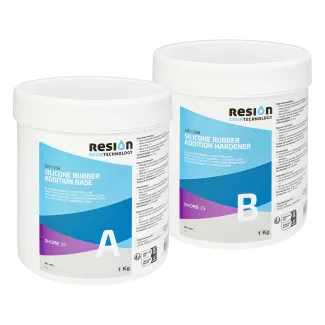
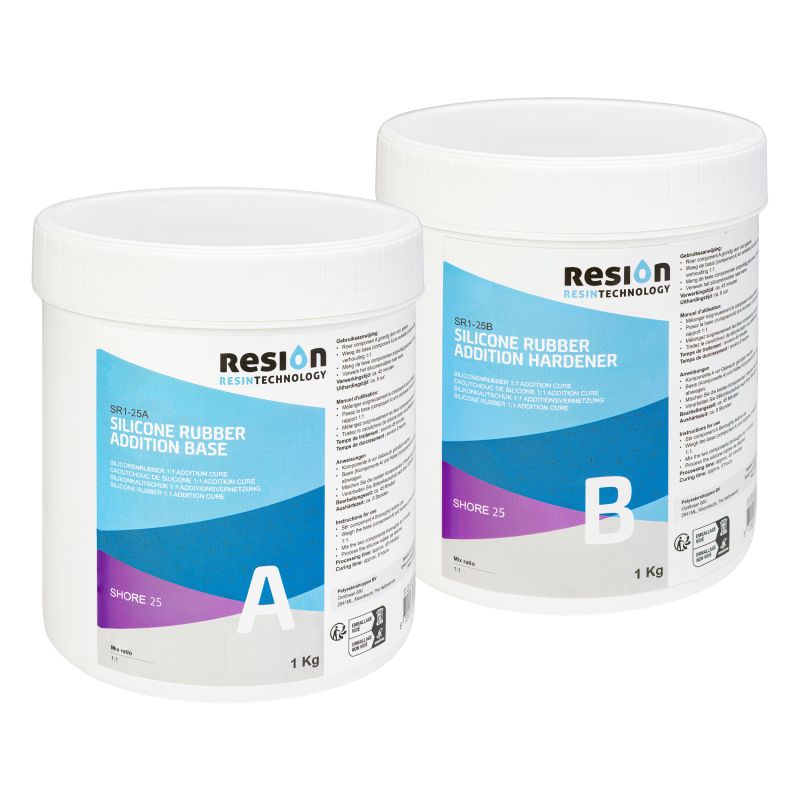
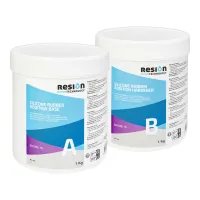
RESION Silicone Casting Rubber Shore A25 is a platinum-cure RTV-2 silicone rubber designed for producing slightly flexible moulds for a wide range of applications. The silicone rubber is strong, dimensionally stable, food-safe and produces moulds with excellent durability and outstanding detail reproduction.
Thanks to its simple 1:1 mixing ratio, this platinum silicone is easy to use and suitable for both beginners and experienced users. Shore A25 Silicone Casting Rubber is recommended for applications where a slightly firmer mould is required, while still remaining flexible enough to allow easy demoulding without damaging the cast. This type of silicone is particularly suitable for producing detailed concrete moulds.
Features silicone casting rubber
Platinum cure (addition-cure): clean curing with minimal shrinkage.
Shore A25: slightly flexible; firmer than Shore A15, yet still easy to demould.
1:1 mixing ratio: easy to measure and process.
Low viscosity: flows easily into the mould and helps minimise air entrapment.
High tensile and tear strength: for durable, long-lasting moulds.
Food-safe silicone: certified for applications involving contact with food.
Heat resistant: up to 200°C continuously and 300°C for short periods.
Shore A25 is the ideal choice when you need to produce sturdy, slightly flexible and highly detailed moulds for applications such as:
Detailed concrete moulds. The higher Shore hardness provides the mould with sufficient rigidity to withstand the pressure of concrete, while still offering enough flexibility for easy demoulding without damaging the finished cast.
Silicone moulds for epoxy resin castings.
Moulds for polyurethane and polyester casting resins.
Food-safe applications, such as moulds for chocolate, fondant and ice.
The slight flexibility of Shore A25 offers the ideal balance between rigidity and ease of demoulding, making it a versatile choice for both decorative and technical applications.
Processing platinum silicone casting rubber
Accurately weigh Component A (base, green) and Component B (curing agent, white) in a 1:1 ratio using a scale.
Mix both components thoroughly but gently for approximately 3 minutes using a mixing spatula. Scrape the sides and bottom of the mixing cup well. Then pour the mixture into a second, clean mixing cup and mix briefly again.
Pour the silicone slowly into the mould or mould box. The working time is approximately 45 minutes at 20°C. At higher temperatures, the silicone cures more quickly, giving air bubbles less time to escape.
After approximately 8 hours, the silicone is fully cured and tack-free.
Add a silicone thickenng agent to easily convert this casting silicone into a brushable or spatula-applied silicone.
Specifications
Packaging
Base (SR1-25A)
Curing agent (SR1-25B)
2 kg
1 kg
1 kg
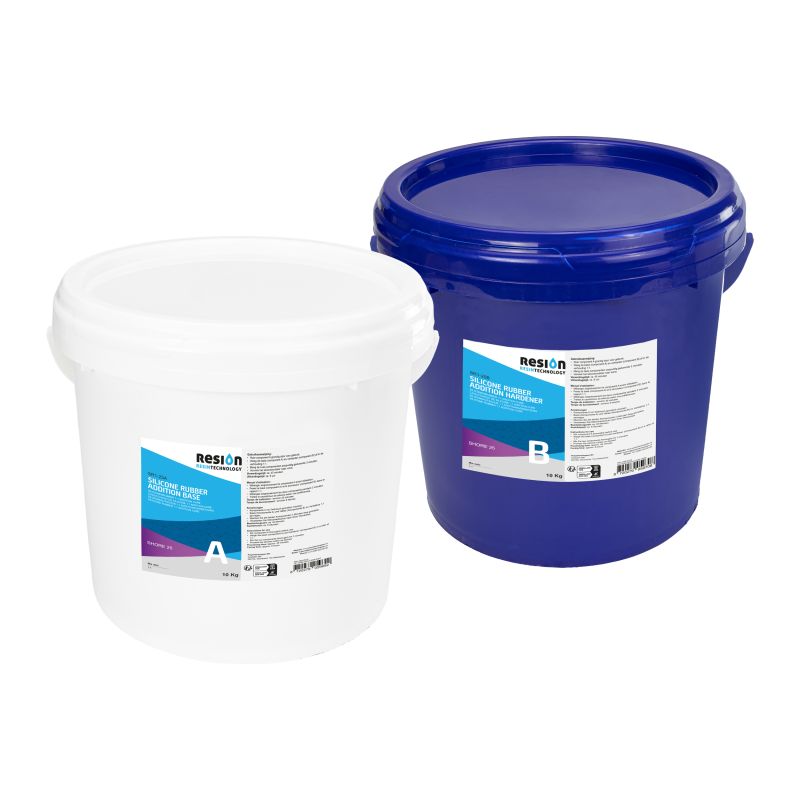
20 kg
10 kg
10 kg
200 kg
100 kg (10 x 10 kg)
100 kg (10 x 10 kg)
400 kg
200 kg (drum)
200 kg (drum)
Also available in other Shore hardnesses
Looking for a softer or firmer silicone rubber? RESION also offers the following 1:1 mix ratio variants:
Order Silicone Casting Rubber Shore A25 and all other silicone rubber products easily from Polyestershoppen.com. Place your order on working days before 5:00 PM CET, and it will be dispatched the same day. If you have any questions about silicone casting rubber or would like advice on choosing the right Shore hardness, feel free to contact one of our specialists.
Product properties
The key technical properties clearly listed in one place.
Article number
SIL000599
The technical product category, such as primer, resin, hardener or cleaner. It explains the product's purpose and helps you find other products with a similar function.
Silicone casting rubber, Platinum Cure RTV-2
Mixing ratio indicates how much of each component is needed, for example resin (A) and hardener (B). A ratio of 100:50 by weight means 100 grams of A to 50 grams of B; by volume you might use millilitres. Weight and volume ratios are not necessarily the same because the components may have different densities. Accurate measuring is important for proper curing.
1:1
The tasks a product is intended for, such as laminating, casting, bonding, sealing or protecting. Products intended for the same application can differ considerably in processing, curing time and final properties.
Making a concrete mold
Hardness describes a material's resistance to indentation. For silicone rubber and other elastomers, the Shore A scale is commonly used: Shore A 15, for example, is softer than Shore A 40. Harder plastics may be rated on the Shore D scale. The number belongs to its Shore scale and is not a unit like MPa; values on different scales cannot be directly compared.
Shore A 25
Density describes the mass of a material per unit volume. Values may be given in g/cm³, kg/L or kg/m³; 1 g/cm³ equals 1 kg/L. For example, one litre of a liquid with a density of 1.2 kg/L weighs approximately 1.2 kg. Density helps convert between weight and volume, but it can vary with temperature.
1.02 kg/dm³
The period for which an unopened product remains usable under the specified storage conditions. Check whether the period starts from the manufacturing date or another date. Shelf life may be shorter after opening, especially for products sensitive to air or moisture.
24 months
Cure shrinkage describes how much a resin, adhesive or rubber becomes smaller as it cures. The value is usually given as a percentage (%) and may refer to volume shrinkage or shrinkage along one dimension; these are not the same. Shrinkage matters for casting accuracy and for limiting stress or distortion.
Low shrinkage after curing
Working time is the period during which a product remains workable after mixing or activation, usually given in minutes at a specified temperature, often 20 °C. With reactive resins, the chemical reaction also continues in the mixing container, and larger quantities or higher temperatures can shorten this time. Working time is different from gel time and full curing time.
Approximately 45 minutes (at 20 °C)
Heat resistance describes the temperature a material can withstand after correct processing and curing, usually expressed in degrees Celsius (°C). Continuous exposure is different from a brief temperature peak, and mechanical loading may also affect the limit. Heat resistance is not the same as the temperature at which the product can be applied.
Up to 200 °C (short-term up to 300 °C)
Colour
Green
Curing time is the period a product needs to reach a specified stage of cure. It is usually given in hours or days, often at a reference temperature such as 20 °C. A product may be tack-free or safe to handle before reaching its full mechanical and chemical resistance. Film thickness and mixed quantity may also affect the time.
8 hours
Food contact suitability means that a material may come into contact with food under specific, defined conditions. This suitability does not automatically extend to every application.
Food type: for example water-based, acidic or fatty foods.
Contact time and temperature: brief contact may have different requirements from long-term storage or contact with hot food.
Processing: correct mixing ratio, full curing and any required post-curing may be conditions of approval.
A fully cured or odourless product is not automatically food-safe. Check the manufacturer's declaration or technical documentation for the permitted use.
Yes
Safety information
Read the warnings and use appropriate protective equipment before handling the product.